
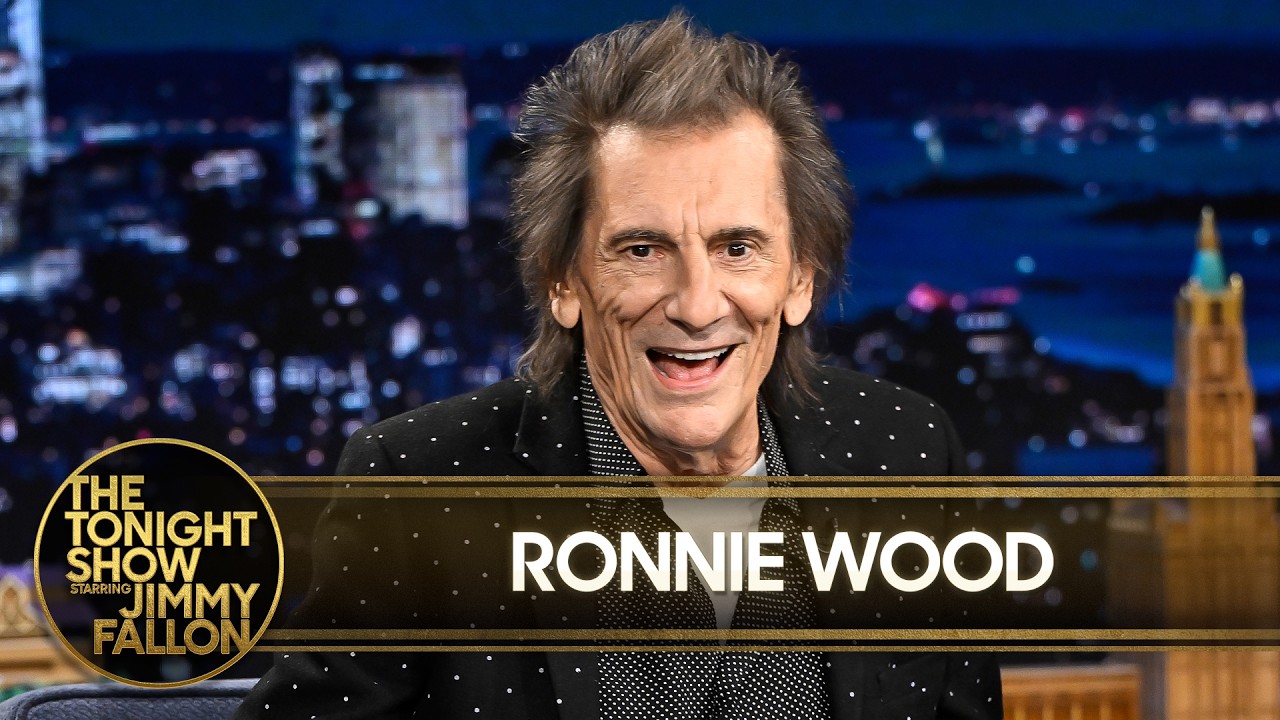
Ronnie Wood isn’t usually in the business of looking back. But during a recent appearance on The Tonight Show Starring Jimmy Fallon, promoting the Rolling Stones’ new album Foreign Tongues, the conversation kept circling back to memory — how music begins, how it’s shaped, and how it sometimes arrives already carrying emotion you didn’t plan for.
One of those moments, Wood said, came while recording “Back in Your Life,” when the session unexpectedly intersected with a week of major losses in music.
During the interview, Wood revealed he recorded a nine-minute guitar solo for the track — an expansive performance that was later edited down.
“I played a nine-minute guitar solo,” he said. “We cut it down to four or five. I was so moved that day — disappointed and sad, and I had so much feeling because Brian Wilson died that day. I’ll never forget. And that week, Sly Stone died, too. And I thought, ‘Oh no, it’s so sad.’ And it came out through my guitar, the feeling.”
What emerged in the studio, he said, didn’t feel entirely like conscious playing.
“Just one take,” Wood explained. “And I just said, ‘I didn’t do that.’ The guitar played itself. It felt that way. It’s just magic.”
That sense of instinctive performance, Wood suggested, wasn’t something that arrived late in life. It had been there from the beginning — long before stadium tours, and even before he fully understood what being a musician would mean.

He recalled getting his first guitar around the age of five.
“My brothers were eight and ten years older than me, you see? And they were both musicians and artists,” he said. “So if they played, I would play. And if they painted, I would paint.”
A borrowed instrument first sparked it all.
“A friend of theirs gave me his acoustic guitar to borrow,” Wood said. “And then he got called up to the Army and took it back. And I was so disappointed.”
His brothers stepped in, buying him a guitar on a payment plan.
“And that’s where I started.”

From those early days, Wood’s path into professional music unfolded through a series of near-accidental turns. One of the most consequential came when he briefly played bass with the Jeff Beck Group in the late 1960s, after his early band, the Birds, broke up. At the time, Jeff Beck was leaving the Yardbirds and assembling a new lineup with Rod Stewart.
“I met Jeff Beck on tour, and he said, ‘One of these days, we’ll get together,’” Wood recalled. “So my group, the Birds, split up, he left the Yardbirds, and I rang him up and I said, ‘What are we gonna do?’ He said, ‘Come on, let’s get together. I’ve got this vocalist. I don’t know if you know him — his name is Rod Stewart.’ And I said, ‘Oh, Rod.’ I met him. So he said, ‘Would you mind playing bass?’”
“I said, ‘No. I love a challenge. Let’s go.’ Boom! So that was it.”
There was just one problem: he didn’t own a bass guitar.
After borrowing one for rehearsals, Wood went to the Selmer music store in London to try to sort out a more permanent solution.
“I said, ‘Could I have that [Fender] Jazz Bass? Could I borrow it?’ And they said, ‘Yeah. You’ll have to get your parents to sign the form, you know, if you like it — promise to bring it back this afternoon.’”

He never did.
“So later on — five years later — I went back to the store and said, ‘Do you remember that Jazz Bass that went missing?’ And they went, ‘Yes, we do.’ And I said, ‘It was me, and I’ve come to pay you.’”
Wood’s teenaged adventures also included thwarting Pete Townshend in the volume wars by having Jim Marshall build him an 8x12 speaker cabinet — just before Townshend requested one for himself.
“Pete Townshend came in and went, 'You bastard!" Wood recalled. Unlike other rock and roll tales, Wood has the document to prove it.
