
As one of the most recorded guitarists in history, Louie Shelton has stories to tell about recording tracks by Boz Scaggs (“Lowdown”), Whitney Houston (her global breakthrough “Saving All My Love for You”) and Lionel Richie (“Hello”), among dozens of others.
But one gig hit particularly close to home — not for Shelton but for Guitar Player.
“I was playing at the Flamingo in Las Vegas with Seals & Crofts,” Shelton recalls of his time with the soft-rock duo from the 1970s. “There was another similar group that was alternating with us. On this particular night, the guitar player of the other group broke his foot, so I had to fill in for him for that show.”
Years later, Shelton had a chance meeting with the anonymous guitarist.
“I never knew who he was until much later, when I walked into the offices of Guitar Player magazine in Monterey, California, to introduce myself to the president,” he says. “And he says to me, ‘You may not remember me, but you filled in for me once in Las Vegas.’ It was Guitar Player magazine founder Bud Eastman!”
Shelton has spoken to us about his time recording for the Monkees. Here, he tells us tales behind two other sessions: one famous, one infamous.

Boz Scaggs’ “Lowdown”
By the 1970s, having made a name for himself through his session work, Shelton decided to expand his horizons by moving into production. Over the next decades he produced albums for soft-rock acts that included his friends Seals & Crofts, Art Garfunkel, and England Dan & John Ford Coley. But he still found himself in demand for studio recording.
“When I did a lot of those big records like the Boz Scaggs, Whitney Houston and Lionel Richie records, I wasn’t even a session player,” he states. “I would occasionally get called asking if I could come in for a session on guitar. And I’d go, ‘Okay, I’ll do it.’
“But I had moved into producing Seals & Crofts and was officially a producer on the Seals & Crofts records. And when I started producing Seals & Crofts, I had used [future Toto members] David Paich, Jeff Porcaro and David Hungate [keyboards, drums and bass, respectively].”
In the fall of 1975, Paich, Porcaro and Hungate were at work on Silk Degrees, Boz Scaggs’ 1976 album. After years without a hit — including a memorable session with Duane Allman — Scaggs would score big with Silk Degrees, making him a breakout star and going five time Platinum.
“When David got the gig to do the Boz Scaggs gig, he thought I would be the right guy to join that little group. So he called me and asked me if I wanted to do it.
One of Shelton’s favorite moments on record is the fiery solo he put to tape on “Lowdown.” Scaggs has referred to the song — little more than a two-chord vamp from Em9 to A6 — as “an accident” that didn’t have “a chance in hell” of becoming a hit. Still, they all liked the song and put it on the album as the opener to side two.
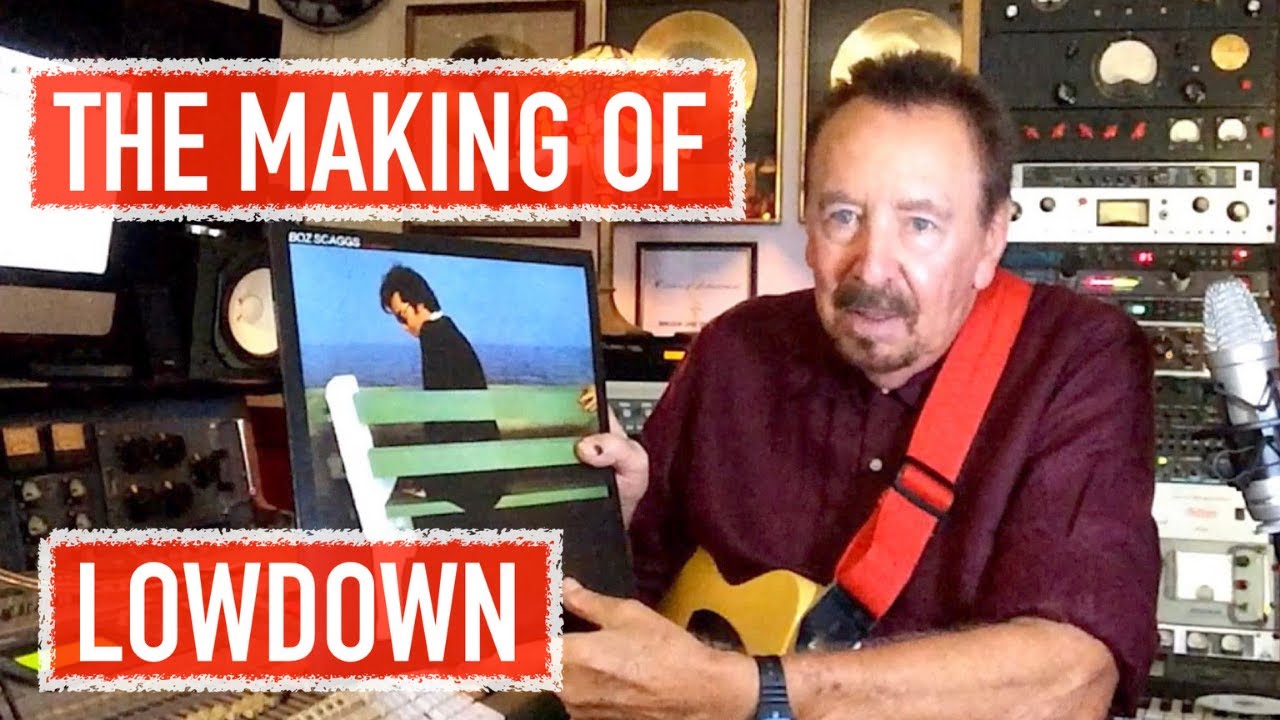
“The solo was an improvised thing where they just simply asked me to fill in the spaces,” Shelton says. “We had a chord chart and they instructed me to play something from bar 38 or whatever. All of that stuff was spontaneous. Nothing was planned. I was just listening to the song and reading the chord chart and I improvised something straight off the cuff.
“And it was all a first take. There was no going back and punching in or planning a solo. I just played a clean rhythm with my Telecaster through a ’69 Fender Princeton Reverb amp throughout the song until it was time to play some guitar lines. Then when it came to the guitar solo, I had a little distortion pedal, a basic Boss pedal that cost $30, that I clicked on to add some color to the solo.”
Shelton’s solo was exactly the element the track needed to help it crossover from disco to rock. When a Cleveland disc jockey decided to play “Lowdown” right off the album — it hadn’t been released as a single yet — it quickly caught on with listeners, leading other radio stations to follow suit. It became the album’s breakout hit, serving as a gateway to Silk Degrees’ chart-topping success.

John Lennon’s Rock ’n’ Roll album
But not every session is as successful. Shelton was among the many guitarists — including Larry Carlton — hired to perform on John Lennon’s 1975 solo album, Rock ’n’ Roll. Produced by Phil Spector, the album was made over one year, from October 1973 to October 1974, during a time when Lennon was deep into partying and drinking.
The sessions were so loose that no one can be sure exactly who played on what songs. Carlton says that while he and Leon Russell attempted a recording of “Bony Moronie” with Lennon, the session ended in failure, yet both performers are credited on the album.
Shelton’s experience was quite similar.
“The session was very disorganized,” he recalls. “John pretty much didn’t have much say as far as the arrangement or anything else on that album. When John showed up for the session, Jim Keltner, the drummer on the session, introduced me to him, and John couldn’t have been nicer.

“But Spector, who was producing the session, came in late wearing a black cape, a top hat and the darkest sunglasses he could find. He was supposed to bring in an old Stax R&B record that he and John wanted us to cover for the session, but Spector didn’t have the record with him. They had to send his driver back to the hotel to retrieve it.”
While they waited for the producer to return, Shelton and Lennon chatted.
“We had a conversation about my playing on the Monkees’ ‘Last Train to Clarksville,’” he recalls. “John told me that I had a done a great job on it. But I told him that I was just copying George Harrison!

“It was a great opportunity to just have a chat with him, because I was a big Beatles fan. I was the kind that, even though I'm a guitar player that liked to listen to the jazz guys like Wes Montgomery and others, I’d also grab the next Beatles record and take it home and really listen to it with my sound system. So I was flattered that I even got to do that one session with John.”
When the driver finally returned with the record, Spector ordered Shelton and the crew to listen to the record and figure out their parts by ear.
“We had a lot of musicians in the room, but none of us were given a chart,” the guitarist explains. “Usually there's at least a chord chart. If you’ve got five or six musicians, you’d want to give them a chord chart but, instead we had to listen to the record and do our own chord charts.”
At the outset of Shelton’s session career, his gear had been limited to just a ’64 Fender Telecaster and a ’64 Fender Super Reverb combo. “Before all the session gigs, I could only afford one guitar, as we didn’t make a lot of money playing the club,” he explains. “So if I wanted a different guitar, I had to trade my old one.
“But as the sessions became regular work, I was able to I buy an ES-335, a Fender Strat, a Gibson Byrdland and a bunch of acoustic guitars. But the Telecaster was my main electric guitar, and still is to this day. The Tele seems to handle just about everything.”
For months after the session, Shelton heard nothing about it, and no new Lennon album was released. Spector had been taking the master tapes home at night and they “disappeared” some time after the sessions wrapped.
“The master tapes from the sessions went missing and because of that, John and Phil had a falling out,” Shelton says. “A couple of years after my session, Phil got into a car accident in L.A. and they found those tapes in the boot of his car. And that’s when the album, with the session that I played on, finally came out.”

