

Adding one of the best looper pedals to your rig can have numerous benefits, whether you’re practicing at home, songwriting and demoing ideas for new music, or you want to expand your live performance capabilities without another musician. A looper pedal can help with all of the above, but there’s a lot of choice out there nowadays, so finding the perfect pedal for you can be a tough call.
The looper pedal is a tool that records a phrase of your playing, whether that’s a chord progression or a riff, and then plays it back in a continuous loop. Loopers are way more than just practice tools, though, with the likes of Ed Sheeran popularizing them for performance purposes to build songs from thin air, using just an acoustic and a looper pedal, and even now, viral sensations Angine de Poitrine use a looper to stack layer upon layer of microtonal guitar riffs on top of each other to create perfectly controlled chaos.
For most players, the best looper pedal overall will be the Boss RC-5, which offers compact looping, high-quality audio, and plenty of features. If you want something even simpler, the TC Electronic Ditto 2 is a great option for beginners, offering simple operation anyone can pick up, and great quality sound for relatively little cash. Experienced live players should look at the Boss RC-600 if they want to unlock the full power and potential of live looping.
If you’re here looking for your first looper and this all sounds a bit confusing, I’ve added some beginner-friendly sections to this guide to get you up to speed. My how to choose section will guide you through everything you need to know before making a purchase, the FAQs section answers loads of the most common questions, and I’ve included a glossary of key terms if you need help decoding the technical terms used in this guide.
Best overall

✅ Buy if: You want high-quality looped audio in a compact package.
❌ Avoid if: You don’t want to buy external footswitches, the single footswitch has a lot to do, and an extra footswitch is recommended for ease.
Overview
Combining portability with versatility, the brilliant Boss RC-5 Loop Station is perfect for beginner and veteran loopers alike. Packing enough depth to add to your live performance as well as being easy enough to use for home practice, regardless of your playing level or technical proficiency.
Build quality
At what point does the question of ‘build quality’ become redundant for Boss pedals? There isn’t a bad one available from a purely build point of view, and that is exactly the same with the RC-5. It has the typical boss switching mechanism, which is super easy to use, and robust enough to be stomped on continuously for years and years – though it doesn’t require a heavy stomp to start or stop a loop, it’s very responsive.
Usability
Colored LCD lights let you know what mode you’re in, and some handy buttons on the front of the pedal control memory locations. The RC-5 offers you more memory than you’re ever likely to use, with a huge 13 hours worth at 1.5 hours per track. 99 memory slots allow you to store your loops, and you can even import and export loops to your PC.
The one downside of the RC-5, and this will actually be a positive for many, is that it does so much all from one footswitch… maybe too much. I’d recommend buying an additional external switch to make it simpler to use.
Sounds
Aside from fundamental usability, the most important thing with a looper is that your loop sounds great, and the upgraded 32-bit audio quality means that is absolutely the case. Combine that with a total of 57 rhythm tracks you can use for accompaniment when playing solo, with each rhythm having seven different kits and two variations, and you can see that the RC-5 is a looper that is hard to beat.
Best for beginners

✅ Buy if: You want a really simple route into looping, with some premium features.
❌ Avoid if: You want to loop in stereo. There is a V1 version of the Ditto in stereo, but no V2 version yet.
Overview
The teeny-tiny TC Electronic Ditto 2 is a dream for players on a budget or those who have pedalboard space that is at a premium. While the Ditto 2 still removes any extraneous and arguably unnecessary extra features, it has added some welcome improvements over its predecessor, making it a worthwhile upgrade.
Build quality
Despite a small footprint, the Ditto 2 is tough, built with a solid metal chassis. An upgrade on the V1 of the Ditto is the addition of a magnetic footswitch, which is equal parts more reliable and generally more satisfying to use. One slight concern is the position of the power input on the side, which I would suggest is both awkward and more prone to breakages, but this is a minor gripe.
Usability
I’ve tried countless bigger loopers and really enjoyed the freedom they give you to stop and start loops as you like, but for most cases, the ease of the Ditto is all I want, which is why it still remains on my board after many years. Its simple layout means you’ll be relying on the LED to determine what’s happening with your loops, with red indicating record, green showing playback, and a quick double tap of the switch to end playback. A feature that will appeal to many players is the ‘loop snap’ function, which automatically corrects minor timing errors. It’s clever and seamless in operation.
Sounds
You can overdub loops infinitely with this looper, and thanks to the 32-bit uncompressed quality – upgraded on the 24-bit of the V1 Ditto – there is no discernible drop in quality. A generous five minutes of looping time should be enough for anyone to get the most out of practice or performance.
Best for live performance

✅ Buy if: You use a looper pedal for live playing and composition – it is best in class for these purposes.
❌ Avoid if: You’re looking for a compact looper. It is still relatively compact for what it offers, but this has the footprint of a small pedalboard on its own.
Overview
If you want to build a live performance around your looper, then the Boss RC-600 Loop Station gives you the looping time and connectivity to ensure you can build full-scale compositions
Build quality
To fit more footswitches on, Boss has opted for the more conventional circular button footswitches, rather than their normal square pedals, which makes sense for space-saving, but they always feel a little less robust to me. The rest of the unit is extremely rugged, with even the knobs and selector buttons at the top of the unit designed for serious amounts of gigging.
Usability
It’s intimidating just looking at this thing, but you’d be surprised at how easy it is to get up and running. Six footswitches with dedicated start and stop controls mean you can just plug in and get looping straight off the bat, and a quick dab of the track select switch gives you access to three more.
Sounds
With two mic inputs and two instrument inputs, you can run a whole rig around this incredible looping unit, with all of your audio at 32-bit, to ensure pristine sound quality.
The RC-600 also includes a host of built-in effects and even some amp models, so you can play without any other devices. Easy importing and exporting to your DAW alongside a bunch of built-in rhythms makes this among the most complete loopers money can buy.
Best multi-track

✅ Buy if: You want to experiment and get creative with your loops, rather than simply stacking them.
❌ Avoid if: You’re not interested in sonic creativity with a looper and just want a simple practice tool.
Overview
Pigtronix markets the Infinity 3 looper as ‘the most musical looper’ on the market, and while I feel that is a bold statement, they might not be too far off. It’s far from the simplest of looper pedals, but it has a list of features that should excite experimental players who want to push the boundaries of what can be achieved with a looper pedal.
Build quality
Built with a robust, all-black metal chassis and featuring high-quality metallic footswitches and heavy-duty rotary knobs, the Infinity 3 is suitably solid all around. It’s also surprisingly compact despite being a multi-track
Usability
Having two separate tracks for looping makes it an excellent songwriting tool, and you can choose to play them back both in serial and parallel modes with overdubs, allowing you to build up complex compositions. 50 preset locations let you save your loops, allowing you to build tracks and recall them whenever you want.
Sounds
24-bit audio is enough for most, and loops will sound clean, though it can’t match the 32-bit audio of some of its rivals. What it outdoes some competitors is the discrete analog limiter stages and transparent analog pass-through, which keep your original signal intact and sounding exemplary. The standard 48kHz sample rate is standard at this level, but what isn’t is the ability to switch that down to 24, or 12kHz, which allows you to pitch shift loops either during or after recording – a fun feature, for sure!
Best with drums

✅ Buy if: You want to practice and build tracks around high-quality drum loops.
❌ Avoid if: You’re not interested in integrated beats; there are more economical loopers out there that will do what you need.
Overview
Following a welcome return for DigiTech, it took a few years before we started to get some fresh pedals, one of which is the DigiTech JamMan Solo HD. A rekindling of the original XT, this powerful looper is a great option for musicians playing live or practicing at home with a ‘real band’ feel.
Build quality
DigiTech is known for making pedals that last, and you can expect the same from the JamMan Solo HD, though if I had to put it in a fight with an equivalent Boss pedal, I’d expect the Boss to come out on top. The footswitch is a highlight and feels a little softer to engage than ‘normal’ stompboxes, which is what you want on a looper. If I had a gripe, it’s that I don’t think it’s a looker, though I’ve never been particularly fond of the DigiTech aesthetic.
Usability
The cavernous storage quantity means you can record to your heart's content, save your loops, and recall them at any time. It does take a little bit of learning, and you'll definitely want to peruse the manual, but it's absolutely worth taking your time as this pedal has a lot of depth on offer.
Sounds
The JamMan boasts a high definition, low-noise, low-distortion A-D/D-A audio converter, so your loops stay well defined even when stacking loads on top of one another. My favorite Feature of the JamMan is that you can load and then trigger your own loops when playing live. It's great for launching extra drone tones that you can then play over, or just to use for backing tracks. There are also 10 drum loops from Pat Mastelotto (King Crimson, Stick Man, Mr. Mister), rhythm patterns built in if you want to play along to some drums.
Best creative

✅ Buy if: You’d like a looper that is integrated into another pedal, giving you additional functionality.
❌ Avoid if: You are looking for a pedal that simply loops and takes up little room on your board.
Overview
This is a bit of a cheat addition to the list, because first and foremost, the DL4 MkII is a delay pedal – and a very good one at that. It also has an integrated looper function, which is absolutely not an afterthought or add-on; for many players who perhaps don’t specifically want a standalone looper pedal, it will be the perfect solution.
Build quality
For those familiar with the Mk I DL4, you’ll be pleased to hear that the construction is vastly improved with its successor. Rather than a plasticy feeling case, the DL4 Mk II is made from durable cast-aluminum, and attention to detail is clear throughout, such as slightly recessing the control knobs into the unit, meaning it’s more difficult to stomp on them and cause damage. It’s also smaller than the original DL4; it’s still much larger than some single-pedal loopers.
Usability
Fitting a looper into a delay pedal might sound as though it were an afterthought, and therefore the user experience will be compromised, but that is certainly not the case here. You can engage the looper in either a traditional 4-Switch Looper, giving you more control, or the 1-Switch Looper, which is simpler with a one-button operation. You can extend the length of your loops, too, by inserting a micro SD card to increase the memory.
Sounds
Sonically, this is where it’s hard to ignore the DL4’s prowess in terms of effects – this is so much more than just a looper. The delays this thing creates are incredible, but looking at it purely from a looping point of view, it can only boast 16-bit/48kHz audio (for the looper section specifically – the rest of the pedal operates at 24-bit), which may give a slightly more lo-fi feel than competitors.

“Even if you just want to use it for three presets that cover your basic delay needs live, and maybe replace your reverb unit in the process, the MKII sounds great and is likely worth the outlay, even at its list price – and at the sub-$300 street price… sheesh! What a bargain. Add in the versatility of some 30 delay types, Secret Reverbs, looping, and more, and c’mon, need I say more? It’s an Editors’ Pick Award winner if ever there was one, and good luck getting this one back from me.”
Read more: Line 6 DL4 MKII review
Also consider
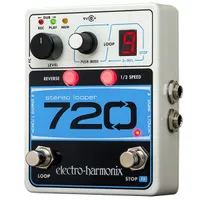
How to choose

At one point in time, your choice of loopers was extremely limited – as was their functionality, limited to stacking tracks on top of each other and little more. Since then, however, there has been a looping revolution, and with it a swathe of looper pedals to choose from.
While the fundamental functionality of every looper pedal should be the same, the scope and capabilities can vary, with some being less suited to your needs than others. There are some things you can consider before purchasing a looper pedal to make it much more likely that it’ll be the right one for you.
1. Performance vs practice
You can trust Guitar Player. Our expert reviewers spend hours testing and comparing guitar products so you can choose the best for you. Find out more about how we test.
The fundamental thing to establish is whether you are looking for a looper for home practice or performance. While any performance looper pedal will be more than suitable for home practice, the same may not be applicable conversely, and while a substantial performance-focused looper pedal will certainly be usable at home, it may well be significantly more than required and come with a significant price tag. Decide where you want to use your looper, and shop accordingly.
2. Multi-track looping
If you decide you do want to perform, then you may want to consider a looper with individual recording channels, allowing you to stop and start different loops independently of each other, rather than having them stacked. Single footswitch loopers tend to only allow you to record each track on top of the one before it, and you may be able to undo the last take if you make an error, but it is unlikely that they have the functionality to stop/start individual loops you have made in your loop stack. Larger loop pedals, such as the Boss RC-600, do have this functionality.
3. Multiple instruments
Some looper pedals will have multiple inputs, for multiple guitars, other instruments, or even vocals. If you are a multi-instrumentalist, you may want to become your own band, to practice or perform along to, which may mean you require one of these multi-input pedals. On top of that, you may also want to consider whether you would like those inputs to be stereo, if you use stereo effects with your guitar – many larger performing loopers can accommodate this.
FAQs

Should I get a one-button or two-button looper?
If you’re new to looper pedals, I’d suggest starting with a single one-button looper, such as the TC Electronic Ditto. This will help you get used to setting up loops, and they’re ideal for home practice. Two-button looper pedals allow dedicated control for stopping, undoing, and redoing loops, which is better for those who want to have more control over their loops, which is particularly useful if you’re likely to perform with the pedal.
Where should I place the looper in my signal chain?
This is really up to you, but remember, your looper will only record and loop the sounds of whatever is in front of it, so if you want a loop to have distortion, you need to have that in front of the looper – this goes for all effects, including those integrated into your amp, so you would need your looper in the effects loop if you want to be after those effects. If you want to be able to change the sounds of the loops after you’ve recorded them, then place your pedals after the looper.
Be warned, if you have stacked a lot of loops on top of each other, adding effects after your looper can give you a really muddy, messy sound, so I would only do this if you have a fairly sparse loop stack, e.g., one guitar track. If you’re totally unsure, I would suggest sticking your looper at the end of your chain as the safest bet.
Why is there a gap or glitch when my loop repeats?
While there can sometimes be latency issues with digital looper pedals, more often than not, small gaps in your loops are caused by timing inaccuracies during the recording process rather than a malfunction of the pedal itself. If you’re out by even a few milliseconds with your stomp on the pedal, it can be really noticeable when your loop comes back around. With practice, you’ll get into the rhythm of starting and stopping loops at just the right moment.
Do I need a looper with an SD card or USB port?
Generally, you only need a looper pedal with an SD card or USB port if you plan to store, export, or import long, complex audio files/backing tracks or back up your loops to a computer. If you intend on just looping your guitar on your pedalboard and using it as a practice tool, you’re unlikely to need these features, but performers may like to have these as an option.
Why do my loops sound muddy?
Loop pedals can sound muffled because they are placed before a distorted amp, causing the amp's preamp to distort the already-recorded sound again; if you want a cleaner signal, place it at the end of the signal chain, in the effects loop. Muddiness may also be caused when you have a thick, layered loop featuring lots of tracks, which can overpower your amp speaker, creating that unwanted, unclear sound, especially if the volume is low.
Another, more universal cause of muddiness in a signal chain is using cheap cables or a lack of a buffer, which causes "tone suck," where high frequencies are lost before the signal hits the looper. If you’re stacking lots of tone-sucked loops on top of each other, that’s going to be pretty noticeable.
Can I sync my looper pedals with MIDI?
Many looper pedals, though not all, can be synced with MIDI. This allows them to match a tempo via MIDI Clock, and sometimes even start/stop in time with drum machines or DAWs - though this has to be pre-programmed. Looper pedals that can do this include the Boss RC-5 and Pigtronix’s line of loopers.
Is it worth getting a looper with drum patterns?
Loopers with drum patterns are brilliant for practice use, because nothing beats playing along to a proper rhythm, rather than just a click, or worse, no rhythm at all. Most loopers with built-in drum patterns will have numerous rhythm types and can even have different-sounding drums. Even the best of these drum patterns don’t sound like a real drum kit, so I wouldn’t suggest that you replace a drummer with them, but they’re still extremely handy.
Is it better to get a buffered or true bypass looper?
There isn’t a blanket right or wrong, and the best choice depends on your signal chain length. True bypass loopers are ideal for maintaining a pure signal with few pedals – ideal for acoustic guitarists who don’t use effects at all – while buffered loopers are better for players with long cable runs and reducing high-end loss (tone suck) in large pedalboard setups, particularly as they (generally) sit at the end of the chain where tone suck will be at its most severe. For some players, it may be more preferable to buy a standalone buffer that can be added in the chain independently at the right spot, to complement a true bypass looper.
Key terms
- 32-bit: Higher audio resolution – cleaner, more detailed loops with less noise or distortion.
- Auto-start: Starts recording automatically as soon as you play, with no need to stomp right on time.
- Buffer: An active circuit that boosts your guitar signal to a low-impedance state, preventing "tone suck" (loss of high frequencies) caused by long cable runs or multiple pedals.
- DAW (Digital Audio Workstation): Recording software on a computer, which some loopers can sync or export to.
- DC (Direct Current): The type of power most pedals use, including loopers.
- Dry signal: Your unaffected guitar tone – what you played before any looping or effects.
- Effects loop (FX loop): A way to route certain effects separately – useful for placing effects before or after loops.
- MIDI (Musical Instrument Digital Interface): A digital music communication protocol that, in the context of a looper, lets it sync or talk to other gear like drum machines or controllers.
- Multi-track: Ability to record and control separate loops independently – like building layers you can mute or switch.
- Overdub: The act of recording new parts on top of an existing loop.
- Phantom power: Power sent through certain cables (usually XLR) – not typically used for guitar loopers, so may limit your options if you plan to plug a condenser mic (which requires phantom power) into your looper.
- Phrase: A recorded loop segment – one complete chunk of audio you can trigger or store.
- Quantize: Automatically snaps your loop timing to a grid and helps keep everything tight.
- Reverse: Plays your loop backwards.
- Signal chain: The order in which your pedals are connected in.
- Stereo: Two-channel audio that produces wider, more immersive loops if your setup supports it.
- True bypass: When off, your pedal doesn’t affect your signal at all and keeps your tone pure.
- Undo/redo: Lets you remove or bring back the last overdub.
- XLR: A type of cable connection mostly for microphones, and not standard on guitar loopers, but some will have this.
How we test

At Guitar Player, our team of passionate guitarists understands the power and creative possibilities looper pedals offer. With our deep appreciation for looping as a musical tool, we have extensively tested and analyzed numerous pedals to identify the best options available.
To compile our list of top looper pedals, we combine our practical expertise, meticulous research, and insightful discussions with our editorial team. We consider factors such as sound quality, functionality, ease of use, durability, and value for money, ensuring that we showcase the finest pedals on the market.
As dedicated musicians, we recognize the importance of capturing and layering musical ideas on the fly. Whether you're a solo performer, a songwriter, or an experimental sound artist, our goal is to provide reliable and knowledgeable recommendations to help you find the perfect looper pedal that unlocks your creative potential.
Read more on how we test gear and service at Guitar Player.

