

Whether you’re just buying your first pedals or expanding your collection of stompboxes, you need one of the best pedalboards to ensure your effects are in order. Nothing makes me wince more than a bunch of indiscriminately arranged pedals that move around as a guitarist attempts to stomp them on a dark stage. Don’t get me wrong, I also carried around my first 4 pedals in a plastic bag, setting them up each gig, but my life got a whole lot easier when I finally picked up my first pedalboard.
Not only do pedalboards make your performances easier, but they also ensure less stress during the changeover, as you can quickly set your stompboxes up on stage, leaving more time for tuning and other tasks. Pedalboards are available in a whole range of different sizes and configurations, so no matter what your requirements for your effects are, there will be a ‘board that’s just right for you.
If you’re looking for a great starting point, the Pedaltrain Nano Plus is affordable, lightweight, and comes with a case. On the other hand, if your first pedalboard has come to the end of its life, then the Pedaltrain Novo 18 is an upgrade suitable for even the most famous guitarists.
Using my years of experience playing live, plus working in a busy guitar shop for the last decade, I’ve collated all the top-choice pedalboards available today. If you’re new to purpose-built pedalboards, then have a look at my FAQs section, my helpful how to choose guide, and my glossary of key terms for more information. For those who just want to get their ‘boards in order, keep scrolling for our top picks.
My top picks

Capable of housing around 8-10 pedals, the Pedaltrain Novo 18 is an ideal platform for the vast majority of guitar players. Built like a tank yet surprisingly lightweight, it comes with a soft case so you can take it straight to a gig.

Whether you're looking for your first pedalboard or a smaller, fly-away option, the Pedaltrain Nano Plus is superb value for money. It's incredibly well made, but the aluminium construction ensures it's relatively lightweight.

If you want your first pedalboard to grow as your pedal collection does, I'd go for the D’Addario XPND 1. Able to expand to a larger size whenever you need it to, the unique telescopic design of this 'board makes it an ideal companion for first-time pedalboard users.
Best overall

✅ Buy if you want the best overall pedalboard: The Novo 18 hits a real sweet spot between price, size, and build quality.
❌ Avoid if you want a better under-board power supply install: Some power supplies fit totally fine, but others require brackets or a bit of creativity.
Overview
The Pedaltrain Novo 18 sits within Pedaltrain’s mid-range selection of pedalboards, and pound for pound, it is the best overall pedalboard you can get. Coming out of Nashville, Tennessee, Pedaltrain is a company that solely focuses on ‘boards, so you can be sure they take this accessory seriously.
Build quality
It’s a five-rung, aircraft-grade aluminum construction, so capable of taking between 8-10 standard-sized pedals, depending on how brave you’re feeling. The all-aluminum construction also makes the Novo 18 incredibly lightweight, so even loaded up with your pedals, transport is the least of your worries.
Features
If over-stretching your feet and ankles to get to a pedal at the back is of major concern, then Pedaltrain has a selection of pedal risers available. Luckily, they’re fairly inexpensive and can offer valuable assistance when trying to avoid mashing buttons and other controls.
One thing to take into consideration is the power supply situation. Some pedalboard power supplies will mount underneath with absolutely no problem. In fact, Pedaltrain even sells a power supply bracket for various different brands and models. However, if you don’t own one of those, then it may be time to get creative - or just mount it on top. Doesn’t look quite so pretty, but does the job nicely.
Best budget

✅ Buy if you want a grab-and-go rig: If you only use a handful of pedals, perhaps you are just starting out, the Nano Plus will do you a great turn.
❌Avoid if you have a chunky power supply: This ‘board isn’t angled, so if you have a large power supply, it may not fit underneath.
Overview
Pedaltrain’s second appearance in this list, the Nano Plus is a much more compact option, as the name would suggest. Not quite the smallest ‘board in the range, the Nano Plus will accommodate five or six pedals - ideal for those who like to keep their rigs simple.
Build quality
Another aircraft-grade aluminum offering, the Nano Plus is tough and durable, but still lightweight. At this price point, this is a huge bonus, meaning if you aren’t planning on expanding your pedal collection, you may never have to upgrade this at a later stage.
Features
One of the Nano Plus’ biggest selling points for us is the fact that it is so damn cheap. A pedalboard, case, and extras for the price of a second-hand Boss pedal is impressive to say the very least, and makes the sometimes exclusive world of pedals and pedalboards very accessible for those just starting out or working on a smaller budget.
The only downside of the whole Nano range is that they aren’t angled like the larger Pedaltrain ‘boards. This makes mounting power supplies underneath a pretty challenging task, as you’ll either need to do some DIY or spend extra on a slim power supply.
Best for beginners

✅ Buy if you want a pedalboard that is future-proof: The expanded feature means this will accommodate your growing pedal collection for years to come.
❌ Avoid if you’re planning on gigging: This doesn’t come with a gig bag, which is quite disappointing, particularly if you plan to take it to gigs, lessons, or your friend's house.
Overview
It feels surprising that it took D’Addario until 2021 to release their first-ever pedalboard. This giant of guitar accessories clearly took its time, and in my opinion, it paid off. The XPND range is a pedalboard that can grow alongside your pedal collection, making it ideal for beginners who might start with just a few pedals but quickly expand their setup.
Build quality
The telescopic technology that allows the board’s length to extend is made from incredibly durable aluminum. It can take a fair amount of punishment, which is perfect for beginners who may be a little heavy-footed while getting to grips with using effects pedals.
Features
The XPND 1’s expandable design ranges from 14” to 24”, allowing it to house roughly four to eight standard-sized pedals. It also features a smart cable management system, complete with patch cable clips to keep everything neat and tidy.
The pre-installed hook-and-loop is another thoughtful touch that will appeal to first-time pedalboard users, and the overall design looks slick and premium. The lack of an included gig bag is slightly disappointing, but it’s unlikely most beginners will be travelling with a pedalboard early on.
Best for gigging

✅ Buy if you want a pedalboard built for travel abuse: This thing is clearly designed for players who are constantly on the move. If your pedals regularly go in and out of vans, cars and venues, this is the ‘board for you.
❌Avoid if you want something lightweight: Weighing in at 6.7kg before any pedals, this isn’t a ‘board for players chasing the lightest possible setup.
Overview
It's only right that the pedal experts themselves get to have a go at pedalboards, and Boss does not disappoint with the BCB-1000. It's by no means the first BCB pedalboard we've seen from them, but perhaps the best to date.
Build quality
Made from a combination of aluminum and ABS plastic, the BCB-1000 offers maximum protection to your prized pedals, all while remaining fairly lightweight. Granted, it's heavy compared to some of the other 'boards on this list - but just look at it. It's not designed to be the slight, slender option. Boss has designed the BCB-1000 for artists who travel, and throw their gear in and out of vans, planes, cars, and venues for fun.
Features
Furthermore, the BCB-1000 has even been designed to fit on any flight as hand luggage, so TSA won't feel the need to demolish your signal chain. We would usually say that this kind of pedalboard is a little bit too much, a bit excessive, perhaps - but we kind of feel like that's the whole point. It's for those who feel like that a great big metal flight case just isn't obvious enough. This offering from Boss, however, is still lighter and easier to transport than many flight-cased alternatives.
Best compact

✅ Buy if you value durability: MONO makes incredibly robust gear, meaning if you’re prone to breaking things, this is the best choice for you.
❌ Avoid if you’re looking for something more cost-effective: Unless you absolutely need a compact ‘board, there are perhaps better value-for-money options out there.
Overview
As soon as you hear the name Mono, you know you’re in for a treat. Best known for exceptionally hard-wearing and protective cases, the Mono pedalboard continues that bloodline of strong, sturdy, and reliable gear.
Build quality
Made from lightweight anodized aluminum construction and included Monosoft case means that it's a pleasure to transport, with the knowledge that it'd take a lot to damage any of your prized possessions within.
Features
You can fit between six and eight pedals on the small pedalboard (the one we're referring to), which is actually pretty decent and will be more than enough for many players. The downside is that compared to options like the Temple Audio Solo and Pedaltrain Novo, it's pretty pricey.
For what is essentially a sheet of metal bent a few different ways, you're definitely paying more than we'd hope or expect. That being said, the included bag is by far the best on this list – so it may not be so unfairly priced after all.
Best lightweight

✅ Buy if you don’t like using Velcro: If peeling sticky residue off pedals drives you insane, or the sound of Velcro makes your skin crawl, this is the pedalboard for you.
❌ Avoid if you like changing around your signal flow: Pedal Plates are super solid once installed, but they are not as quick to rearrange your signal flow like Velcro.
Overview
Temple Audio has pulled it out of the bag here with the Solo 18. With the ability to fit up to 10 effects, the Solo 18 is again the perfect size to host most rigs.
Build quality
Made from strong, durable aluminum, the Solo 18 weighs less than a kilo - so you won’t be suffering after load-in. The perforated top surface means that hook & loop probably won’t do the trick of holding your pedals, but Temple Audio has come up with a brilliant solution - the ‘Pedal Plate’.
Just mount the plate to the bottom of your pedal, position it as you wish, and then screw in the thumb screw. This is ideal for a few reasons, one being that your pedals won’t have tape residue all over the back, and that your board won’t collect all the dust, pet hair, and other grossness that hook & loop seems to accumulate.
Features
The Solo 18, like all Temple Audio ‘boards, features slots on either end. These are designed to accommodate Temple Audio’s optional extra ‘modules’ which include buffered and non-buffered inputs and outputs, a DI module, a power supply module, and a power amp module, among others. It frustratingly doesn’t come with a case as standard, but they are available separately or as part of various bundles.
Also consider
How to choose

Although a relatively simple product, for beginners, selecting the correct pedalboard can often feel like a daunting task. That is exactly why I’ve written this How to Choose section. Calling on my decades of touring, alongside working in a guitar store, I have devised three top considerations to keep in mind when selecting your next pedalboard.
1. Size
You can trust Guitar Player. Our expert reviewers spend hours testing and comparing guitar products so you can choose the best for you. Find out more about how we test.
Firstly, and most importantly, is the size of the pedalboard. I think it is vital to allow yourself room to grow, as accumulating pedals will happen quicker than you realise. The last thing you want to do is buy a pedalboard that needs an upgrade six months after purchasing it. However, on the flip side, having a massive pedalboard that is unwieldy and, frankly, far too big isn’t ideal either.
I typically advise beginners to go for a pedalboard that will allow them four or five more pedals, as that will give them plenty of room to grow without their board being excessively big. Discovering your sound and formulating an opinion on effects you like and don’t like is an important part of any guitarist’s journey, so get a ’board that allows you to do that.
2. Power supply
An often overlooked aspect when beginners purchase a new pedalboard is the power supply slot. There is nothing worse than taking a new pedalboard home and realising it doesn’t accommodate your power supply underneath it. If you already have a power supply, great, measure it and bear it in mind when selecting the pedalboard. If you don’t, decide on which power supply you are going to get and choose a ’board that will house it. Trust me, you’ll appreciate the extra space on top of your pedalboard if you can slot it underneath.
3. Protection
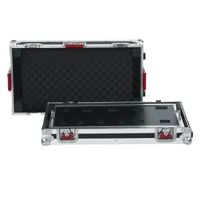
Lastly, do you need a gig bag or a hard case? Chances are, if you’re just beginning, a hard case may be overkill as you’re unlikely to go on tour anytime soon. A gig bag, or soft case, can be a good choice if you want to take your pedals to a friend’s, a practice room, or a jam. It will also give you a place to tidy away your ’board when you aren’t playing it. Of course, this isn’t a necessity, but most appreciate having the option to carry, protect, or store their pedalboard in a bag or case.
FAQs

Can I build a DIY pedalboard?
Yes, you can build a DIY pedalboard. In fact, many players do, as it’s a creative and fun way of injecting a bit of personality into an accessory that isn’t the most exciting. I’ve been to many venues where the band’s guitarist has made a pedalboard from an old skateboard, or even their mother’s chopping board.
However, it’s often trickier than first anticipated, particularly if you need something lightweight and professional. Aircraft-grade aluminum is difficult to get your hands on, and building a board that’s ergonomic, can house your pedals, and won’t fall apart after a few uses is easier said than done. For as many awesome DIY pedalboards as I’ve seen, I’ve seen just as many fall apart.
Should I factor in room to grow?
This is always an important point to consider when selecting a pedalboard. Factoring in growth is a smart move, as we guitarists are often like kids in a candy shop when it comes to effects pedals. Take my word for it, I thought I’d only ever have an overdrive, distortion, reverb, and chorus pedal. I now have two ‘boards full of pretty much every effect you can think of.
Products like D’Addario’s XPND 1 are a fantastic choice, with telescopic expansion that allows you to add up to four more pedals. This gives you the freedom to grow your rig without worrying about space. I’d always advise going for a pedalboard with at least three or four spare spaces, as flexibility is key; after all, variety is the spice of life.
Is a flat or angled pedalboard better?
In my opinion, this comes down to personal preference. Many players prefer angled pedalboards for a few reasons: they make it easier to fit a power supply underneath, cable management is often simpler, and some players find they’re less likely to accidentally hit another pedal when the board is angled.
Flat pedalboards, on the other hand, are great for single-row setups. Their low profile can make it easier to see what you’re doing on stage, especially if you’re singing and relying on your peripheral vision. Also, flat ‘boards are excellent for expression pedals, as the low height makes them more ergonomic to use. The downside is that fitting a power supply underneath is rarely possible, so there are definite pros and cons to both.
Will my power supply fit underneath?
This can be one of the trickiest parts of choosing a pedalboard. With so many different brands, sizes, and dimensions, pairing a power supply with a board that accommodates it underneath can take some research. Many pedalboards include an under-board cavity, but you’ll still need to check the available depth, as some power supplies are simply too chunky or wide to fit neatly.
A safe bet is to stick with the same brand for both your pedalboard and power supply. Brands like Voodoo Lab and Fender make power supplies designed to fit perfectly with their own boards, which can save a lot of hassle.
Do I need a soft case or a hard case?
You should approach this decision the same way you would with a guitar case. Soft cases are lighter and easier to carry, but they don’t offer nearly as much protection as a hard case. This may be fine for local gigs, but if you’re travelling long distances, flying, or loading gear into the back of a van for extended tours, a hard case is the safer option.
However, hard cases are heavier, more cumbersome, and usually more expensive. Deciding whether you value portability or protection more will quickly give you your answer.
What’s the best way to attach my pedals?
The most popular, and perhaps most traditional, method is Velcro. It’s as simple as attaching sticky-back Velcro to the underside of your pedal, and the opposite side to your pedalboard. Job done, you’ve got a secure and easily adjustable setup.
Alternatively, some higher-end pedalboards use metal mounting systems, such as Temple Audio’s Pedal Plates. If you don’t like the idea of covering your pedals in Velcro residue, opting for a board with mounting brackets is a clean, professional, and very secure way to attach your pedals.
Key terms
- Buffer: A buffer preserves your guitar’s signal strength as it travels through long cable runs or multiple pedals, helping to prevent high-end from seeping out.
- Cable routing: This refers to how your patch and power cables are laid out on a pedalboard to keep things tidy.
- Center negative: Center negative is the standard polarity for most guitar pedals, meaning the negative connection is on the inner pin of the power jack.
- Current draw: This refers to how much power a pedal requires to operate correctly, measured in milliamps (mA). Your power supply must either meet or exceed this figure to operate properly.
- Daisy chain: A daisy chain powers multiple pedals from a single output, which is convenient but can introduce noise, especially with digital pedals.
- Dual-lock (3M): This is a heavy-duty alternative to Velcro that uses interlocking plastic stems, and it offers a much stronger hold.
- Flight case: A flight case is a hard case designed to protect your pedalboard from damage whilst travelling.
- Patch cables: These are the short cables used to connect pedals together on a pedalboard.
- Pedal planner: A pedal planner is a digital tool or app that helps you visualise pedal placement and cable routing before committing everything to your board.
- Polarity: Polarity refers to how power is delivered to a pedal, and getting it wrong can stop the pedal from working or lead to damage.
- Rails: These are the horizontal bars on a pedalboard that the pedals mount to.
- Riser: A riser lifts pedals at the back of the board, making them easier to reach without accidentally hitting pedals in front. Angled ‘boards typically have risers to create the playing angle.
- Signal path: The signal path is the order in which your pedals are connected, which has a big impact on how your overall tone behaves.
- Solderless: This is a type of connection that allows you to cut and assemble patch cables without soldering.
- Top-mount jacks: Top-mount jacks place inputs and outputs on the top of a pedal, as opposed to the side. It can help save space if your pedals are tightly packed together.
- Voltage: This is the amount of electrical pressure a pedal needs to run, typically 9V, 12V, or 18V, and must always match the pedal’s requirements, otherwise you will destroy it.
How we test

At Guitar Player, it's safe to say we've played a fair few live shows in our time. In doing so, we've also managed to play a variety of pedalboards from small to large and this ensures that our reviews and recommendations are rooted in practical knowledge gained from countless hours of playing guitar.
As dedicated musicians ourselves, we understand the significance of finding a pedalboard that suits your needs and enhances your playing experience. Our selection represents a careful curation of pedalboards that are built to withstand the rigors of the stage and studio while providing practical solutions for organizing and powering your effects pedals. Where we're able to get our hands on the pedalboard in question, we rigorously put them through their paces, considering factors such as durability, functionality, layout, cable management, and overall design.
Each choice in this article is handpicked by our team of experts who have spent years navigating the pedalboard landscape. We wouldn't recommend a pedalboard that we don't genuinely believe in. With Guitar Player you can confidently explore our recommended pedalboards, knowing that they have been thoroughly vetted by musicians who understand the importance of a well-designed and reliable platform for your effects pedals.
Read more on how we test gear and service at Guitar Player.

