
If you’re weighing up switching from a solid-body guitar to one of the best semi-hollow guitars, I can tell you it’s well worth exploring. Semi-hollow guitars give you a new set of tonal tools to experiment with, delivering a warm, resonant character that’s somewhere between an acoustic guitar and an electric guitar.
If you’re looking for the best semi-hollow guitar overall, I’d go for the Gibson ES-335. It’s the classic semi-hollow for a reason, and has been delivering for professional guitar players for a very long time. It’s incredibly expensive, though. If you want something a little more budget-friendly, have a look at the Ibanez Artcore AS53, which delivers superb performance without breaking the bank.
At Guitar Player, we’re fortunate enough to have tried everything from entry-level semi-hollows to premium Custom Shop guitars from the likes of Gibson, as well as vintage icons from brands such as Rickenbacker. It would be disingenuous to say that guitars at the upper end of the market play exactly like those towards the bottom, and there are nuances that make those premium guitars worth their price tag. However, brands like Gretsch show just how much choice there is across the price spectrum.
If you’re new to semi-hollow guitars, I’ve broken down the best available across a number of categories, so whatever style or price you’re looking for, you should be covered. If you’re not sure where to start, check out the how-to-choose section, which can help point you in the right direction. And if you have any questions about semi-hollows, visit our FAQ section, where you will find the answers to the most common questions.
Best overall

✅ Buy if: You can accept no imitations and want the real deal. Few semi-hollows can match it.
❌ Avoid if: You’re on a tight budget, because this is a premium instrument at a premium price point.
Overview
If you close your eyes and picture a semi-hollow in your mind, there’s a pretty good chance you’re picturing an ES-335; the most famed semi-hollow of them all. The love out there for this guitar is enormous and its sound instantly distinctive, having been at the core of so many famous records over the course of many decades. It’s still the best around.
Build quality
As with anything from Gibson’s American factory, you can expect supreme quality through. The standout is the AAA-figured maple finish which oozes class, though the bits you don’t see, such as the maple center block and Adirondack spruce bracing used to make it acoustically louder, are equally special and contribute to a more open plugged-in experience. The hardware is, unsurprisingly, premium-feeling, with lightweight aluminum used for the ABR-1 bridge and stopbar tailpiece, which is anchored with steel thumbwheels and studs.
Playability
Despite its size, the ES-335 has always had a reputation for being one of the most comfortable semi-hollows to play, and this model keeps that tradition alive. The rounded “C” mahogany neck sits in the hand nicely, offering enough substance without feeling cumbersome, while the 12-inch rosewood fingerboard radius and medium jumbo frets make bends and chord work equally smooth.
Sounds
Looking at the 335, you could be forgiven for thinking it could be limited to more ‘old-fashioned’ styles of music, but that would be a mistake. It comes with medium-output calibrated T-Type humbucking pickups which are warm without a hint of muddiness, but touch-sensitive with bite when overdriven. They’re super dynamic, which is exactly what you want in a semi-hollow, allowing you to go from soft, rolled back, neck pickup tones, all the way to barking bridge bite.
Best budget

✅ Buy if: You want the classic semi-hollow experience without spending a fortune.
❌ Avoid if: You’re expecting the same level of refinement and tonal depth that you may associate with premium semi-hollows.
Overview
The Ibanez Artcore series has long been one of the most cost-effective ways to add a great semi-hollow guitar into your collection with plenty of character and classic-inspired looks. The Artcore AS53 is a great option for players seeking a slightly smaller body that does not compromise on tone.
Build quality
Featuring Linden tonewoods on the body, back, sides, and Nyatoh for the neck, this guitar is striking to look at, with a choice of finishes - Tobacco Flat or Transparent Black - that you’d be forgiven for thinking could be a special option found on guitars double the price finish and subtly highlights the elegance of the body shape. These finishes won’t be for everybody, but I am a fan.
Playability
With its reduced body size, the AS53 is comfortable and should be accessible for the vast majority of players. The neck is smooth and easy-playing, and I could see this as a perfect transitionary guitar for those used to playing solid-bodies.
Sounds
The sounds of the AS53 are defined by its Infinity R humbuckers, which offer a punchy sound, with a warm, full neck tone and a brighter bridge. I’d definitely call this more traditional in terms of voicing, and works well for blues, jazz, and rock. If I had one criticism, the pickups can sound a little bright or clinical compared with some other semi-hollows, though it’s still the best in its price bracket.
Best for beginners

✅ Buy if: You’re looking for a versatile, comfortable semi-hollow that captures the classic ES sound in a more compact package, perfect for smaller players.
❌ Avoid if: You want the full-size feel and deeper, more expansive sound of a traditional ES-335, the smaller ES-339 may feel like it’s not full-fat.
Overview
While parent company Gibson sit on top of the tree when it comes to semi-hollows, the reality is that many of those guitars are simply unattainable for most, unless of course, you invest in the Epiphone versions. These come in at a more palatable price point, with surprisingly little trade off in quality, making them perfect for beginners. The ES-339 is an ideal body shape too, as its smaller body means that even younger players can feel comfortable with a semi-hollow.
Build quality
You can see that Epiphone has paid attention to the build quality of the ES-339, equipping it with excellent hardware such as Grover tuners and the chrome-finish Tune-O-Matic bridge and tailpiece offering stability that should last. Will the attention to detail on areas such as the fret edges and binding be as its Gibson big brother? Of course not, but that doesn’t mean it isn’t an incredibly well built machine.
Playability
With a comfortable rounded C neck and a slightly smaller body than a traditional ES-335, the ES-339 is a really easy-playing guitar. It has a familiar 24.75-inch scale and medium-jumbo frets, which make it a great semi-hollow to migrate to if you’ve been playing a Gibson-style guitar (Les Paul or SG) to date, as this will feel very similar.
Sounds
The pair of Alnico Classic PRO humbuckers delivers the warm, rounded character you’d expect from a semi-hollow, with enough clarity and bite from the bridge pickup for rock, or switch to the neck and roll back the tone and get some jazzy, bluesy sounds. It’s a really versatile guitar so if you have eclectic taste in music, it’s definitely a good fit for you.
Best mid-priced

✅ Buy if: You want classic Gretsch looks with surprisingly versatile tones thanks to its coil-split push/pull control.
❌ Avoid if: You aren’t prepared for the hurdle of a Bigsby and prefer simple, fuss-free tuning and string changes.
Overview
No list of the best semi-hollow guitars would be complete without Gretsch, and I’ve opted for one of the models from their more accessible range, the Streamliner G2622T. This has all the looks and tones that make Gretsch icons when it comes to semi-hollows, without busting the bank, making it my pick for the best mid-priced semi-hollow you can buy.
Build quality
The G2622T is solid, rather than elegant like some other semi-hollows, with a laminated maple body, chambered centre block and set nato neck. The classic Gretsch styling, available in multiple excellent colorways, and Bigsby B70 add plenty of visual appeal, however, as much as I love them, Bigsbys are, in my opinion, an inherently flawed design, so if you don’t want the hassle of that, simply opt for a standard G2622 and save yourself a bit of money too.
Playability
The familiar-feeling 24.75-inch scale, soft “C” neck and 12-inch fingerboard radius give the G2622T a comfortable feel that most will instantly gel with. Those looking to use the whole range of the neck will appreciate the double-cutaway body, while the medium-jumbo frets make bending and lead playing straightforward.
Sounds
The Broad'Tron BT-3S humbuckers give the G2622T a bold, punchy, and quintessentially ‘Gretsch’ sound with plenty of low-end and a good amount of output signal, making it well suited to rock. A push/pull control adds coil-split tones, which gives it a nice extra bit of versatility beyond those fatter humbucker sounds.
Best T-style

✅ Buy if: You want a humbucking semi-hollow with a much smaller profile for additional comfort and easier storage.
❌ Avoid if: You’re looking for something with contemporary features that is wildly versatile, as the vintage-style spec won't suit players looking for a more modern Telecaster.
Overview
When I think of semi-hollows, I generally think of the larger-bodied guitars out there, something grand and imposing, not something that is compact. That, however, is doing a disservice to the Telecaster Thinline, a guitar that has been around in some form or another since the 60s. Of the current variants available, the American Vintage II 1972 takes inspiration from one of the great Thinline models and recreates its vintage charm in a modern package.
Build quality
The American Vintage II 1972 Telecaster Thinline is part of Fender’s premium lineup, and as its name suggests, it is made in their USA factory. It aims to be a faithful recreation of Thinlines from 1972, with a semi-hollow ash body, one-piece maple neck, and vintage-accurate hardware. The attention to period-correct detail is a big part of its appeal, but it also feels like a serious, high-end instrument built for modern use and with longevity in mind.
Playability
As with the rest of the construction, the neck is made to 1972 specifications and sizing, with a “C” shape and 7.25-inch radius, topped with a maple fingerboard. Expect a distinctly vintage feel which traditionalists will love, and with Vintage Tall frets that make bending and vibrato easier than the relatively curved fingerboard might suggest, even fans of more modern necks may get on better than they expect after some adjustment.
Sounds
This Tele doesn’t have the traditional Telecaster single coils; rather, it’s equipped with two CuNiFe wide-range humbuckers, providing a distinctive voice that combines the clarity and snap of a Tele with the thicker, more muscular character of a humbucker. It has plenty of midrange and a higher output than you’d expect from most Teles, but retains enough top-end bite to keep things sounding distinctly Fender.
Best with trem

✅ Buy if: You’ve always wanted a semi-hollow with a Bigsby but were worried about its stability. The Duesenberg trem is on another level.
❌ Avoid if: You want a super-recognizable name. Duesenberg are extremely highly regarded, but the name doesn’t carry the weight of Gibson to the average Joe, despite being in a similar price range.
Overview
A name like ‘Starplayer’ may feel a little on the nose, but the reality is that this guitar should probably be called ‘Superstarplayer’. German guitar architects Duesenberg apply the same level of attention to detail in guitar making as compatriots Mercedes-Benz to car building, and this is clear in abundance on the Starplayer. Every piece of hardware is designed in-house, right down to the pot covers and the fantastic trem integrated on the Starplayer, which is built to not only look stunning but also to withstand the rigors of the road.
Build quality
The first thing you notice when you see a Starplayer TV is the sheer quality of the construction – not always something visible at a glance with other guitars. Every angle has been carefully crafted, from the Super Smooth Z-Tuners to the signature D logo and chrome detailing on the Diamond Deluxe Tremola. It has been painstakingly considered from top to bottom with an Art Nouveau vibe, and it isn’t just for show, with no better exemplification than the Tremola, which delivers one of the smoothest actions on the market and is incredibly responsive.
Playability
The distinctive look of the Starplayer TV may make you think it would feel equally distinctive to play, however the medium D-shaped neck and 12-inch-radius fingerboard gives it a familiar feel, which is reassuring. The neck is hand-finished, with rounded fret edges and a rolled fingerboard that make it feel effortless in the hand. Duesenberg’s PLEK-finished frets – levelled to within 1/100 of a millimeter – and careful setup also make for a smooth, refined playing experience.
Sounds
This guitar pairs a Domino P90 with a GrandVintage Humbucker, offering a wealth of tones. Both pickups are Duesenberg’s own designs, with a clarity and articulation that really stand out. The combination is as versatile as it is articulate, capable of covering a wide range of styles, from blues to punchier rock tones, while maintaining supreme definition.
Also consider
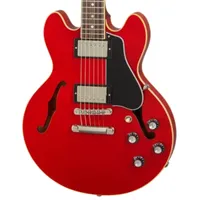
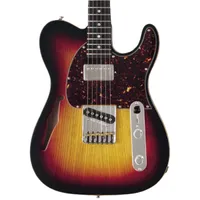
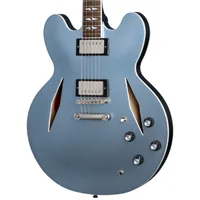
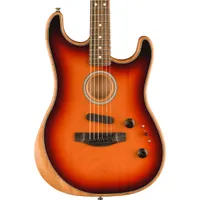
For me, the above picks should cover most guitarists needs when it comes to semi-hollow guitars. If you didn't find what you were looking for though, here are some more great options for you to have a look at.
How to choose

While semi-hollows may feel like a separate, standalone type of instrument, in reality they fall into the same pantheon as the rest of the electric guitars on the market. There are, however, some unique considerations you should be having when it comes to purchasing a semi-hollow. If you’re not sure what they are, don’t worry, because I have listed them out for you.
1. Body Shape
You can trust Guitar Player. Our expert reviewers spend hours testing and comparing guitar products so you can choose the best for you. Find out more about how we test.
If you’re new to semi-hollows the jump from something like a solid-bodied Stratocaster to a ES-335 is going to feel significant – the 335 body is about three to four inches larger at its broadest point, though the difference in the depth of the guitar is closer than you may expect. In fact, many semi-hollows are actually pretty thin, so, particularly for players who tend to stand a lot, they may find that they get on well with the size. For those who are concerned that their body and arms may be too small for something the size of a 335, shapes such as the ES-339 keep the same looks and style, but in a smaller body – about two to two and a half inches smaller – which will appeal to some.
If you’re looking for something more conventional in terms of body shape, it is possible to find semi-hollow versions of those shapes, the most common of which being the Thinline Telecaster, but there have also been limited runs of semi hollow ‘ES’ Les Pauls from Gibson/Epiphone, and even Stratocasters, while PRS also have a range of semi-hollow versions of their classic shapes permanently in their catalog. So the move to semi-hollow doesn’t necessarily mean a move of guitar shape.
2. Tremolo
It is an iconic image: a semi-hollow with a Bigsby. The two just work together in both a looks and sound department, and given that Bigsbys, while available, are less common than other trem systems on solid-bodied guitars, a semi-hollow does seem like a good opportunity to get one. T
he warm and more subtle wobble of a Bigsby is a unique trem proposition – it is worth acknowledging at this point, it is of course, not actually a tremolo effect, it is vibrato – and it’s a sound I adore that works particularly well with the rounded warmth of a semi-hollow. If that wobble is an effect you like to incorporate into your sound, or think you may like to, absolutely consider getting a guitar with a Bigsby, or another similarly well built tremolo arm, such as Duesenberg's Diamond Deluxe.
If you don’t currently use a trem arm and don’t think you will, I would recommend not just getting a guitar with one for the sake of it, as they do require upkeep and make simple jobs such as string changes more difficult, not to mention the impact they have on tuning stability. I have had friends get rid of semi-hollows purely as they didn’t get on with the Bigsby system, so it’s worth being sure you want one before buying.
3. Sounds
While there is a general understanding of the kind of qualities that semi-hollow guitars have tonally, they do not all sound the same. This can be due to the pickups, where you will typically come across humbuckers used in the construction. Semi-hollow guitars can sometimes suffer from feedback, particularly when using gain, and humbuckers are designed to minimize unwanted hum and noise. Humbuckers are warm, rounded, and great for classic rock, which aligns with the style that many wish to play on these kinds of guitars.
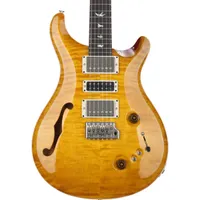
If humbuckers aren’t your thing, particularly on smaller bodies, single-coils and P-90s are often used too. For example, some iterations of the Thinline Telecaster have traditional single coils, while the PRS Special is an HSH configuration guitar providing a best of both world situation, and brands like Duesenberg often like to experiment with P-90s.
The use of spankier single-coils that offer a brighter and slightly more articulate tone, is a nice counterpoint to the airy warmth of a semi-hollow, marrying the two in an interesting and enjoyable combination, though with lots of gain, this combo has a recipe for lots of noise and feedback. Think about the sound you want to achieve with your semi-hollow, and the likelihood is that there will be a guitar out there for you with the pickup configuration to realize it.
FAQs

What's the difference between a semi-hollow and hollow body guitar?
Externally, semi-hollow and fully hollow electric guitars may look very similar; however, on the inside, semi-hollow guitars have a block of wood running through their center. While adding a level of additional strength to the overall frame of the guitar, the primary purpose is to alleviate feedback, which fully hollow guitars can really suffer with, particularly when playing at high volume or with distortion.
The center block also adds additional sustain; however, this does mean that semi-hollows can’t boast quite the same level of ‘acoustic’ resonance as their fully hollow counterparts, though still significantly more than solid-bodied guitars.
Can you play metal or hard rock on a semi-hollow?
You can definitely play hard rock on a semi-hollow – ask Dave Grohl, who has played some pretty huge riffs on his signature Gibson semi-hollow – and even metal isn’t off the cards. Bear in mind, however, that while the center block does reduce feedback over fully hollow guitars, it is still more likely to suffer than a solid-bodied guitar.
The natural acoustic resonance of semi-hollows can also mean they have a warm low end, which is generally viewed as a positive, signature part of a semi-hollow sound; however, with lots of gain, this can quickly go from warm to muddy, though you can combat this with by cutting some of the low end and boosting the mids on your amplifier.
Are semi-hollow guitars too big for smaller players?
While the traditional image of a semi-hollow guitar is a guitar with a large body, such as the Gibson/Epiphone 335, there are a number of semi-hollow guitars that can be more suited to smaller players, such as the 335’s shrunk-down brother, the 339, which has the same classic looks in a smaller body. For something that is significantly smaller, the Fender Thinline Telecaster (Squier versions also available) is a noticeably smaller guitar, and offers Telecaster tones, with an added bit of semi-hollow warmth.
How different do semi-hollow guitars sound compared to solid body guitars?
The sound of semi-hollow guitars is by no means night and day compared to solid-bodied guitars; however, they have a naturally warmer, airier, acoustically resonant tone compared to solid guitars, which have a tighter tone with both more attack and longer sustain. If you were to compare a semi-hollow Thinline Telecaster with a traditional Tele, you would be able to hear the difference, but both would have those unmistakable Tele qualities.
Is it hard to change the pickups in a semi-hollow?
Changing pickups in a semi-hollow guitar can be significantly more challenging than a solid-bodied guitar, as they don’t have rear cavity cover and no removable front scratch plate. These two features are often really useful in doing much of the more fiddly jobs of replacing pickups without significant obstruction, whereas this is not possible on semi-hollows and work has to take place either through the tiny holes on the body of the guitar, or through the pickup cavities directly. It’s far from impossible though, and there are some things you can follow to avoid some common pitfalls that make the job even harder.
Do semi-hollow guitars tend to neck dive?
Semi-hollow guitars are more prone to neck dive as their bodies are lighter than solid-bodied guitars. This means the guitars can be imbalanced, with the neck and headstock – set away from the pivot point of the strap – prone to diving towards the ground. This isn’t always the case and using a great strap can help mitigate this.
Key terms
- Archtop: A type of semi-hollow (or fully-hollow) guitar that has a curved wooden top, as opposed to a flat one found on a Stratocaster, for example.
- Bigsby: This is a brand of tremolo system widely used on semi-hollow guitars. The mechanism produces a smooth and often subtle tremolo effect.
- Bracing: Wooden supports inside the guitar that help strengthen the body and shape its resonance and response.
- Center block: A center block is the solid piece of wood running through the middle of a semi-hollow guitar. It has two routed wings attached to either side.
- Coil-split: A coil-split is an electrical feature installed in a guitar that disables one half of a humbucker, allowing single-coil tones to be produced.
- Double-bound: A guitar with binding around both the front and back edges of the body. It looks classy and helps protect the body edges, too.
- F-holes: An F-hole is the ornamental design found on a semi-hollow guitar’s top; it is always featured on the ‘wing’, or hollow section of the top.
- Feedback: This is an audio loop produced when a guitar’s amplified sound is picked up by the pickups, resulting in feedback. It often sounds like a high-pitched howl.
- Hollow body: Unlike a semi-hollow with a center block, a hollow body guitar is fully routed, doesn’t have a center block, and is fully hollow.
- Humbucker: This is an electric guitar pickup formed by two single coils being bunched together. The opposing polarities help reduce any unwanted hum.
- Laminated top: A laminated top is a type of composite wood made up of multiple thin layers of wood glued together to produce the top.
- Neck profile: Simply put, the neck profile is the cross-section of the back of a guitar’s neck. Usually described by letters, like ‘C’, ‘D’, or ‘U’, this gives an idea of the shape.
- P-90: Somewhere between a single-coil and humbucker, a P-90 is technically a single-coil as it has one wire coil, but with a much shorter and wider bobbin.
- Resonance: This is how your guitar’s body will vibrate to a particular frequency. Semi-hollow resonance is a little brighter and airier compared to a solid body.
- Scale length: This refers to the measurement of the guitar’s length between the bridge and nut.
- Set neck: Unlike a bolt-on neck, a set neck is glued into the body in a pre-cut pocket.
- Single-coil: A pickup design that uses a single magnet and coil of wire. They sound bright, clear, and snappy, but can sometimes pick up a little hum.
- Sustain: How long a note rings out once you play it. Semi-hollows usually have more natural sustain than fully hollow guitars, but a little less than solid bodies.
- Trapeze tailpiece: A tailpiece that extends from the end of the guitar and curves down in a trapeze-like shape. It anchors the strings without passing them through the body.
- Thinline: A term used for slimmer semi-hollow guitars. They keep the airy tone but feel lighter and easier to handle. It is a term coined by Fender and its Telecaster Thinline model.
- Tone block: The solid piece of wood running through the center of a semi-hollow. It adds sustain and helps keep feedback under control.
- Trestle bracing: Internal wooden supports used in some Gretsch hollow and semi-hollow guitars. They strengthen the body while helping control feedback and maintain a lively response.
- Wings: The two outer sections of a guitar body that sit either side of the neck joint and centre block. On a semi-hollow, these areas are typically hollow.
How we test

At Guitar Player, our expert team of guitarists is fully immersed in the world of guitars. With our deep appreciation for the unique tone and versatility of the instrument, we have extensively tested and played numerous guitars to identify the best semi-hollow guitars available.
To compile our list of top semi-hollow guitars, we combine our hands-on experience, meticulous research, and in-depth discussions with our editorial team. We carefully consider factors such as craftsmanship, playability, tonal range, and overall value to ensure we showcase the finest products on the market.
As dedicated musicians ourselves, we understand the importance of finding the perfect instrument that suits your playing style and musical preferences. Whether you're exploring jazz, blues, rock, or any genre that benefits from the warm, resonant tones of a semi-hollow guitar, our goal is to provide reliable and informed recommendations to help you discover the ideal instrument for your musical journey. With the best semi-hollow guitars in your hands, you'll have the tools to express your creativity and elevate your sound to new heights.
Read more on how we test gear and service at Guitar Player.

