
Madcap Quebec duo Angine de Poitrine are quickly becoming one of the internet’s most unlikely breakout acts — and it’s not hard to hear why.
Armed with a self-built microtonal double-neck guitar that looks and sounds like it came from another dimension — and outdoes Jack White’s Ugly Stick for weirdness — the pair have turned dissonance into a viral language. Their performance on KEXP last month alone has surged past 3.5 million views, helping fuel a rapid rise that’s caught the attention of players like Cory Wong and Rick Beato.
So what exactly are people hearing — and seeing?
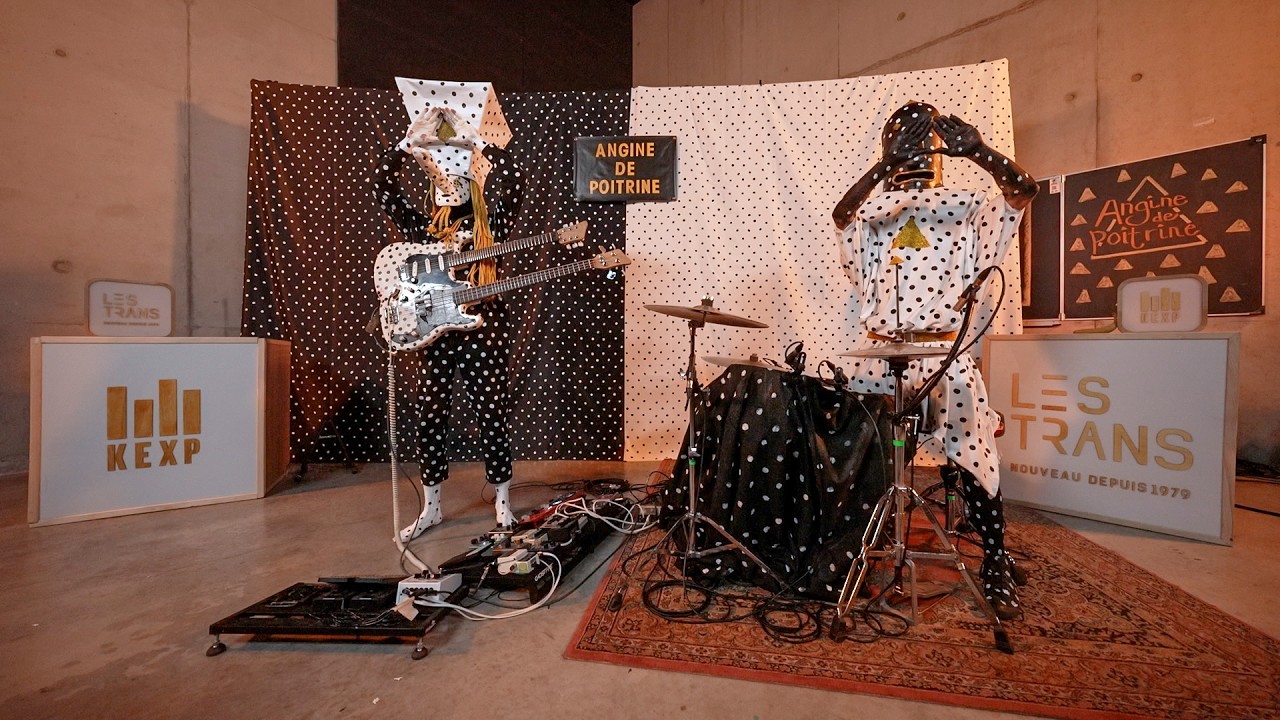
Active since 2020 and based in Quebec, the duo traffic in a dense, disorienting blend of jazz, prog, math rock and global influences. Their stark black-and-white polka-dot costumes and papier-mâché heads only add to the intrigue, giving their already alien sound a visual identity that’s equal parts hypnotic and nightmarish.
But the real story is under their fingers.
The moment we started playing with it, we just laughed because of the friction created and the proximity of the notes.”
— Klek
At the center of their sound is a homemade microtonal instrument — a Stratocaster-style double-neck guitar that’s half electric guitar, half bass. It’s modified with extra frets carved in by hand, unlocking intervals that fall between the notes of a standard Western scale.
“I built the first microtonal guitar we used myself,” drummer Klek de Poitrine says in an interview with Noize. “I added more frets on a guitar with a saw.”
What started as an experiment quickly became the band’s defining voice.
“The moment we started playing it, we just laughed,” he continues. “But since I’m not a guitarist, I wasn’t using the instrument’s full potential.
“So I brought it to Khn. I told him, ‘You have to try this, it makes absolutely no sense.’ Then, right away, the moment we started playing with it, we just laughed because of the friction created and the proximity of the notes.”

That “friction” is the point. Drawing inspiration from Indian and Japanese music traditions, the duo lean into quarter-tones and micro-intervals not as ornamentation but as the foundation of their compositions.
Guitarist Khn, whose background spans progressive rock and modern jazz, approaches the instrument less as an exotic novelty and more as an expansion of harmonic language.
The way I use quarter tones lets me stretch chromatic ideas and build more tension. It becomes something closer to a Zappa-like phrasing — but pushed even further.”
— Khn
“The way I use quarter tones allows me to explore chromatic approaches that are twice as long and then build more tension,” he explains.
Even so, he insists the results aren’t as abstract as they might seem.
“Ultimately, most of the tunes we make could be harmonically compared to something along the lines of the tunes on John Scofield’s Überjam or Miles Davis’s So What.”
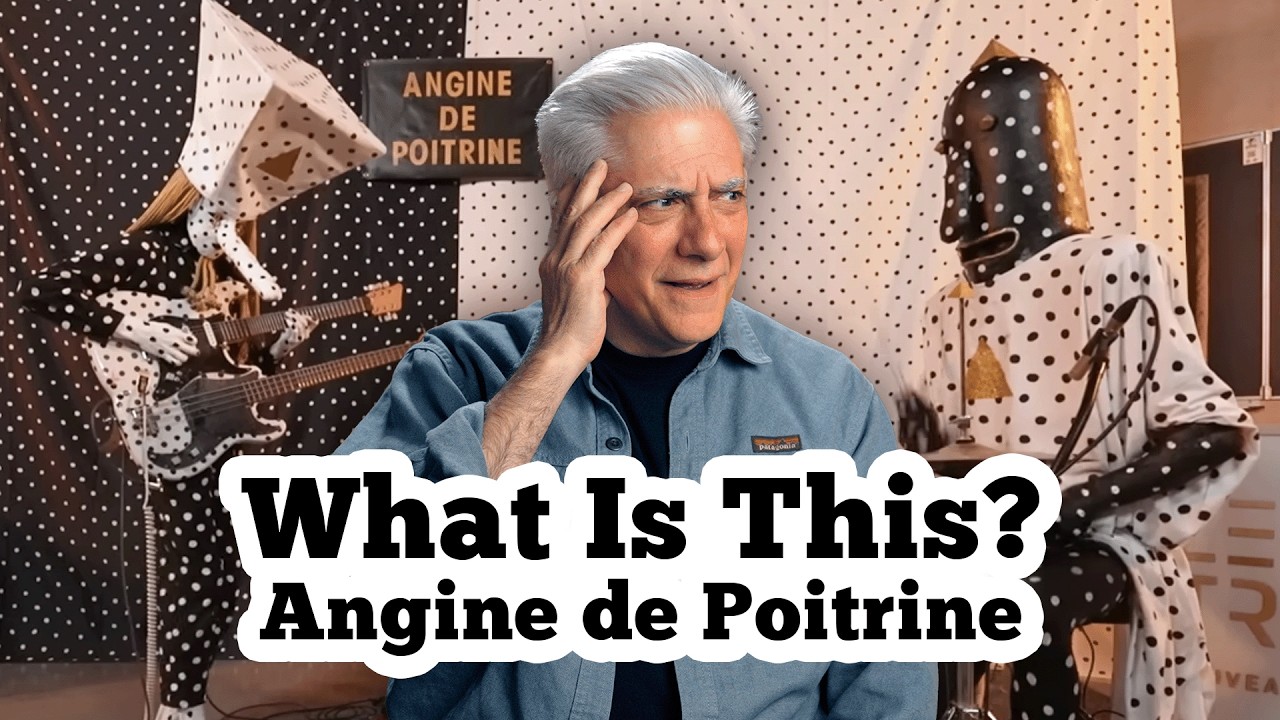
If listeners are still trying to process it, they’re not alone. Beato says no other act has flooded his inbox quite like Angine de Poitrine.
“I get 25 emails a day about them — thousands of comments,” he says. “You watch it and think, ‘How do they even play this?’ This is what I imagine the future of music sounds like.”
With their second album, Vol. II, arriving April 2, the band’s mission is clear: push microtonal music out of the margins and into the mainstream — not as a curiosity but as a fully realized musical system, and beyond the limits of microtonality previously explored by Jeff Beck.
“The goal is to use these notes like any others,” Khn says. “Not as decoration but as the language itself.”
Expect their strange, dissonant world to keep expanding throughout 2026.

