
At first, Joe Satriani wasn’t sure how to respond to one of Steve Vai’s most elaborate new recordings.
The track arrived dense, layered, and saturated with guitars — the kind of maximal arrangement Vai is known for pushing to extremes.
Satriani remembers his immediate reaction:
“What am I gonna play on this song that’s got 18 Steve Vai guitar tracks on it?”
It wasn’t frustration so much as recalibration. After decades of working with Vai in different contexts, this was something else entirely: a fully formed sonic environment already overflowing with guitar ideas before he even entered the picture.
The track is “Dancing,” the Spanish-flavored latest single from the SatchVai Band, which also includes bassist Marco Mendoza, guitarist Pete Thorn, and drummer Kenny Aronoff. The song is an interpretation of a piece by Italian singer Paolo Conte and is accompanied by a humorous video featuring 13 dancers, including Aronoff and mutual friend Brendon Small of Metalocalypse fame.
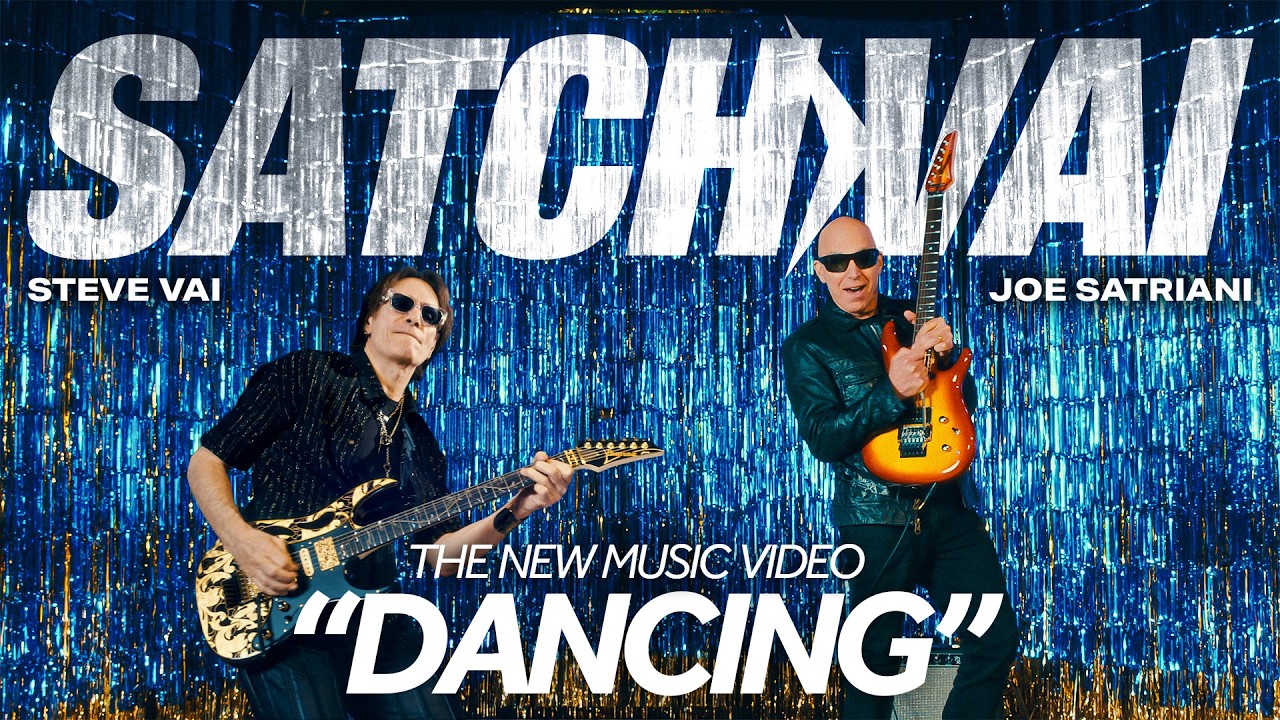
“I found that track in the early ’80s and just fell in love with it,” Vai says. “I kept listening to it through the years and imagined it as a guitar piece. I sent it to Joe and said, ‘I’ve got a crazy idea. I want to turn all the horns into guitar parts and beef up the arrangement.’
“I thought he’d say, ‘What are you, crazy? This isn’t rock and roll.’ But he came back and said, ‘I don’t know what I’m gonna play on this, but I trust your insanity,’ so we did it.”
I thought he’d say, ‘What are you, crazy? This isn’t rock and roll.’ But he said, ‘I trust your insanity,’ so we did it.”
— Steve Vai
Vai says the third single was originally intended to be Satriani’s “Mayhem,” but both agreed “Dancing” offered a better left turn creatively.
Satriani agrees the choice worked precisely because of its unpredictability.
“It is good, because it is so different,” he says. “It showcases some of Steve’s bizarre ideas about what you can do with the guitar and arrangement — like a peek into the genius of Steve. I remember thinking, ‘This is the craziest idea Steve has ever had,’ and when it came together it was just pure fun.”

The SatchVai collaboration began decades earlier in suburban Long Island, where a teenage Vai studied guitar under Satriani. Vai says those early lessons rarely felt formal.
“We’d sit in his backyard with two electric guitars, no amplifiers, and we’d sit back-to-back and just play,” he recalls.
What began as instruction quickly turned into long improvisation sessions — an early training ground built entirely on listening and reaction rather than technique.
I’m glad we waited for this. If we’d done it earlier, we would’ve brought that anxiety into the studio and had pressure from outside sources.”
— Joe Satriani
That shared instinct resurfaced decades later when the idea of recording together finally became unavoidable.
A 2024 co-headlining tour accelerated things. The two began jamming at the end of shows, and informal ideas evolved into full exchanges of compositions.
Vai sent Satriani two pieces that became “The Sea of Emotion, Pt. 1” and “Pt. 2.” From there, momentum took over.
“We said, ‘Come on, let’s do it. It’s time,’” Vai says.
Satriani says timing was crucial. Both musicians were no longer operating under the pressure of proving themselves.
“I’m glad we waited for this,” Satriani says. “Now we’re older, and we’ve had a crazy roller coaster of success. If we’d done it earlier, we would’ve brought that anxiety into the studio and had pressure from outside sources. Doing it now, we were able to let it just happen.”

The SatchVai album weighs in at 10 songs — “I Wanna Play My Guitar” is the only one with vocals — and has been mixed and mastered. It has no title or release date yet, however, though the pair is anxious for fans to hear the full body of work.
When the album does finally drop, Satriani and Aronoff will resume with Sammy Hagar’s Best of All Worlds band for summer shows, while Vai will be back with the all-star King Crimson adjunct Beat for a European tour during June and July. They also each voice a desire work on their next solo projects, which will leave the prospect of SatchVai as a going concern somewhat up in the air.
“Joe and I kind of work in the moment,” Vai says. “We never even talked about putting a band together until it just happened, because the time was right. I think that’s going to be the M.O. moving forward.
“I know that we are interested in getting back to being our own generals and entering back into our own creative impulses on a solo level, but SatchVai was such a fun process, and it was easy and creative and fun, I can’t imagine not working together again, even if in the future it’s just sharing tracks and creating like that.”

