
Listening to Matteo Mancuso is impressive, but witnessing his devastatingly precise electric fingerstyle shred up close in person is mind-blowing. Having the chance to do so on American soil is a rare treat, as the young Italian virtuoso spends the lion’s share of his time overseas. Mancuso resides near Palermo, Sicily, and only travels to the States on occasion.
But he is coming to the States for his first extensive tour this spring, and he was at the NAMM Show in January where he put on a blistering show before a huge and enthusiastic audience at the Yamaha Grand Plaza Stage. Before heading home, Mancuso played a few gigs in California, and Guitar Player did a Presents promotion for his show in Santa Barbara at the stunning Lobero Theatre.

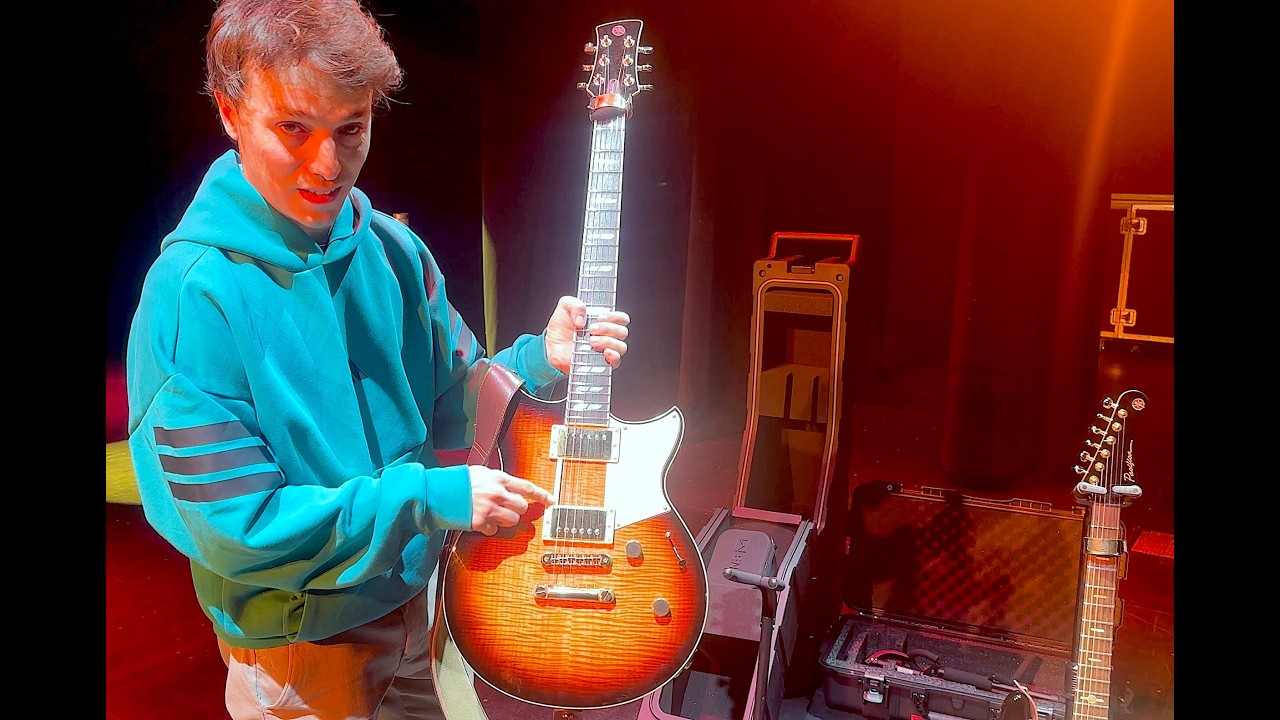
We caught sound check and then he walked us through his gear (see video below). Afterward, in the dressing room, he graciously sat down for an intimate look and in-depth explanation of his otherworldly plucking technique that is the talk of the guitar universe. He also hipped us to inside information about his upcoming album, Route 96, dropping April 24 on Artone/Music Theories.
The album features a couple of cool collaborations. The kickoff cut, “Solar Wind” is a dazzling duo with shred icon Steve Vai, while the advance single, “Isla Feliz,” features gypsy jazz master Antoine Boyer. The utterly unique blend of different guitar styles and tones makes it one of the most interesting instrumental tracks you’ll hear this year.
Watching the “Isla Feliz” video, it appears you laid down a gypsy acoustic track with the band, and then perhaps overdubbed your electric lead part and Boyer’s gypsy lead. Would you please explain your vision and how you developed the track?
I wanted to get close to Steve’s style in order to invite him, and ‘Solar Wind’ was my attempt to write a song resembling that.”
— Matteo Mancuso
That is how we developed the track. I wanted to build a song incorporating gypsy, electric guitar, and classical elements on the same record. Antoine Boyer was the first guest I invited for the album, and I’m excited about this being our first collaboration.
It’s a perfect fit because he’s not the typical gypsy player that only plays Django [Reinhardt]. He listens to a lot of different stuff and can play a variety of styles. So, he was open-minded enough to participate, and I feel that what he did is a masterpiece.
How did you go about getting Steve Vai involved on the album’s first cut, “Solar Wind”?
I wanted to get close to Steve’s style in order to invite him, and “Solar Wind” was my attempt to write a song resembling that. There are a lot of melodies with his kind of taste, and like Frank Zappa, I used odd time signatures such as 5/4 and 7/8.
Did you ever listen to the classic fingerstyle rock players like Mark Knopfler and Jeff Beck?
Of course.

There’s a great Jeff Beck tribute in Northern California involving a virtuosic player originally from Italy named Daniele Gottardo that Steve Vai praised as one of the brightest talents in modern electric guitar. Care to share thoughts on him?
Oh yeah. He is truly one of the best players in the new generation. And I’m not just saying that because he’s Italian. Daniele is a complete player. He can literally play everything. I remember when Daniele’s videos came out. Everyone was mind-blown by his tapping technique, his taste and his tone.
The same is true about you, particularly regarding the use of advanced fingerstyle techniques to rip licks on electric. Is it safe to assume that you were classically trained on using free strokes and rest strokes?
Yes, of course. There are quite a lot of differences, and you need to learn how to play with both techniques. Free stroke is a little bit harder to control because you don’t rest your finger on the next string after plucking a note. Your fingers are kind of floating around, so the free stroke technique requires development.

I use it a lot for playing passages with one note per string, such as arpeggios. It helps very much to have a dedicated finger ready to strike each string, so you don’t have to wait for the pick to arrive on the string.
You also have the thumb available. So the wrist is like this [demonstrates coming at natural strum-style angle of about 45 degrees]. It’s not like that [with elbow tucked in and hand perpendicular to the strings]. All four fingers are available, but I never learned how to use the pinky, so I never do.
It helps very much to have a dedicated finger ready to strike each string, so you don’t have to wait for the pick to arrive on the string.”
— Matteo Mancuso
Using free strokes informs your phrasing. You wind up playing different forms and patterns. For example, I like to play perfect fourth intervals. [He plays an arpeggiated passage.]
It appears the plucking hand is in the shape of a claw with the thumb and first three fingers each assigned to a string. As you play arpeggios from low to high, the position jumps from hovering at the ready over strings six through three, to five through two, and on up to strings four through one. The reverse happens on the way down, and for anything in-between or back and forth, you move the focus to wherever is appropriate.
Yes, exactly. Each finger is assigned to a different string, and you basically move your hand based on what strings you have to play.

For a passage requiring successive notes on a single string, that’s when you pull your elbow in and flip your hand vertical for the rest stroke technique, correct?
Yes, the rest stroke technique is a little bit easier to control if you’re playing on the same string, basically tremolo picking. The other advantage of developing a strong rest stroke attack is greater volume.
For example: this is the free stroke [plays a tremolo picking part]. This is the rest stroke [plays the same thing, and it’s clearly louder.] They always suggest playing melodies with the rest stroke for more volume and clarity, and then using the free stroke for arpeggios because it’s easier.
Bending the wrist too much, like some bass players do, is not good for your tendons or your comfort.”
— Matteo Mancuso
So I learned this lesson from the classical world, and I try to apply it on the electric guitar. Of course, I wind up using the free stroke when playing melodies on multiple strings, but I prefer to use the picado, the rest stroke technique, because then there’s more clarity to the line.
I pull my elbow in so that my arm and wrist are going straight downward, not bent to the side. The fingers are more relaxed because the wrist is straight. Although I will hold my hand a little bit further away from the strings and have somewhat of a downward bend at the wrist. It’s a little bit more comfortable to me to do some of the lines.
Bending the wrist too much, like some bass players do, is not good for your tendons or your comfort. Of course, the classical way is to use a stool and place the guitar on your left leg, which makes the bending less of a problem because it’s not so severe and you have that support.

It's cool how you have a ledge built-in on your guitar above the sixth string to support your thumb while using fingers for rest strokes. How many fingers do you use typically?
I often do it with two or three fingers.
When you get going with picado plucking, does the order of fingers go: middle, ring, index?
Well, it’s kind of a mix. I can do it in both directions. Sometimes the order can be 3, 2, 1, 2, 3. It’s almost instinctual to me, depending on the line. It’s a bit easier to have the accent on the same finger when playing triplets.
I borrowed some techniques from the bass world, the classical world, and some other things from the electric world as well.”
— Matteo Mancuso
The tremolo picking part near the end of “Eruption” is a great example of a line that breaks down into triplets, so repeating the pattern of ring, middle and index fingers is always good. But for something more varied such as this Malmsteen run, it’s more of a mix. [He plays a crazy Yngwie Malmsteen passage.]
It's wild to watch someone rip Yngwie licks using fingerstyle.
It's rare to see this approach on electric guitar, but I don’t think it's a technique that I totally invented from scratch. I borrowed some techniques from the bass world, the classical world, and some other things from the electric world as well. I had to figure out variations from the classical technique because classical players don’t need to control distortion, and they have more space between strings.
Therefore, my movements are comparatively a bit less wide and more focused. I also need to control distortion a bit, so I’m palm muting just a tiny bit. If I mute too much, then I don’t have the same sound.

What are your thoughts on fake versus natural nails?
Natural nails don't last long. You need fake nails. I use acrygel, which is a mix between acrylic and gel. It’s hard enough for my attack and doesn’t get consumed too much by the strings. Of course, I must file a little bit with sandpaper after every concert, but other than that, it’s a good solution.
How do you avoid the nails getting hung up on the strings?
The angle of attack is key. The point of impact when I pluck is slightly to the left side of the nail. That’s where it gets consumed most by the strings, especially on my middle finger. The other side is not that important to me. What’s is important is the shape and that the nail is not too long. The less space you have between strings, the shorter the nail needs to be.
It’s very complicated to play electric guitar with fingers.”
— Matteo Mancuso
Classical guitars do have much wider spacing. How come more classically trained players don’t apply those fingerstyle techniques to lead electric guitar the way you have?
Well, I don’t know. It’s very complicated to play electric guitar with fingers. My story is that my father is also a guitar player. He can also play with a pick, but back when I became interested he was playing a lot of fingerstyle classical guitar. Meanwhile, I was listening to a lot of rock music.
My introduction to guitar was AC/DC and Led Zeppelin. I was way more fascinated with the electric world. So, I started playing electric guitar with fingers because I thought that every guitar was meant to be played like that. I didn’t know that you should use a pick for electric and fingers with classical. I figured you can play whatever you want.
