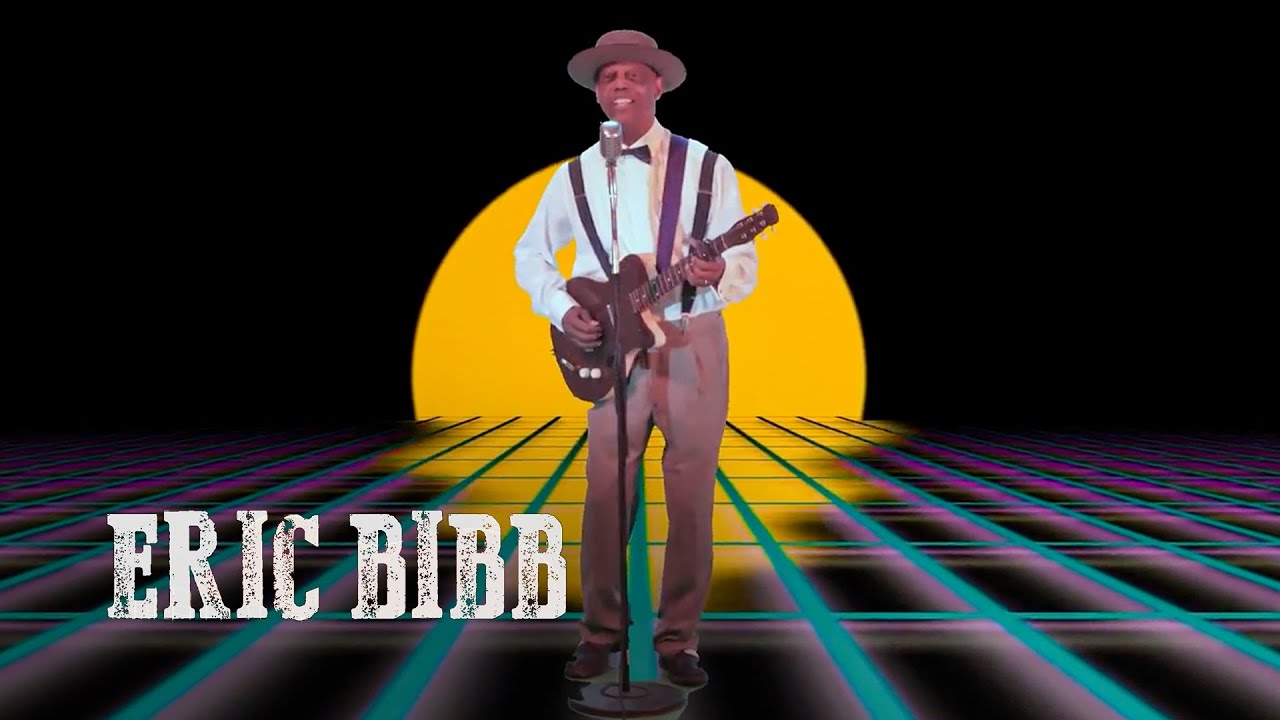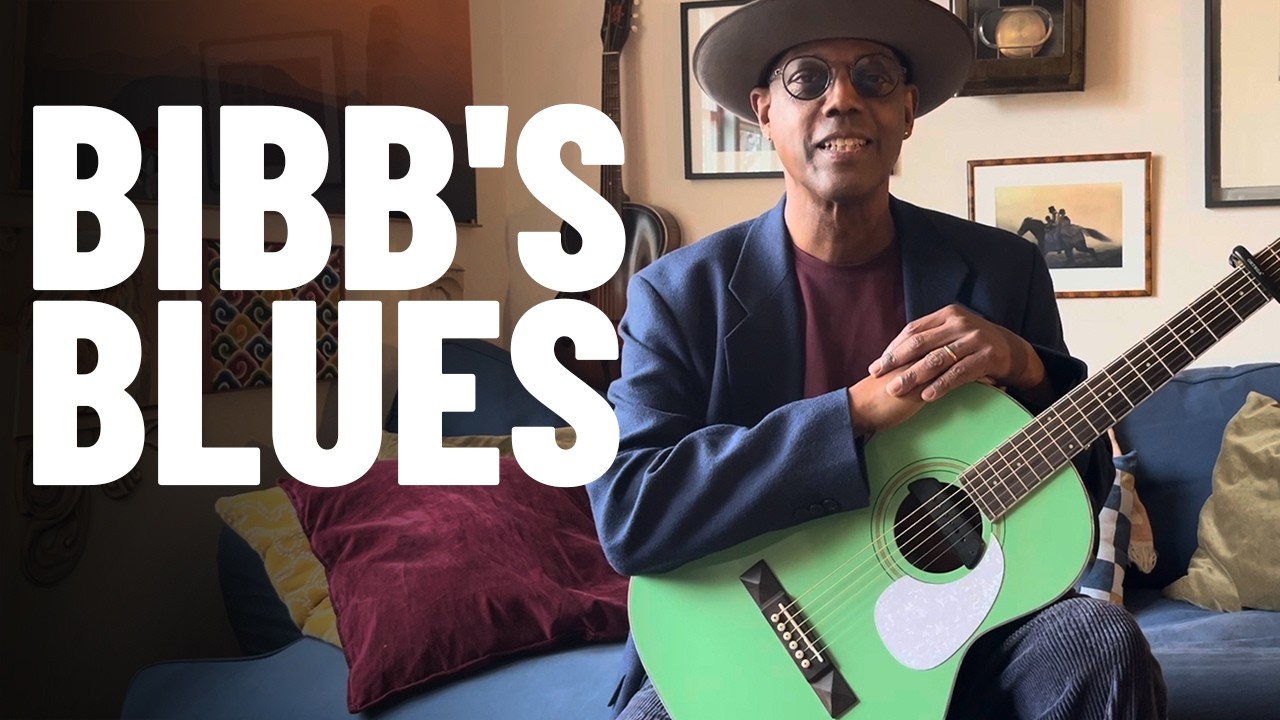
If you’ve ever wanted to improve your fingerstyle blues playing with direct guidance from a modern-day master, this tutorial presented by Eric Bibb is for you.
Eric is a Grammy-nominated acoustic blues stylist who has performed and recorded with a wide range of blues, folk and roots musicians, including Taj Mahal, Mavis and Pops Staples, Bonnie Raitt and Charlie Musselwhite.
At age 11, he got some sage advice from Bob Dylan, who told him, “Keep it simple, forget all that fancy stuff.” Eric took that to heart, building on a “less is more” philosophy that emphasizes steady, alternating bass lines combined with intricate, often arpeggiated melodic playing on the higher strings.
Here, Eric takes some time out from his 2026 tour to share five of his favorite fingerpicking exercises on acoustic guitar. These examples outline ideas he uses all the time and are also elements he has gleamed from earlier roots legends such as Mississippi John Hurt.

As a jumping-off point for the examples, Eric isolates various parts of the blues, such as the move from chord I to chord IV (the first change of any blues progression), and the turnaround (usually featured at the back end of a blues progression). This will allow you to focus in on specific techniques and sections of blues progressions without getting overloaded with long parts to learn.
Integral to all this is a versatile fingerstyle approach that combines driving bass lines with a syncopated melody. While the bass line and melody can often be simple in nature, when combined they produce a composite guitar part that’s perfect for singing or soloing over. In short, you’ll be crafting your skills at being a one man blues band.
Eric begins with his guitar tuned to drop D tuning (D-A-D-G-B-E), with a capo on the 2nd fret. The low D on the sixth string makes playing octave bass lines easier, as no fretting is required. As for the capo, this changes the key without having to change the fingering pattern. Alternatively, the fret numbers in the tab will work in open position if you don’t have a capo, but they will just sound one whole step lower than what Eric plays.

As for the chord names, you’ll see two listed above the notation when the capo is used. For instance, Example 3 shows a D chord above a C chord, (C). The D chord is what you hear; the (C) refers to the chord shape you’ll play. As the capo is placed on the second fret, the C shape will sound as a D chord.
For the last three examples, Eric returns to standard tuning (E-A-D-G-B-E) both with and without a capo. All tuning and capo directions are labeled in the tab/notation below.
Throughout this lesson, Eric talks through his approach to using syncopated melodies, which make his playing so appealing. The melody notes can fall on the beat and be played at the same time as the bass note. This is facilitated with a pinch of the thumb and first or second finger. The melody note can alternatively anticipate the bass note or be placed in between the bass notes for a more sophisticated sound.
Another technique to watch out for is when Eric uses his fretting-hand thumb to play the bass notes on the sixth string. The thumb hooks over the top of the neck and traps the sixth string. This may take a bit of practice to get right. Both the size or your hands and the size of the guitar neck are limiting factors.

Jon Bishop is a U.K.-based guitarist and freelance musician, and was a longtime contributor to Guitar Techniques and Total Guitar. He’s a touring/recording guitarist for British rock and roll royalty Shakin’ Stevens, guitarist for many movie+orchestra tours such as Love Actually, Labyrinth and La La Land and a fan of all blues music, especially acoustic blues.
Example 1: Moving between I (E) and IV (A)
Here, Eric is in drop D tuning (D A D G B E). To achieve this, simply drop the sixth string down a whole step, from E to D. You’ll also need to place a capo on the 2nd fret.
The bass notes are plucked exclusively with the thumb, and a light palm mute is used to increase the attack and thicken the tone. We recommend starting slowly and spending some time getting comfortable with the bass pattern.
The melody is played on the top three strings and fits in the gaps between the bass notes, resulting in a syncopated line.
Says Eric, “I syncopate a lot. I like to have that ‘hiccup’ in the playing. It’s just a little hipper, I think.”
If you’re new to this style of playing, you’ll find slow practice and perseverance are the keys to success.


Example 2: Blues turnaround in B: V(F#7) - IV (E7) - I (B)
This second example is a blues turnaround that can be used in the key of B (or A without the capo). Again, you are in drop D tuning with the capo on the 2nd fret. Use your thumb to fret the low F# notes (2nd fret, sixth string) in bar 1.
This example has a shuffle feel in a 12/8 time signature, making it easy to see how the rhythms (three notes per beat) tie in with the bass notes. Remember to experiment with a light palm mute to accentuate the bass notes with punch and warmth.
This is another example that benefits from being played slowly, especially when separating the bass line from the melody so you can achieve the most performance clarity.

Example 3: Moving between I (D) and IV (G)
Time for a tuning change as Eric opts for standard tuning (E A D G B E). To get into this tuning, simply bring the sixth string back up a whole step, from D to E. The capo can remain on the 2nd fret.
This time you’re starting with a C shape chord. Again, the bass notes are plucked exclusively with the thumb with a light palm mute. Notice that the eighth notes have a lilting, straight feel that provides a sense of summertime.
This example uses hammer-ons and pull-offs to create fluidity and a smooth tone. It’s well worth isolating the melody and ensuring that the legato phrasing is even with respect to velocity and timing.


Example 4: Bluesy picking with I (F#) - IV (B) - I (F#)
Once again, you’re moving from chord I to chord IV in B major (F# - B), but this time using E and A shape chords. This example uses a hammer-on idea that players like John Hurt made popular.
Start slowly and spend time getting the bass pattern dialed in. Again, the melody is played on the top three strings, and fits both in the gaps and on the beat. When the melody note falls on the same beat as a bass note, you’ll need to pick simultaneously with the thumb and second finger.


Example 5: Pick and strum with I (G) - IV (C) - I (G)
This final example is in the key of G and played in standard tuning, with no capo. In the video, Eric demonstrates his preference for the open G5 fingering. The picking pattern is a little unusual as it combines the thumb for plucking the bass notes with a down strum using the second finger.
The nail strum adds brightness and attack to the top three strings, and is a great way to push your projection forward. We have notated the bass note plucks with ‘p’ and the down strums with ‘m’ in the first bar, so you can clearly see how this part functions.

Eric Bibb in action
Eric Bibb – “This One Don’t”
This playful, yet powerful song is the first single from Eric’s latest album, One Mississippi. With Robbie McIntosh’s searing slide guitar, Greger Andersson’s harmonica, and the communal shouts of Shaneeka Simon and Sara Bergkvist Scott, it speaks directly to the times, reminding us that in a world full of noise and division, music — and a solid groove — still brings people together.