
Vince Gill, not surprisingly, owns a lot of guitars — electrics and acoustics. They include the Martin D-28 Herringbone with which he launched his career and a 1959 Les Paul “Burst” with a tragic back story.
But the most famous axe and the one he’s most identified with is a 1953 white Fender Telecaster that graces the cover of his new EP, Down at the Borderline, which comes out February 13.
“I got that guitar in 1978,” Gill tells Guitar Player. “It’s the first Fender I ever bought,” and he reckons it was the second electric guitar he ever owned, following a Gibson ES-335 his parents gave to him as a Christmas present when he was 10 years old.
“I’ve got several other old Fender Telecasters. I’ve tried to find a sister or a brother to it, but nothing touches this one. To this day it’s the best neck of any Fender guitar I’ve ever had. That one just suits my hands, suits my ears. Everything about it is kind of a huge part of my entire catalog of playing guitar over all these years. It’s been a part of every record I’ve been on — some of the Pure Prairie League records, my own. It’s real special.”

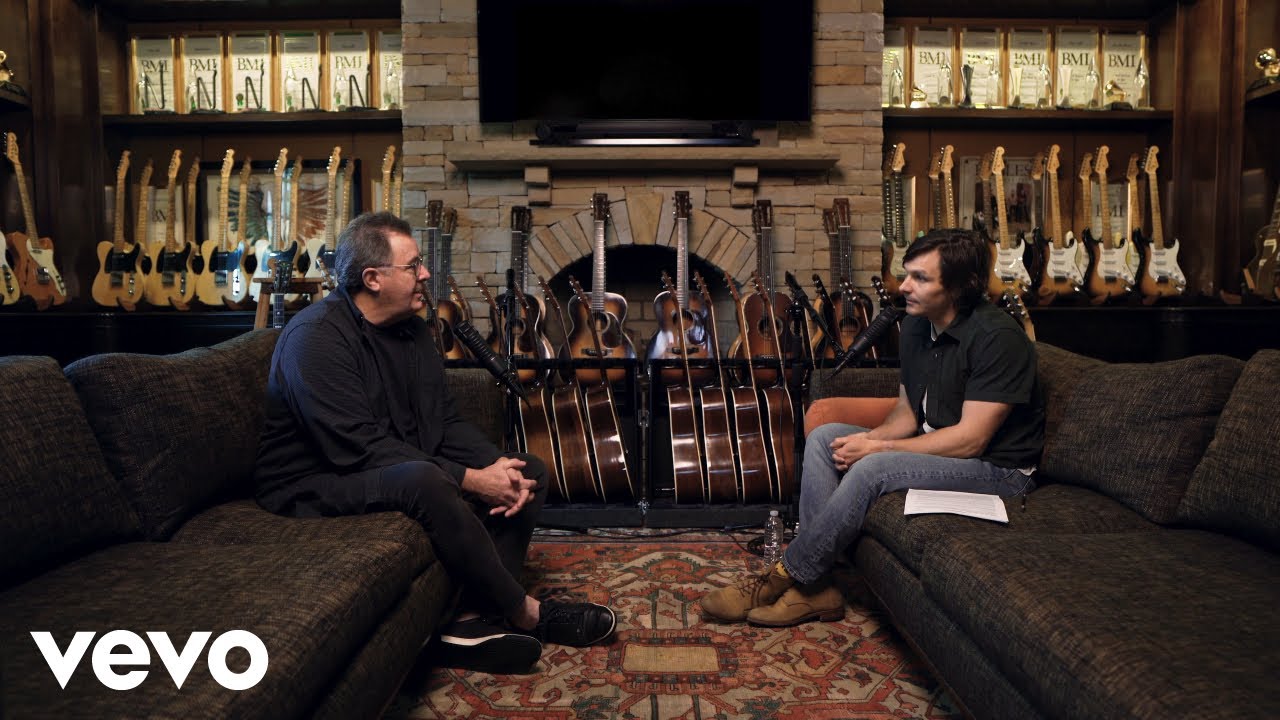
Gill — who’s preparing for his next run of shows with Eagles at Sphere — recently recounted the story of acquiring that Telecaster for the latest 50 Years From Home podcast hosted by Charlie Worsham, the Country Music Association’s 2024 Musician of the Year. A Telecaster was already on his wish list, thanks to the influence of several guitarists.
“I’d heard Albert [Lee] and I’d heard James Burton, Don Rich… and that’s the sound you wanted and you needed,” he tells Worsham.
As fate had it, Gill was back visiting in Oklahoma and stopped by Del City Music in Oklahoma City, owned by his friend Bob Woods. Woods was in the midst of trading guitars with Larry Briggs, a vintage dealer from Tulsa who owned Strings West Forever.
I said, ‘How much?’ He goes, ‘$450.’ It’s 1978; it might have been worth another two or three hundred bucks in the vintage world, but I said, ‘I’ll take it.’”
— Vince Gill
“Larry brought, like, 20 guitars in and he wanted to trade with Bob, and Bob had 10 or 15 guitars that he was going to trade back to Larry,” Gill recalls. “Larry had the white Telecaster in his pile and he traded it to Bob, and I watched the whole deal go down.
“And I grabbed that Tele and I started playing it and I go, ‘Oh boy…’ Larry left and Bob was kind of looking over what he’d taken in. And I said, ‘You just took in this old white Tele. You want to sell it?’ and he goes, ‘Sure.’
“I said, ‘How much?’ He goes, ‘$450.’ It’s 1978; it might have been worth another two or three hundred bucks in the vintage world, but I said, ‘I’ll take it.’ So I bought it, and then I had a great Telecaster…. It’s a really remarkable-sounding guitar.”

Gill — who subsequently turned down an offer from Fender to build a custom model based on the ’53 Telecaster — adds that, “Until the day he died, Bob had that music store, and I’d go see him every time I’d go back and visit home and buy things from time to time. And he’d say, ‘You S.O.B., you got to me on that Telecaster. You got to me so good. You got that so cheap.’
“I said, ‘Bob, I did not. It’s worth maybe a couple hundred bucks more than I paid for it.
“You ought to be proud that that guitar helped make me who I am, you know, and that’s been the definitive guitar in my life. Hell, you got me on that deal.’”
The image of the Telecaster on the Down at the Borderline cover testifies to the amount of use the instrument has received.
“A lot of the finish is gone,” Gill tells us. “They didn’t make very many white ones. Most of the old Telecasters were what they called butterscotch; the white ones are rare. I’ve only seen a handful in my life, few and far between. I sure as hell didn’t know that when I bought it, though.”
Gill used to keep a backstage pass affixed to the bottom of the body, which hid the most scratched-up area.
“I remember bringing that guitar to Nashville; I was doing a TV show probably around 1983 or ’84, something like that,” he says. “I had a couple of amps and I was getting ready to wire up and go play the show. The stage manager looked me up and down and looked at my guitar and said, ‘Is that a prop?’ I said, ‘You’ll find out.’ He said, ‘You already look too loud.’ I said, ‘I am.’
“I think if you look throughout the history of country music, the majority of artists are not [instrumentalists]. They’re singers. They might have a guitar and strum and play chords and rhythm in their songs and whatnot. That was pretty standard fare, to see a guy singing with a guitar in his hand.
I knew when I moved to Nashville, if I was gonna make a mark it would be because of my singing more so than my playing.”
— Vince Gill
“I knew when I moved to Nashville and started making country records that it wasn’t a world that was filled with tons of guitar players; if I was gonna make a mark it would be because of my singing more so than my playing. I just let people discover I could play as I did more and more. I wasn’t trying to shove it down their throats.”
Gill is releasing a new 50 Years From Home EP each month through August, commemorating the five decades since he left Oklahoma to pursue a career in bands — including Pure Prairie League, the Notorious Cherry Bombs, the Time Jumpers and, now, Eagles — and as a solo artist. He now has 22 Grammy Awards to his credit as well as the Country Music Association’s most recent Willie Nelson Lifetime Achievement Award. He returns to Sphere with Eagles on February 20 for two more runs of residency shows.
He recently he filled in for an ailing Joe Walsh, singing lead on “Rocky Mountain Way” and “Life’s Been Good” in his stead.
“That was a little daunting,” notes Gill, who will also begin a solo tour during June. “I tried. I did my best. The funny part was hearing me sing ‘Life’s Been Good,’ talking about driving Maseratis and trashing hotel rooms. That was humorous.”

