
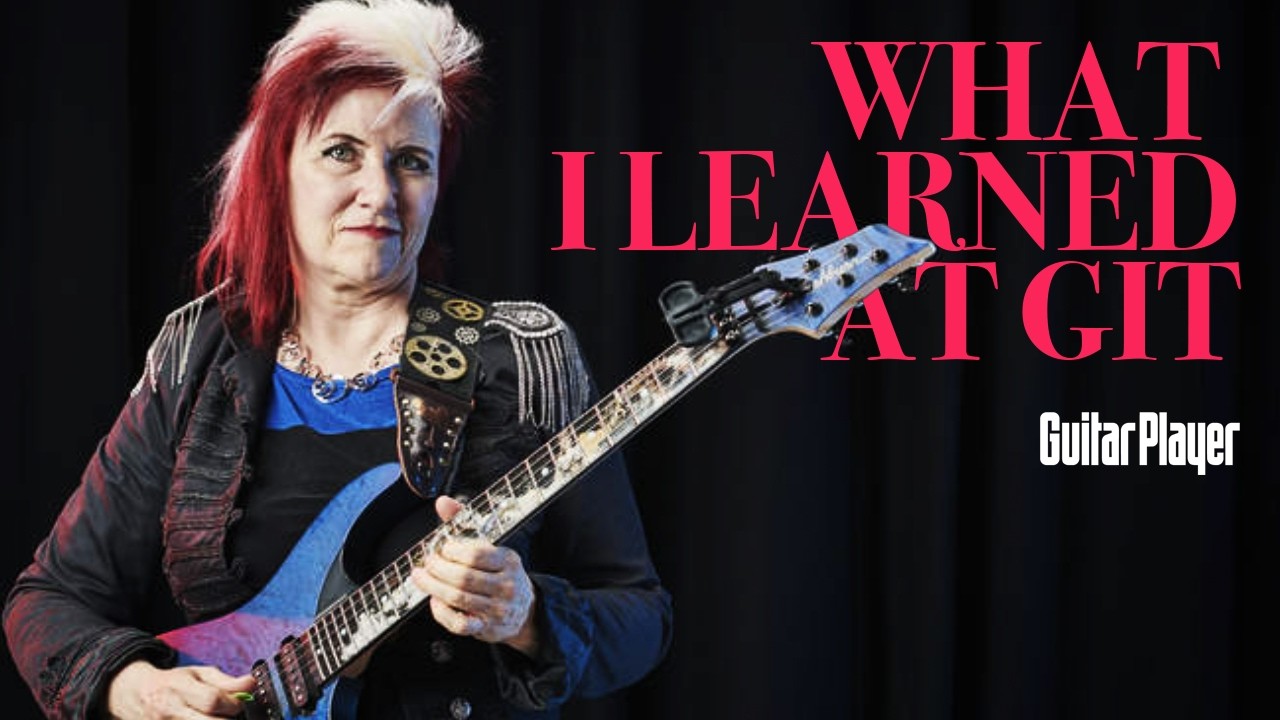
Jennifer Batten sure has been busy over the decades: monumental world tours with Michael Jackson, performing and recording with Jeff Beck and releasing a stunning portfolio of her own albums.
As one of the world’s most accomplished performers of two-handed tapping, Batten is well known in guitar education circles and hosts masterclasses and clinics all over the world. She has also released critically acclaimed instructional products, including Two Hand Rock (Hal Leonard), Ultra-Intervallic Guitar Licks and Truefire courses.
In 1979, Batten became the first woman to graduate from the Guitar Institute of Technology (GIT) in Los Angeles. Two guitarists made a huge impact on her playing during her time as a student there. One was fellow classmate Steve Lynch, whose two-handed tapping techniques were quite advanced.
The second was her lecturer, Joe Diorio, a pioneer in the use of wide intervallic ideas to create progressive and modern-sounding lines designed to push the boundaries in jazz and bebop. Batten worked tirelessly on making these sounds her own, and following graduation, she was appointed by the school as their first female instructor.

John has performed with Billy Cobham, John Williams, Frank Gambale, Paco Peña, Biréli Lagrène and Stochelo Rosenberg. John has also toured the world with both Carl Palmer and John Jorgenson. He wrote numerous tutorial articles for Guitar Techniques over two decades and now writes for Guitar Player and Guitar World. As a masterful fusion player (and two hand tapper), he's ideal for transcribing Batten's wonderful playing here.
For this bespoke Guitar Player tutorial, Batten has kindly contributed a trio of licks that evoke her time as a student at GIT. First, she looks at a Diorio-inspired line based around A minor pentatonic, but phrased in a non-bluesy way by using consecutive 4th leaps. Her second example is a bebop phrase in E minor, perhaps inspired by Joe Pass, who was also a regular visiting instructor at the school. And her final example showcases the tension and release produced by superimposing two major arpeggios a tritone apart, reminiscent of saxophonist Michael Brecker and pianist McCoy Tyner.
Batten plays and then analyses her three licks, explaining the underlying concept and the suggested harmonic application for each. While these ideas are undoubtedly inspired by jazz, she delivers them with an energetic high-gain rock tone that makes them shine. In keeping with the rhythmic backing, she slightly swings the 16th-note phrasing here, so pay attention to the feel and listen closely to pick up crucial articulation details.
We suggest learning these examples exactly as written to begin with. Once you’re fluent and familiar with each, you can get to work creating variations and transformations. You should try moving each idea through a selection of different keys, or perhaps try them over different chords. Aim to find each line in a different area of the fretboard, or consider changing the rhythm, tempo or time feel. Your aim here is to develop fluency so you can improvise in the moment, using each concept as inspiration for any number of musical ideas reacting to any musical scenario in real time.

Example 1: 4th based intervallic lick for A minor
Batten starts with an A minor line inspired by her teacher and mentor at GIT, Joe Diorio. The majority of the melodic material is based around A minor pentatonic scale (A-C-D-E-G), with just one additional 2nd interval (B) at the end of bar 2, allowing you to use this phrase in either Dorian (A-B-C-D-E-F#-G) or Aeolian scenarios (A-B-C-D-E-F-G).
The interest here is largely provided by the intervallic contour of the line. You'll begin with two chains of four consecutive notes, all positioned a perfect 4th apart (A-D-G-C, E-A-D-G), although the last note of each group is displaced down by an octave. As Batten suggests, keep each note distinct and clear by articulating with a roll of the finger, so that the notes don’t bleed together, especially when using distortion.

Example 2: Rock-meets-bebop lick for E minor
This second example moves to E minor and showcases how Batten reflects her bebop influences, albeit using an overdriven rock tone.
In the first bar, you're moving a six-note phrase up in octaves, derived from E minor pentatonic with an added second (E-F#-A-B-D). Toward the end of this opening bar, Batten starts to add more chromaticism, initially by surrounding the root (E), with the semitone below (D#) and scale tone above (F#), a common move in bebop, before descending chromatically between the root and 5th (B). She ends the line with a bluesy slide-and-bend combination, adding the b5 (Bb) into the mix.

Example 3: Ascending A and Eb triad licks for A7
This final example illustrates how Batten creates tension and release while outlining an A7 tonality (A-C#-E-G), initially by alternating between two major triads (A and Eb) situated a tritone (diminished 5th) apart.
First, she ascends A major (A-C#-E), before moving the same pattern up by one string and a fret, to play Eb major (Eb-G-Bb). When considering these intervals against A, this provides b5 (Eb), b7 (G) and b9 (Bb). The second bar is based around a decorated A major triad, descending chromatically from the 5th (E) to the major 3rd (C#), before approaching both the root and 3rd with the consonant scale-tone found above (2nd to root: B-A, 4th to 3rd: D-C#).

Batten reflects on her time at GIT
"From 1985, I taught a couple of different classes at GIT. One was to help kids stay up or catch up with the curriculum, but the class I remember most was called open counseling, which was basically a free-for-all where they could come in at random and jam and ask questions.
“Every single day I felt like I told them everything I know about music. I would go home exhausted, feeling like there was nothing left of me. So I worked really hard to always have something new to deliver.
“I also put a lot of effort into bringing in alternate approaches, like breaking up teaching with reading about two-headed aliens out of the Weekly World News. This is because I was aware that you just can’t focus on learning hour after hour without getting burnt out. So these little breaks were a way to provide a little time out.
“As it turns out, that is the perfect way to learn, because the brain can only truly focus on something new intensely for 15 to 20 minutes before it starts spinning out. Later I learned from a brain science course that when your mind goes onto something else after learning something new, it’s actually finalizing what you just learned in the background.
“I hit that realization when I learned a Joe Pass chord solo and brought it in. That is some pretty rich stuff to expect them to remember more than a few bars without having time to absorb it.
“After 20 minutes I could see the players eyes rolling back in their heads, so I knew they needed a break! So really, those classes were a combination of entertainment and teaching. I think that combination is the best way to learn anything in the end."

Michael Jackson - Beat It (the solo)
Here's Batten playing Eddie Van Halen's famous “Beat It” solo with the legendary Michael Jackson. She played lead guitar on all three of his world tours between 1987 and 1997.

