
Todd Rundgren has made a career of surprising and sometimes confounding his fans. The first time was in 1973, when he abandoned the three-minute pop stylings of hits like “I Saw the Light” and “Hello It’s Me” to create the prog-psychedelic album A Wizard/A True Star.
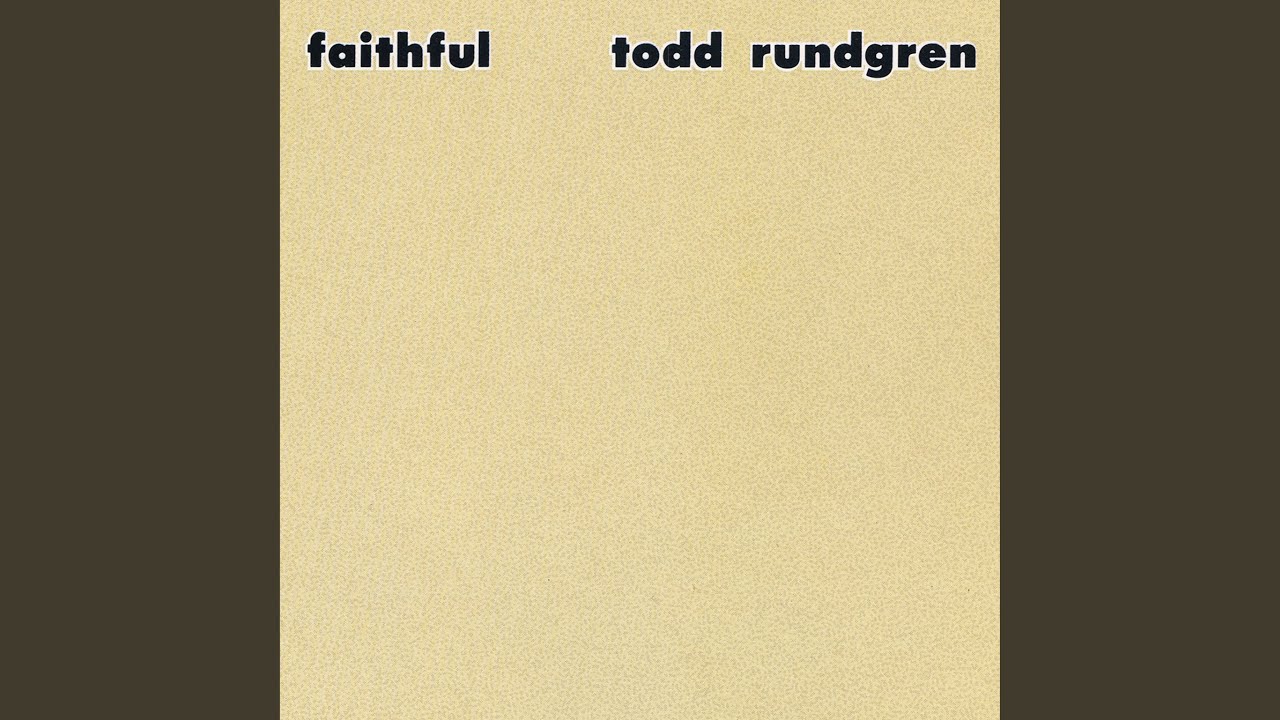
The second occurred three years later, when he released his seventh solo release, Faithful.
When I turned 18 and graduated from high school, that was for me a banner year. It was the year ‘Sgt. Pepper’s’ came out, so there were all kinds of cultural shifts going on.”
— Todd Rundgren
Coming 12 months after his progressive-rock album Initiation, Faithful raised Toddophiles’ eyebrows with its first side, which included covers of songs by the Yardbirds, the Beach Boys, the Beatles, Bob Dylan and Jimi Hendrix. True to the title, the tracks were recorded to sound as faithful to the originals as possible, right down to the electric guitar tones of "Happenings Ten Years Time Ago” and the layered harmonies of “Good Vibrations.”
For Rundgren, who produced the set and recorded it with members of his group Utopia — keyboardist Roger Powell, bassist John Siegler and drummer John “Willie” Wilcox — Faithful was both an exercise and a tribute.
“I was, in a sense, 10 years in the business at that point, and so much had changed,” he tells us via Zoom from his home in Hawaii. “When I turned 18 and graduated from high school, that was for me a banner year. It was the year Sgt. Pepper’s came out, so there were all kinds of cultural shifts going on.

“The most important thing from my standpoint was radio was not yet syndicated, before everybody was playing the same thing from the same playlist. So it was all local, and the local DJs and program directors had control over what got played.
“I remember listening to the radio in Philadelphia and you’d hear anything at all; it would be Judy Collins and then Bill Evans and a symphony orchestra and then the new Beatles single, then a blues record or something like that. There was a sort of freedom — and a lot of it was due to the Beatles, because they would constantly genre-hop and invent a new thing.
“So I wanted to pay tribute to that. That’s why all the songs are so different — a Bob Dylan song and a Beatles song, a Yardbirds song — all the bands I liked to hear. That’s also why it was all covers on side one, and why they were so sort of literal in terms of production. It was supposed to put you in a place 10 years prior.”
Two of Rundgren’s choices for Faithful — particularly the Yardbirds’ “Happenings Ten Years Time Ago” and the Jimi Hendrix Experience’s “If 6 Was 9” — also provided a fascinating primer in the evolution of his guitar approach and orientation. He had already imitated Hendrix on the track “Little Red Lights,” from his 1972 album Something/Anything?
“‘Little Red Lights’ is kind of my version of ‘Crosstown Traffic,’ and I use all of those Jimi techniques to make motorcycle noise and car rumbling noises and things like that.” He applied the same effect on Meat Loaf’s Bat Out of Hell when producing it in 1975 and ’76. “It was just a fun, goofy trick that doesn’t have anything to do with playing — just kind of noise you make. It became a signature thing for Jimi Hendrix.”
In those days there were kind of two camps. I came out of the Yardbirds camp — the Eric Clapton, Jeff Beck kind of things — and you played a Gibson guitar.”
— Todd Rundgren
But Rundgren says Hendrix wasn’t his initial influence.
“In those days there were kind of two camps. I came out of the Yardbirds camp — the Eric Clapton, Jeff Beck kind of things — and you played a Gibson guitar. I played a Les Paul, which had no wangle bar on it — no tremolo tailpiece on it. Jimi played a Stratocaster and made full use of the wangle bar. I personally didn’t have the sense of freedom that Jimi Hendrix had in the sense that he might not play the same thing every time.
“A lot of what I was listening to before that were kind of classical guitar solos that Beck and Clapton would play, and you would learn those literally in the same way you would learn every George Harrison guitar solo — literally. They’re like primers in guitar playing; you’d learn how to play this melody and be expected to play it at the drop of a hat.”
That was no easy feat, he adds.

“One of the seminal listening moments in my lifetime was when I heard ‘Shapes of Things’ on the radio. The way Jeff Beck played guitar wasn’t, like, playing guitar; it was imitating a sitar guitar, all weird kinds of intervals and weird kinds of pushes and trills and things like that.
“And I was totally freaked out: ‘This is a guitar? Wait a minute!’ It was one of the things that kind of cemented my love of the instrument: ‘You can do that with it as well?’ So, yes, I strove, like everyone else did, to try and figure out how that was done.
The Bluesbreakers album was also sort of a revelation, because nobody had completed a transformation like that in the way Eric Clapton had.”
— Todd Rundgren
“And ‘Happenings Ten Years Time Ago’ was kind of like the same sort of thing. The remarkable thing was they did them in different studios. It wasn’t like a thing that they worked on and developed; they just extemporaneously would start flipping the tape around and splicing solos together and all sorts of nonlinear ways of creating a texture that was sort of mysterious, in that you weren’t sure what the melody was. Little fleeting bits of melody would come in and out of drones and whistles and all kinds of other effects.
“The Bluesbreakers album was also sort of a revelation, because nobody had completed a transformation like that in the way Eric Clapton had in his so-called woodshedding period. He went away as one kind of guitar player and came back as a completely different guitar player.
“And the combination of how he got that sound and the soloing on the record — suddenly that was my new god. Now I had to learn every single one of those solos and strive for that tone and play that guitar, the Les Paul.”

On his way to Hendrix and “to start thinking in other ways,” however, Rundgren crossed paths — literally, in this case — with Hendrix just once.
Living in New York during the late ’60s, he was a regular at Steve Paul’s The Scene, a famous no-alcohol club that hosted a who’s who of burgeoning rock bands. It was here Rundgren met brothers Hunt and Tony Sales, the drummer and bass guitarist, respectively, who backed him on his first two solo albums after he departed Nazz, the Philadelphia-based quartet he formed in 1967.
“It was notorious for having jam sessions after the regular show,” he recalls of The Scene, “so every night there’d be a jam session. That would often be the reason why you were there. Some nights you’d get up and jam; some nights you’d just watch.

“I was there one night and some kind of jam was going on. It might’ve been Duane Allman and Buddy Miles. If Duane’s got a guitar in his hands and he’s onstage, nobody gets a note in edgewise. He just never stops. He ignores every other guitar player. It’s not really a jam session when he was there.
His Afro might have brushed my shoulder. That probably would’ve been my only opportunity to meet him.”
— Todd Rundgren
“I was leaving one of these things, and as I’m walking out this kind of short guy with a big Afro walks by. I didn’t pay attention to who it was, and I heard later it was Jimi Hendrix. I guess the reason I missed him was I expected him to be taller. He was a relatively petite guy; even with his hair he wasn’t as tall as I was.
“So I guess I was expecting somebody else. We just walked right by each other. His Afro might have brushed my shoulder. That probably would’ve been my only opportunity to meet him.”
Rundgren, of course, has stayed busier than most artists since the release of Faithful. That includes touring; after a stretch last year as part of the Burt Bacharach Songbook in Concert trek, he’s heading out with his own Damned If I Do Tour, starting June 11 in St. Charles, Illinois, and running through July 19.
He’ll be joined by his regular crew of Kasim Sulton on bass, Prairie Prince on drums, Gil Assayas on keyboards, Bruce McDaniel on guitar and Bobby Strickland playing horns. The itinerary and other information can be found at todd-rundgren.com.

