
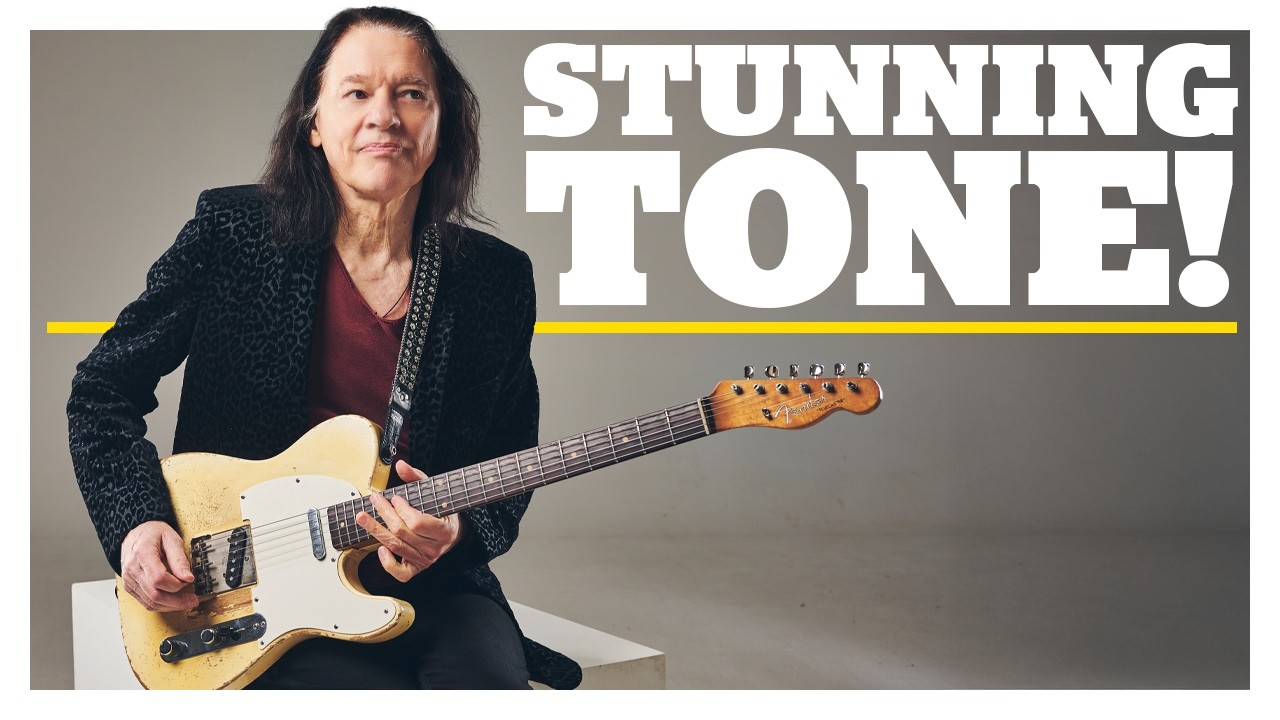
Mike Bloomfield may not have become a household name like many of the guitarists he shared stages with during the cultural boom of the 1960s, but his legacy has never been forgotten by Robben Ford. The underrated player was firmly in his mind in the early ‘90s when a cream-colored Telecaster made its way, unexpectedly, into his hands and heart.
Bob Dylan’s former right-hand man, Bloomfield, was the guitarist who flanked the folk star on the fateful day he went electric at the Newport Folk Festival in 1965, with a similarly cream-colored Tele.
It saw the Tele dubbed as the guitar that killed folk. Bloomfield used it on Dylan’s Highway 61 Revisited album, particularly on the choice cuts “Like A Rolling Stone” and “Tombstone Blues”, and later on The Paul Butterfield Band’s debut record.
It's one of those mystical instruments that rock folklore produces, and it was recently given a tribute reissue by Eastwood Guitars. It has an undeniable aura to it, and Ford knows that all too well.
“I walked into a music store in San Francisco, when we were on the road, to buy some guitar strings,” Ford tells Guitarist of his unexpected love affair with the Tele. “I looked to my left and [the Tele] was sitting there. And I am just drawn to it.
“Mike Bloomfield was playing one of these. It was a ’63 [the neck is stamped August ’63, and the body is hand-dated to October], but it looked exactly the same, you know? And I [must have] thought, ‘That’s the guitar Mike Bloomfield played. I need to at least check it out.’
“I walked over, started playing it, and I just had to buy it. So I did.”
It didn’t take long for the guitar to get some use in the studio, with Ford putting it through its paces on 1993’s Mystic Mile, and it continues to feature prominently. See his latest record, Two Shades of Blue, which also serves as a tribute to the late Jeff Beck, for evidence. It can be heard on “Jealous Guy” and “Perfect Illusion”.
As he told Vancouver-based journalist Steve Newton way back in 1993, Bloomfield's playing has been a fundamental part of his guitar education, so it was no wonder that Tele stood out so vividly in a guitar store around that same time.
“San Francisco was only two hours away,” the Ukiah-raised guitarist said. “When the whole ’60s musical revolution occurred, I used to see everybody and their uncle in San Francisco. Hendrix, Cream, Albert King, B.B. King, Paul Butterfield—everybody.
“[The blues was] the first thing that ever really excited me about being a guitar player,” he continued. “I think when I was around 13 or 14 I heard the Paul Butterfield Blues Band’s first album, with Mike Bloomfield on guitar, and that’s when I realized that I wanted to be a guitar player.”
Elsewhere, Ford has reflected on what went wrong during his famed disaster tour with George Harrison, a gig that was meant to be his big break. It doesn’t however, take the crown for the wierdest gig he’s ever played. Kiss gets that honor.

