
It’s no secret that Joe Bonamassa has assembled one of the most formidable electric guitar collections in modern blues.
Over the years, the guitarist has acquired some remarkable pieces: Tommy Bolin’s Les Paul, Lowell George’s once-lost Dumble Super Overdrive, a “museum-grade” Martin acoustic and a small army of vintage Gibson Les Paul ’Bursts.
But when it comes to the purchase that means the most to him, Bonamassa doesn’t hesitate.

Speaking recently on the No Cover Charge podcast, the bluesman revealed that his favorite acquisition isn’t the rarest or most valuable guitar in his vault — it’s the one he dreamed about as a kid.
My favorite purchase was the one that meant the most to me.”
— Joe Bonamassa
“My favorite purchase was the one that meant the most to me,” he says. “The Howard Reed Strat. That was the one that meant the most because I had that guitar on my wall when I was 10 years old.
“Some people had Farrah Fawcett — I had the Howard Reed Strat.”
Reed isn’t exactly a household name. The guitarist briefly played with Gene Vincent and the Blue Caps in the 1950s. But his Stratocaster occupies a unique place in Fender lore.
Finished in custom black by Fender, it stands apart from the standard Brown Sunburst Stratocasters offered at the time.
“I will definitely say it’s the first one with a factory black custom color finish,” Bonamassa told Guitar Player in our January 2024 issue. Reed ordered the guitar from McCord Music Company in Dallas in 1955. “There are three definitive pictures from the late ’50s of Howard Reed playing the guitar.”
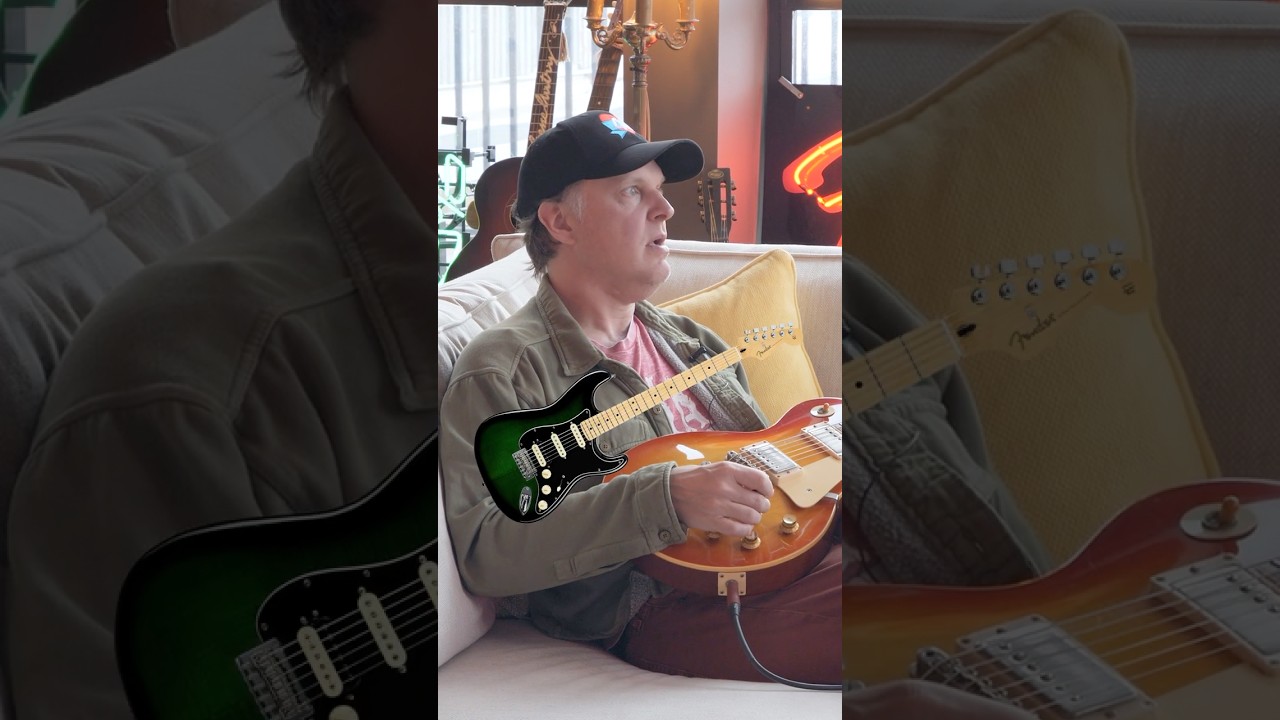
Bonamassa finally acquired the instrument in 2011 — on a day he remembers vividly.
“I [bought it] the day that I played the Ryman for the first time,” he says, referring to Nashville’s historic Ryman Auditorium. “I couldn’t believe I was in the same room as it. I had a reasonable expectation of what a Strat weighs.”
What he discovered was unexpected.
The Reed Strat tips the scales at 10 pounds — roughly three pounds heavier than a typical Stratocaster. Decades of heavy use have also left their mark, including significant wear on the back where the finish has been rubbed away through years of playing.
“It’s heavy,” Bonamassa admits, “but it ultimately represents my journey in the music business more than any of the guitars I can pull out.”


The guitar’s significance goes back to Bonamassa’s childhood.
“It was a Guitar World centerfold and I still have the original poster,” he says. “I had it tacked on my wall, and I thought it was the coolest Strat on the planet. I never thought that [25] years later I’d be picking it up.”
It was a ‘Guitar World‘ centerfold and I still have the original poster. I had it tacked on my wall, and I thought it was the coolest Strat on the planet.”
— Joe Bonamassa
Today the instrument has come full circle. Bonamassa has loaned the guitar to the museum at the Ryman, where it’s displayed as part of the venue’s tribute to Nashville’s musical legacy.
And while the Reed Strat may be the most meaningful guitar he owns, Bonamassa has recently been reflecting on his gear collection more broadly — sharing advice on the best way to mic a guitar amp and revealing how the Los Angeles wildfires prompted him to rethink his gear-hoarding habits.
Ironically, though, the guitarist who most shaped Bonamassa’s playing wasn’t known for a Strat at all. His biggest inspiration built his reputation with a Telecaster.

