
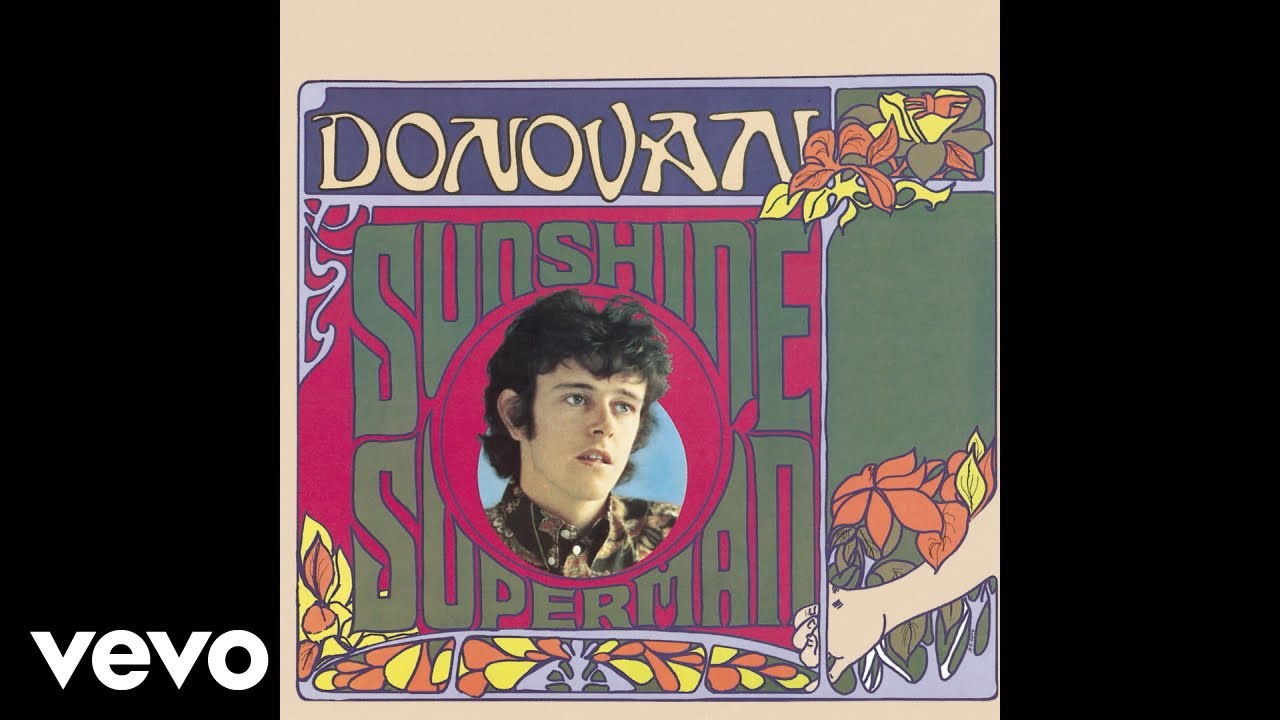
One of the earliest examples of psychedelic rock came courtesy of a folkie, of all people. Donovan, the Scottish troubadour, delivered the genre to 1966 rock fans via Sunshine Superman, a Trojan horse as it were for psychedelia’s entry into the mainstream.
When Sunshine Superman was released in the U.S. in September 1966, it not only topped the Billboard charts, it made Donovan a superstar and introduced elements of world music, Celtic mythology and Swinging London into the mainstream pop universe. The inspiration for it came from his girlfriend, Linda Lawrence.
“It's very important to remember that love songs are very important,” Donovan says about his extraordinary musical achievement, “and the love story of Linda — my muse and sunshine supergirl — and mine is all over this album.”

The story goes that he and Lawrence broke up prior to the album’s creation, and that his longing for her fueled its songs. Apparently so did drugs: “Sunshine” was a popular 1960s term for LSD.
I was known as a folkie, yes, but my parents always played high-quality jazz at home, so that style was with me, as well.”
— Donovan
Produced and recorded by Mickie Most in London at EMI and at Columbia Records in Hollywood, Sunshine Superman was Donovan’s most successful album, peaking at number 11 on the U.S. charts and remaining on Billboard’s Top LPs chart for six months. (Due to contractual disputes, the album wasn’t released in the U.K. until 1967.) Among the album’s tracks are two that became instant hits: “Sunshine Superman” and “Season of the Witch.”
So how did a folkie come to be a psychedelic pop artist?
“I was known as a folkie, yes, but my parents always played high-quality jazz at home, so that style was with me, as well,” he tells Guitar Player. “I was playing ‘Sunshine Superman’ in a kind of funky Latin-jazz way, and Mickie Most said, ‘That's the single! What do you hear on it?’
“I said, ‘A harpsichord, congas, bass and a jazz guitar.’
“I didn't have a band, you see, so Mickie introduced me to the jazz arranger John Cameron, and John said, ‘I love the song. Don't worry — I know what you need.’”
Among the musicians hired for the London session were Jimmy Page, who played the repeating guitar lick using a volume pedal for variation in attack, and John Paul Jones on bass. The two future members of Led Zeppelin would also feature on Donovan’s 1968 proto–heavy metal masterpiece, “Hurdy Gurdy Man.”
As for “Season of the Witch,” Donovan explains that its creation owes a lot to Scottish folk guitarist Bert Jansch.
“Bert Jansch taught me the descending pattern of the Am down to the G bass to the F# bass to the F bass, and also the shape of the D9 chord,” he explains. “The D9 helped me crack the song.”

The tune took shape in Jansch’s kitchen, where guests included his collaborator John Renbourn and the folk musician Shawn Phillips, who joined in, playing lines on a 12-string guitar.
John said that I played ‘Season of the Witch’ for seven hours straight, all night and into the dawn. I didn't know what I had.”
— Donovan
“Bert always had players from all over Europe stay with him,” Donovan explains. The folk singer doesn’t say if drugs were involved, but his memory of the night comes courtesy of what Renbourn told him.
“John said that I played ‘Season of the Witch’ for seven hours straight, all night and into the dawn,” he reveals. “I didn't know what I had. I didn't know that I had something that would last this long.”
“Season of the Witch” is one of the album tracks cut in Hollywood. As Donovan explains, he and Phillips picked up some local musicians to help them achieve the rock-combo sound they wanted. Rather than playing acoustic guitar as he usually did, Donovan played electric on the track.

“When we recorded it, I used my first electric guitar — a white Telecaster — and started chunking the chords. Mickie said, ‘That's it!’ Then we added the spooky, Dracula-movie organ, bass and drums.
“Mickie said, ‘Listen, Clive Davis in New York just gave me three million dollars to record three British bands.’”
— Donovan
“It's funny — the engineers wouldn't let us turn up the bass because the signal was going into the red.”
Most changed their minds by invoking the name of Clive Davis, then president of Columbia Records, which owned Epic, Donovan’s U.S. label.
“Mickie said, ‘Listen, Clive Davis in New York just gave me three million dollars to record three British bands. Do you think if I called him and asked for a little bit more bass that he'd give it to me?’
“The engineers looked at each other and said, ‘Okay, Mr. Most, you can turn up the bass.’”

Donovan has said he believes his greatest contribution to music was the idea of fusing different styles. But while Sunshine Superman stands today as an early example of his achievement, he explains that he was aiming for a higher goal.
“The idea was this, and it was very simple — bring all world music together,” he says. “I wasn't in one genre like all the other bands at the time. I didn't have to do just jazz, blues or pop.
“I thought, If we're really going to be talking about unity, consciousness, meditation, peace, brotherhood and the coming together of all nations, this was going to have to be done musically.
“That was the concept.”
