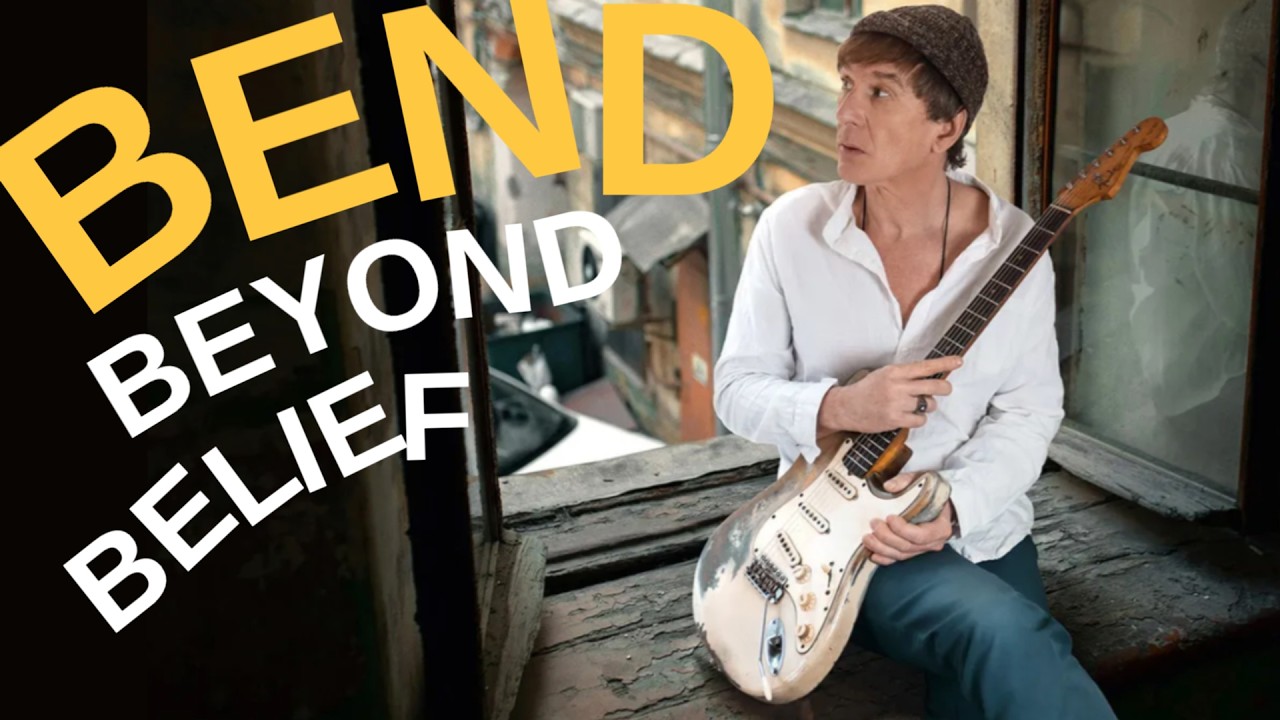
Marcus Deml is a Stratocaster-wielding virtuoso with a massive tone and amazing technique to boot. Our sister title Guitar World called his last album, Pure, "among the most breathtaking instrumental releases you’ll hear in 2025."
Marcus attended the legendary GIT (Guitar Institute of Technology) in Los Angeles, studying with Paul Gilbert, Scott Henderson and Frank Gambale, who inspired him to woodshed for up to 12 hours a day. The hard work paid off as Deml has since recorded on more than 500 albums as a session musician. He’s also helped found the band Errorhead while maintaining an impressive solo career.
Deml’s unique Stratocaster-based electric guitar playing style has a balance of energy, excitement and intent that nods toward the blues-rock influences of Gary Moore and Jimi Hendrix. There is also harmonic sophistication and phrasing intelligence reminiscent of Allan Holdsworth, Steve Lukather and Larry Carlton.

Marcus has graciously contributed this video article based on his dynamic and expressive approach to string bending. Each idea is derived from the the E Major scale (E-F#-G#-A-B-C#-D#), although he chooses to use this collection of notes to highlight either C# Aeolian (a minor sound) or A Lydian (a major sound).
Once you are familiar with each concept or technique, aim to come up with a similar idea of your own, perhaps modifying the initial idea to fit a different chord or rhythmic feel. Creating variations is a very powerful strategy for integrating new ideas into your own style. Enjoy!

John has performed with artists as diverse as Billy Cobham, John Williams, Frank Gambale, Paco Peña, Biréli Lagrène, Stochelo Rosenberg and Carl Verheyen. John has toured the world with both Carl Palmer and John Jorgenson and has written for Guitar Techniques and Guitar World. His appreciation of blues and fusion guitar makes him ideal to transcribe Deml's playing
Example 1a: A major bending lick
This first example features A Lydian (the fourth mode of E major). Marcus skilfully implies this by defining an A major 7 arpeggio (A-C#-E-G#), although he omits the perfect 5th interval (E). Extra interest is provided by bending up to the major 7th (G#) from the tone below (F#), the major 6th.
Marcus resolves the phrase to this note, adding judicious vibrato and expression. He then moves the arpeggio motif through other possible choices in this tonality. If you're looking to use bends to get in and out of melodic notes, this is a great approach to explore.

Example 1b: C# minor bending lick
There’s a definite David Gilmour influence to this second variation, based around a C# minor tonality. Here, you're bending between the b7 (B) and the root (C#), and then between the b7 (B), and major 2nd (D#).
In total, you're bending four semitones (a major third), so preserve your hands by allocating the heavy lifting to a turn of the forearm, reserving finger manipulation to intonation fine tuning. Fretting the notes further toward the fingerprint, rather than the fingertip, will push unwanted bass strings out of the way, and give added purchase against the tension of the strings pushing against your bends.

Example 2: Arpeggio based lick with bends
Here Marcus is mixing C#m9 arpeggio ideas (C#-E-G#-B-D#) with pentatonic blues-based material. It includes a great Hendrix-inspired exchange bend in bars 2–3 that swaps between the second and third strings. Mixing legato phrasing, sweeping, bending, sliding and rapid pull-offs, he creates a cohesive musical line that typifies his entire style.

Example 3: A Lydian bending lick
Here, Marcus highlights A Lydian. He reinforces this by focusing on its two most crucial notes: the major 7th (G#), and the augmented 4th (D#). Notice how he uses his first finger for the semitone bend between G# and A on the second string.
He then shifts position when moving to the first string so he can use his stronger third finger for the tone bend between C# and D#. Pay attention to all the articulation nuances as the variety of vibrato, the micro pauses, rakes and attack all provide character and individuality.

Example 4: C# minor blues phrasing with b5
You're in blues territory here: Marcus integrates slides, bends and hammer-on and pull-offs for a snappy C# minor blues line (C#-E-F#-G-G#-B). Blues guitar licks are often associated with two-notes-per-string shapes, favoring the first and third fingers. However, this line illustrates the potential to play more notes on a single string and how to use each and every finger.
Another takeaway here is the value of knowing the guitar fretboard well. Deml fluently connects multiple scale positions with complete authority and control.

Example 5: Allan Holdsworth–inspired playing
Marcus begins this Allan Holdsworth–inspired collection of lines with tremolo bar scoops, initially derived from chromatically decorated C# minor vocabulary. Toward the end of the phrase, he leans on legato ideas derived from the symmetrical augmented scale (C#-E-F-G#-A-C).
This scale, one of Allan’s favorites, is built on the alternate intervallic structure of minor third and minor second (three frets, one fret, three frets, one fret, etc.). Marcus configures these three-notes-per-string to facilitate fluidity and speed with hammer-ons and pull-offs. You can also configure this as a two-notes-per-string diagonal pattern, a favorite device of another terrifyingly good player, the late Shawn Lane.

Example 6: Three-note pattern with bending
To close, here's a rapid-shifting pentatonic lick connecting the same phrase in three different octaves, negotiating these transitions with assured and aggressive slides. The initial demonstration is played at a slow speed and then increased in tempo. While the example uses C# minor pentatonic throughout (C#-E-F#-G#-B), it ends with an idiomatically appropriate C7#9 (C#-E#-G#-B-Dx), otherwise known as the Hendrix chord.

Marcus Deml in action
Marcus Deml: “Persecución”
Featured on Marcus Deml's latest album, Pure, “Persecución” is a shining example of his uptempo blues-rock playing that highlights the precision in his fast runs and the expression of his string-bending technique.