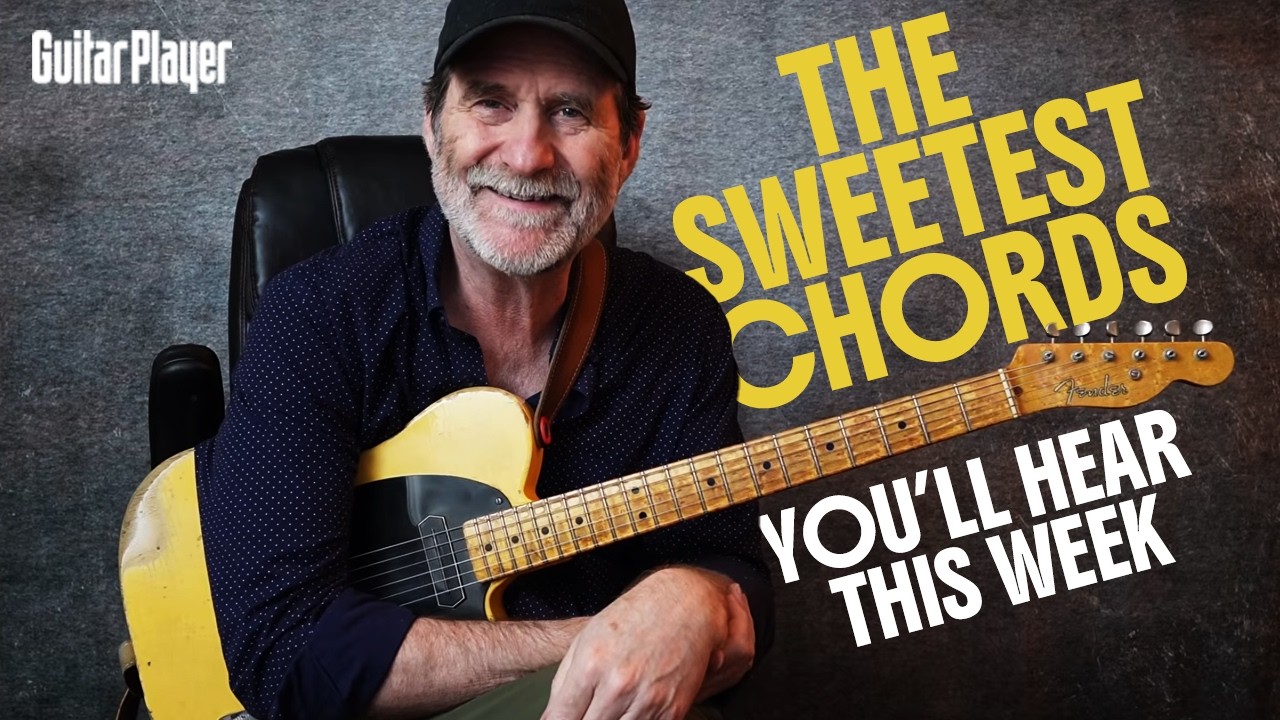
Tim Lerch is a phenomenal guitarist. Specializing in jazz and blues, he leads his own trio and is a long-time member of Pearl Django, one of the most respected groups in the Hot Club style popularized by Django Reinhardt.
Lerch is an absolute master fingerstyle guitarist who is supremely comfortable in duo and solo settings. He’s had the benefit of studying one-to-one with legendary jazz guitarists such as Joe Pass, Joe Diorio, Lenny Breau and Ted Greene, the American fingerstylist and author of the classic reference book Chord Chemistry.
His lesson focuses on some of his favorite chord moves. In it he covers chord forms for minor and major II V I sequences, use of half-whole and diminished based chords, sophisticated chromaticism and melodic approaches within chord changes.

John has performed with Billy Cobham, John Williams, Frank Gambale, Paco Peña, Biréli Lagrène and Stochelo Rosenberg. John has also toured the world with both Carl Palmer and John Jorgenson. He wrote numerous tutorial articles for Guitar Techniques more than two decades and now writes for Guitar Player and Guitar World. As a masterful jazz and fusion player, he's ideal for transcribing Tim's wonderful playing here.
As there's a lot to take from this article, start by learning the examples as written, guided by Tim’s clear video demonstrations on his 2000 Fender Custom Shop ’51 Nocaster Relic Reissue. Once you’re familiar with each concept, explore moving them through a selection of different keys, or perhaps find alternative fingerings on different sets of strings.
Once you’ve finished the lesson, put these new shapes and concepts to work in the music you play. Pick a familiar tune — perhaps a jazz standard or a blues-based piece — and explore some of ideas within the context of playing real music. Don’t worry if things feel a little contrived at first. Be patient, play these ideas little but often and you’ll be using them naturally and easily in no time at all.
Example 1a: Dm7b5 phrase
Tim begins by using the same voicing in different ways by moving in parallel. Here you're using the initial chord form to spell out a Dm7b5 (D-F-Ab-C), albeit with some decorative melodic motion with the highest voice on the second string.

Example 1b: G7#9b9#5 phrase
By moving this exact voicing up a minor 3rd, physically raised by three frets, you can use the exact same chord form along with melodic decoration to outline a G7#9b9#5 chord (G-D-D#-F-Ab-A#), the V7 in the chosen key of C minor.

Example 1c: Cm(maj7)/A phrase
This time you're shifting up by a major 3rd, four frets in distance to give you the Im (the minor one chord). Specifically, you're outlining Cm6/9 (C-Eb-G-A-D), although the melodic extensions give you all of these intervals plus the mysterious sounding maj7 (B).

Example 1d: Dm7b5 - G7#9b9#5 - Cm(maj7)/A
Finally, Tim connects these voicings together to create one cohesive musical phrase, neatly outlining a minor II V I in the key of C minor.

Example 2: Dmadd9 - Bbmadd9 - Cmaj7
For the second example, Tim’s using a beautiful wide-spaced voicing featuring a semitone cluster situated between the third and fourth strings, and maintains cohesion in terms of shape.
Initially he positions this chord at the 10th fret to create Dmadd9 (D-F-A-E), functioning as the IIm chord in the key of C. He moves this down four frets to spell out Bbmadd9 (Bb-Db-F-C), although this could also be reinterpreted as G7sus(#9b5), to provide an altered V7 sound.
Finally, he moves this voicing down a semitone, albeit with a modified root, for a resolving Cmaj7 (C-E-G-B).

Example 3: Ebmaj9/G - Bmaj9/D# - Abmaj9/C - D7#9 - G6
For this cinematic progression in the key of G, Tim’s using a shifting Major 9th voicing with the 3rd positioned as the lowest note.
Initially he selects both Ebmaj9/G (Eb-G-Bb-D-F), and Bmaj9/D# (B-D#-F#-A-C#), which when considered along with the destination key of G major gives a set of harmonic changes associated with the legendary tenor saxophonist John Coltrane.
However, Tim breaks from this pattern for the second bar, dropping down to Abmaj9/C (Ab-C-Eb-G-Bb), and D7#9 and b9 (D-F#-A-C-E#/Eb), to provide a clear V7 to I (D7-G) resolution to end the phrase.

Example 4a: Em7 - A/Bb - Dmaj9
For the next set of transferable shapes, Tim once again is outlining a IIm7 V7 Imaj7 progression. Here, you're in the key of D major (D-E-F#-G-A-B-C#), and both the IIm7 (Em7) and Imaj7 (Dmaj9) come directly from this note pool. The V7 adds tension, derived from the A half-whole diminished scale (A-Bb-B#-C#-D#-E-F#-G).
In this example it’s possible to think of the V7 from two perspectives, either as an A triad with a flattened 9 (A-C#-E-Bb), or as a Bb diminished triad with a major 7th (Bb-Db-Fb-A), exactly the same notes, just with enharmonic respellings.

Example 4b: Em7 - A13b9 - Dmaj9
The beauty of the half-whole diminished scale is in its symmetry, so here you can see the exact same voicing transposed down by a minor third, or down three frets. As the scale repeats via this intervallic leap, you stay completely in the scale but highlight a different selection of notes.

Example 4c: Em7 - C(b9) - A7#9 - Dsus2
Similarly, you can also move up by a minor third, this time up three frets, to allow the use of C(b9) (C-E-G-Db) as the V7. Again, this is possible as all the notes are coming from the host A half-whole scale (A-Bb-B#-C#-D#-E-F#-G).

Example 4d: Sophisticated V-I moves up the fretboard
In this example, Tim shows all four possible resolutions for this symmetrical voicing.

Example 4e: Dm7(maj7) voicings to imply A7alt, resolving to Dmaj9
Again, Tim connects each A7alt voicing — consider how the notes also create variations of Dm7/maj7 — with additional melodic activity on the second string before finally resolving to a sweet-sounding Dmaj9.

Example 5a: Cm9 - F7alt (descending series) - Bb6/9
This collection of connected examples feature a useful voicing for spelling out an altered dominant 7th V7 chord. As Tim points out, the initial form can be considered from multiple perspectives, such as the 3-b7-#9-#5-R of D7alt, or the b7-3-6-9 from Ab13.
Here however, he suggests not worrying too much about the specific intervals within each selection; simply move the chord form in descending parallel motion to create a smooth connected chord melody. Use this voicing to create consonance, tension and release while traveling between Cm9 (IIm), F7alt (V7) and Bb6/9 (I).

Example 5b: Cm9 - F7alt (descending series) - Bb6/9 (variation)
Your second ambiguous shifting example introduces some chromatic sliding between these F7alt voicings.

Example 5c: Cm9 - F7alt (descending series) - Bb6/9 (variation)
For the third variation, Tim introduces ascending motion, although again sticking to the same shape moved wholesale along the fretboard.

Example 6: Blues groove in A minor
This example uses small first inversion triads (3-5-R), derived from the D major scale (D-E-F#-G-A-B-C#). Tim initially demonstrates this by harmonizing the entire scale using these three-note voicings, following this specific pattern: D-Em-F#m-G-A-Bm-C#dim-D.
The transcribed musical example below uses a selection of major and minor options but juxtaposes these sounds over an A bass note. This creates the modal tonality of A Mixolydian (A-B-C#-D-E-F#-G), perfect for creating melodic chordal passages in an A blues progression. Make sure to observe all the expressive slides and embellishments, as these really help to convey the bluesy feeling to this simple but highly effective chordal concept.

Example 7a: Parallel 13th chord shapes with the blues scale
Tim's final concept sticks with a static, grooving bluesy theme, although here you're shifting to a Bb7 tonality (Bb-D-F-Ab).
For the first pair of musical examples, Tim begins by defining an effective voicing for Bb13, although he’s selectively focusing on just the b7, 3, 6 and root (Ab-D-G-Bb). The trick here is to move this voicing in parallel along the top four strings, harmonizing a blues scale (R-b3-4-b5-5-b7), to create riffs, licks and lines, like a section in a swinging big band.

Example 7b: Stacked 4th chord shapes with the blues scale
For the final examples, Tim uses the same type of movement, but this time he selects a quartal voicing, constructed by stacking perfect 4th intervals, initially providing the 6, 9, 5 and root of Bb (G-C-E-Bb), but again moved in parallel through the Bb blues scale (Bb-Db-Eb-Fb-F-Ab).


