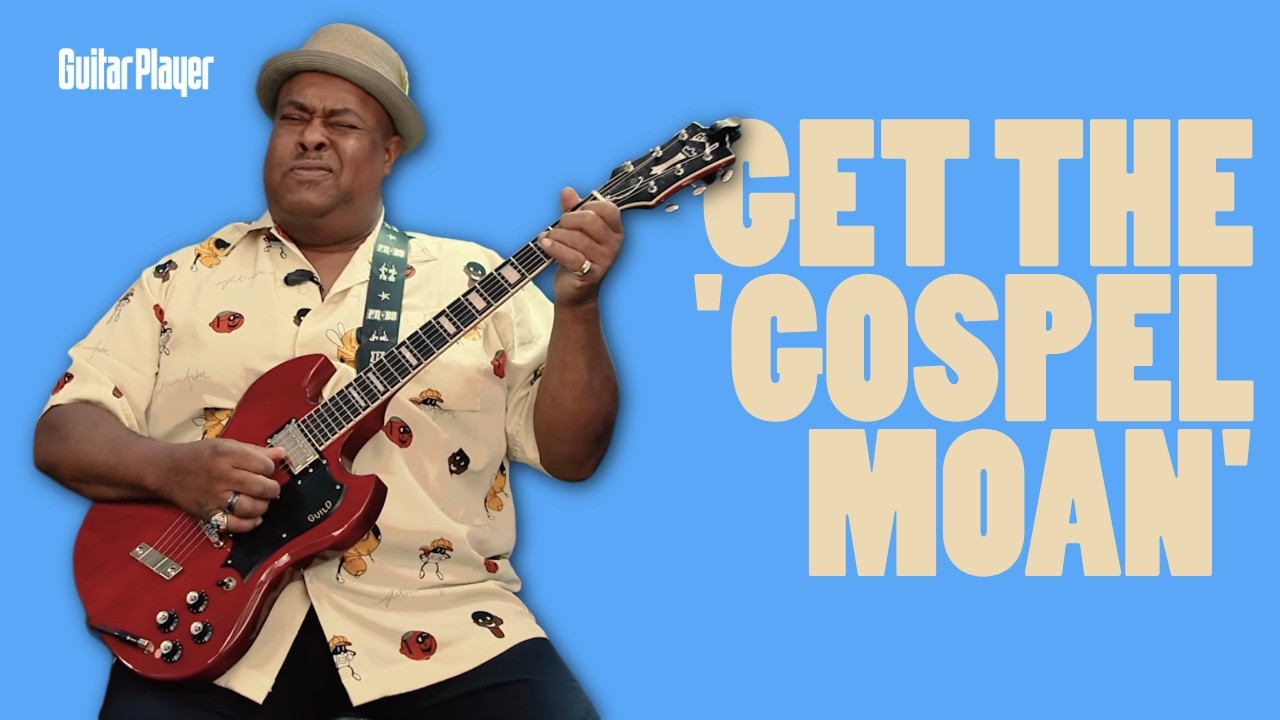
Few modern blues players embody tradition and authority like Larry McCray. For more than three decades, the Rust Belt blues shouter has carried the torch for soul-drenched, high-voltage electric blues. He has drawn deeply from the well dug by the great masters while maintaining a voice on electric guitar that’s unmistakably his own.
His last release produced by Joe Bonamassa and Josh Smith, Heartbreak City, mixed raw blues with vintage soul, southern grit and a road-worn vocal. It is a powerful reminder that authentic blues guitar — rooted in feel, phrasing and storytelling — still hits hardest when it’s played from the heart.
McCray’s lineage is unmistakable, with his singing and playing carrying the DNA of the “three Kings”: B.B., Albert and Freddie. His vocal-like phrasing and commanding use of space and vibrato are straight from B.B’s playbook, while the stinging attack, wide tone and one-and-a-half-step bends come from Albert. Like Freddie, McCray isn’t afraid to dig in hard, but he also carries the fire of Hendrix, mixed with a deep pocket that calls to mind the southern grooves of the Allman Brothers.

Steve is a versatile U.K. guitarist and music educator who has played for the likes of Mica Paris, Lily Allen, Ronan Keating, Lulu, Westlife and LeAnn Rimes. Between performing in the West End and recording for studio sessions, he is BIMM London’s Head of LPW (Live Performance Workshop). As a blues fan, he is well placed to transcribe Larry’s licks for this article.
In Larry’s playing you’ll hear classic minor pentatonic foundations, as well as major 3rd and dominant 7 color. He often enhances his pentatonic vocabulary with touches of the Mixolydian mode — particularly when outlining dominant chords — giving his lines a sophisticated, gospel-infused quality. The gospel element is especially evident in his trademark “church” string bends, that mimic vocal phrasing.
Rhythmically, McCray is rooted in the Chicago shuffle tradition. His feel on a slow or midtempo shuffle strays from what we think of as a classic triplet-based groove, with what Larry calls a “Chicago Lope.”
In this lesson, you’ll see 13 tabbed examples taken from the video, highlighting the key elements of McCray’s style. You’ll look at gospel-inspired string bends, Chicago shuffle phrasing, expressive pick rakes, and how to enhance standard pentatonic licks using Mixolydian color tones. The goal isn’t just to copy the licks but to understand the phrasing, touch and feel that make his playing so compelling.
Example 1: Gospel-inspired bending
“My intent is always to make my guitar sound vocal.”
This is a great example of the gospel-inspired vocal “moan” that Larry is known for. The secret is letting go of the first bend as you slide up for the next, all in one single motion.
Here he gradually bends up a step and adds vibrato at the end of the bend. This is a classic vocal technique and can give your bends a singing quality. Adding vibrato gradually in this way will also benefit the intonation, so it’s a great way to help develop your fret-hand control.

Example 2: Gospel-inspired bending v2
Notes Larry, “One of the things that I learned years ago is that your bends are very important.”
Here he demonstrates how he can develop the initial gospel bend lick. After some classic E blues licks in 5th position, he launches into a blues “rake” technique. The first-finger barre is outlining an E major triad, while the minor/major 3rd lick is tacked on the end.
To execute the rake, quickly flow through the strings with upstrokes in one motion. The final rake outlines a D major 7 arpeggio. Explore lifting each finger in turn as you rake downward through the shape.

Example 3: Ascending with gospel bends
Larry expands upon the basic slide/bend idea from example 1, showing that you can approach any note from the scale in the same way. Here he’s targeting notes from E minor pentatonic (E-G-A-B-D), so take note of the bends that require one-and-a-half-steps at the 9th and 16th frets. It’s worth practicing the scale sideways across one string to help visualize and hear the frets/notes you’ll be bending to.

Example 4: Third- and first-finger bends
This example has a combination of third- and first-finger bends. It shows the influence of Albert King’s wide, one-and-a-half-step bends, this time in the key of A (or playing over the IV chord in E).
The first bend up needs to release before pulling off to the 10th fret, but it should be played in one fluid motion, without muting the string. In the video Larry demonstrates a difficult first-finger bend of a full step (which is a great sound) but here it’s only a semitone, leaning into A blues.

Example 5: The Chicago shuffle in A
“I think that it’s very important to be able to play a good blues shuffle,” Larry says.
Here he demonstrates the “Chicago Lope” on a straightforward 12-bar blues in A. The feel of the shuffle should be a longer first note and a shorter second note than you’d hear with strict triplets. It almost feels like a dotted 8th note followed by a 16th note, but it sits somewhere in between. Notice that Larry shifts this feel around in the video, from a very strong “lope” to something closer to a triplet shuffle.


Example 6: B.B. King–style E major soloing
In this example, Larry shows off his lyrical B.B. King influence in the context of E major pentatonic (so he’d play this over the I chord in E). Although we could think of the underlying scale, Larry’s visualizing the IV chord (A major triad) in the 5th position. This allows him to target the 4th (A), major 6th (C#) and root (E), as well as the F#-to-G# bend, all from E major pentatonic. This includes all the notes from B.B.’s famous “blues box” shape.

Example 7: Chromatically enhanced A blues lick
“There’s a gospel singer by the name of Miss Callie Day, and she has an angelic voice,“ Larry says. “Master any of her licks, any of her riffs and put it to your guitar: that’s what I would advise. Take gospel vocals and become inspired.”
This example is played over the IV chord (A7) and leans into an idea that Stevie Ray Vaughan became renowned for. Technically, this lick is using the E blues scale (the same idea as Example 2), but because we’re playing over A7, the Bb creates an interesting outside b9 sound and works well as a passing note. This can easily be combined with the B at the 7th fret.
Try playing E major pentatonic over the E7 and E minor blues over the A7, and you’ll hear how they interact with the chords.

Example 8: Blues phrasing with string rakes
Larry’s blues rakes can add a great flavor to your lines. Here we’re mostly in and around E Mixolydian and E minor pentatonic, always leaning into the minor to major 3rd sound to reflect the E7 chord. Both upward rakes use a chord shape (the first being B minor in 7th position and the second being E major in 5th position, which have the same hand shape).
The key here is that it’s more of a rhythmic sound from the pick, rather than an explicit sweep arpeggio where every note is audible. Aim to target the bottom note as you travel through the rake, and then you can flip around to a downstroke for the next note.

Example 9: E Mixolydian–based blues phrasing
In this example, Larry is digging into the harmony of the underlying E7 chord using E Mixolydian (the scale of choice for dominant 7 chords). The second note (A#) can be thought of as a brief outside passing note (or part of E Lydian Dominant for theory purists). Likewise, the chromatic passing note (G at the 8th fret, second string) in bar 2 makes the line sound more hip, rather than just simply playing the scale.

Example 10: E Mixolydian descending phrase with raking
Once again, Larry plays a line that weaves through E Mixolydian. The initial rake uses the B minor shape covered in Example 8, and is part of the “chord over chord” approach that we’ll dig into in the next example. When we play Bm7 (B D F# A), the first four notes of the lick, we’re really playing the 5, b7, 9 and 11 of E — tasty-sounding upper extensions of E7.

Example 11: Dmaj7-to–E major phrasing for E7
With this “down a tone” trick, the brain and fingers are thinking of the first arpeggio as D major 7. Because you’re playing over E7, this hits the b7, 9, 11 and 13, which are all the available extensions. As Larry says, this pairs up really well with dominant 7 chords a whole step above.

Example 12: Stacking thirds to create an E13 arpeggio (Larry Carlton style)
This stacking 3rds approach was made famous by another Larry (Carlton) and consists of alternating major and minor 3rds. When playing the full arpeggio (E G# B D F# A C#), this gives a more sophisticated E13 sound — a super arpeggio. This is great if you want to step outside of the standard blues/pentatonic box shapes and sounds.

Example 13: Stacking 3rds & Mixolydian magic
For Larry’s final example, he stitches together some of the Mixolydian ideas you looked at in Example 10 with the stacking-in-3rds approach. The only slight variation here is the G# instead of A (3rd rather than 11th) in the first arpeggio. Either will work well for an E7sus4 sound, so experiment to see what sounds good to your ears.


