

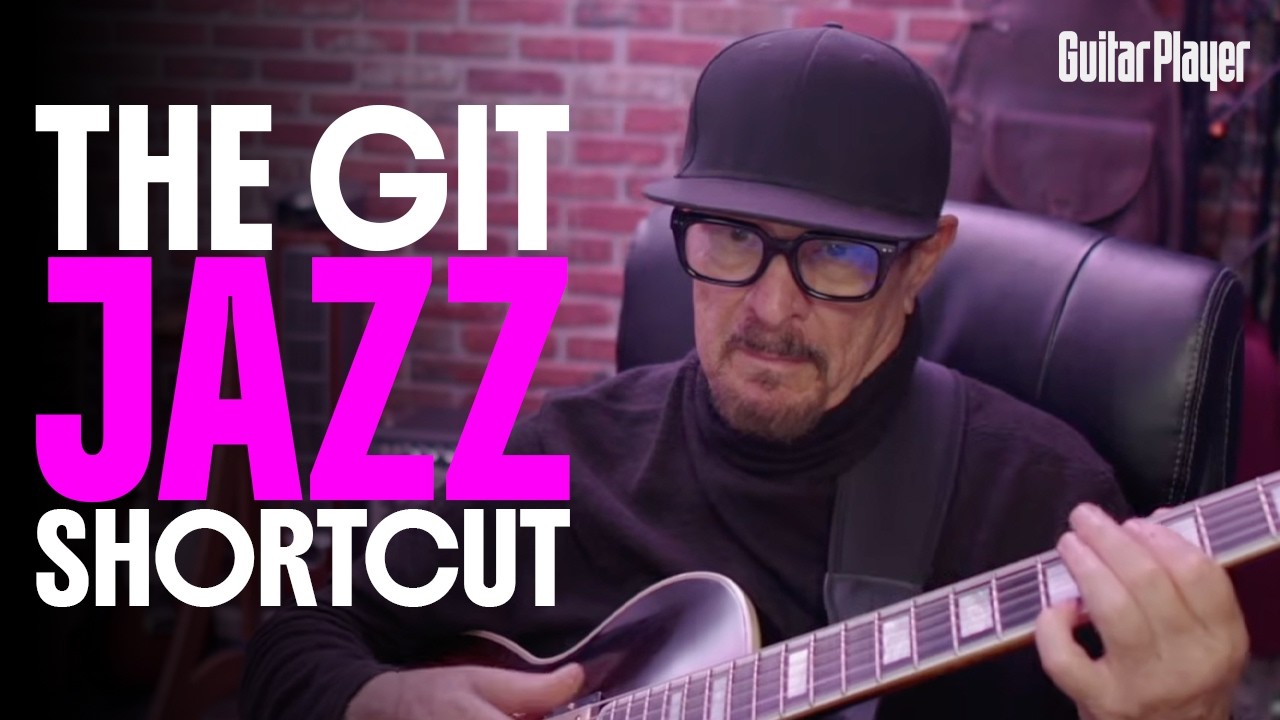
Jazz guitarist and revered tutor Les Wise was one of the first instructors at the iconic L.A. music school GIT (Guitar Institute of Technology), launched back in 1977 by Howard Roberts and Pat Hicks. During his time there, Les inspired thousands of keen students within an early guitar faculty that included Don Mock, Joe Diorio and Ron Eschete, plus guest clinicians such as Joe Pass, Robben Ford, Larry Carlton and Tommy Tedesco.
In this exclusive video lesson, Les shares some of his recollections from the golden age of GIT. In his expert opinion, the area that stood out the most was the intensive real-world live performance opportunities, where students were expected to perform multiple times a week in a wide variety of musical styles and scenarios. To illustrate this, Les shows here how he’d guide a student through an authentic jazz-blues who had limited time to prepare before hitting the bandstand with a live rhythm section.
Wise’s recommendation is a concept he calls “jazz chord pairs,” where he defines each harmonic event in the progression with two complementary voicings that are idiomatically authentic and allow the introduction of motion and rhythmic interest when comping.
His example jazz blues in F is shown below in chart form: three dominant 7 chords (F7, B♭7 and C7) enhanced with a “quick change” to the IV chord (B♭7) in bar 2 and a jazzy turnaround to end that includes D7 (the VI chord in F, made a dominant 7) and Gm7 (the II chord in F).

After performing five choruses in the video, Les defines his selection of chord pairs, starting with two voicings for F13, an extension of the F7 chord family. For B♭7, he moves between a high voicing for B♭13 and a lower-positioned B♭9. The selection of contrasting shapes allows Les to create question-and-answer rhythmic phrasing and add melodic motion.
As the examples progress, he adds further interest by sliding in and out of each shape and adds increasing syncopation and rhythmic density. There are some beautifully connected voice-leading moments here, particularly in the last bars of each 12-bar cycle. The aim is to consider each string independently, making melodic connections whenever possible. This can be achieved by either connecting via semitone steps or maintaining the same note where possible as the harmony shifts through the progression.
To begin, learn these ideas exactly as presented, then, once familiar, feel free to create variations and modifications as you see fit. You could consider choosing your own chord pairs for other types of chord, such as major 7 and minor 7 families. You could also transpose each example into a new key or apply similar concepts to a different piece. With Les’s strong foundational blocks for approaching jazz blues comping, you should find a wealth of new inspiration and vocabulary.

John has performed with artists as diverse as Billy Cobham, John Williams, Frank Gambale, Paco Peña, Biréli Lagrène, Stochelo Rosenberg and Carl Verheyen. John has toured the world with both Carl Palmer and John Jorgenson and has written for Guitar Techniques and Guitar World. His appreciation of jazz guitar makes him ideal to transcribe Les' playing
Example 1: Jazz-blues comping in F, first time
In his opening chorus, Les establishes each chord pair in keeping with the underlying harmonic structure for this Jazz Blues in the key of F. Each of the voicings selected are popular in jazz, and chosen to connect smoothly through the sequence in a stylistically appropriate way.
You’ll notice that it’s only in the last five bars that Les chooses voicings where the root is in the bass. Otherwise, he’s leaving the root note to the bass player. It will help you if/when transposing to a new key to know where the root note is in relation to every voicing, even if you don’t play it.

Example 2: Jazz-blues comping in F, second time
This time Les is using the same voicings, but he’s introducing each new chord from either a semitone above or below. It’s good to acknowledge the rhythmic placement here, with the semitone approach voicing, often positioned on the ‘and’ of beat four.
There are great examples of voice leading here, where each chord blends seamlessly into the next, in the final four bars. It’s worth committing some of these combination moves to memory, to create a vocabulary of chord licks and lines, rather like you might with single notes.


Example 3: Jazz-blues comping in F, third time
Here, you’re occasionally switching the order of chord pairings, so the motion now goes from low to high. Check out the tasty chord-licks in bars 9–12. In fact, you’ll see this exact combination a little later.
You’ll notice also that Les is using his thumb exclusively, using a brushing strumming motion to articulate all the notes. This gives a warm tone reminiscent of the legendary Wes Montgomery, who used his thumb. Of course, equally beautiful results can be achieved with fingers or a pick, but if this is new for you, we’d encourage you to give the approach a try.


Example 4: Jazz-blues comping in F, fourth time
In the next chorus, Les introduces more rhythmic variations and embellishments, mixing up the approaches with greater rhythmic density. Make sure to check out the chromatic descent in bars 7–8 and clock the exact same chord lick from Example 3 in bars 10–12.


Example 5: Jazz-blues comping in F, fifth time
For the final chorus, Les introduces yet more rhythmic variations, sliding embellishments and voice leading to build things to a crescendo from a dynamic intensity perspective. Two standout moments are the oblique motion idea in bars 7–8, with a high F sounding against the four descending chords connecting F13 to D13#9, and the parallel voicing used in bars 11–12 to outline F13-D17(b9#5)-G13-C7(b9#5), before resolving to F13 to finish.


