

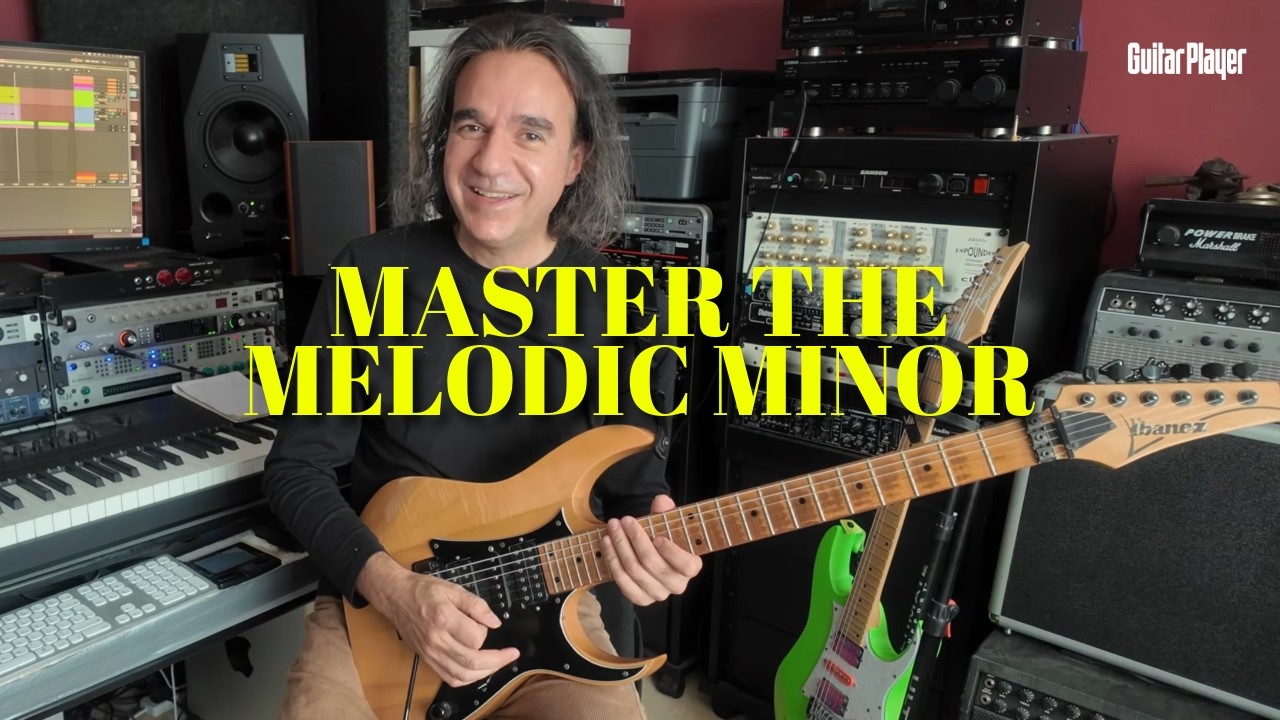
Phi Yaan-Zek is a stunning guitarist and composer with influences ranging from Zappa to Stravinsky, Cardiacs to Mahavishnu Orchestra. His impressive CV includes working with musicians such as Mike Keneally (Frank Zappa), Marco Minnemann and Ron Thal (Bumblefoot) as well as eleven eclectic albums. Not afraid to mix pop with avant-garde, virtuosic chops and heartfelt melodic lines, his playing is a sonic kaleidoscopic especially on his last album, Inner Cosmic Spiral (2025). In this video feature, Phi shares his musical expertise by outlining six of his favorite phrases, sequences and patterns derived from the Melodic Minor scale.
For today, we’re treating the Melodic Minor as a collection of notes that ascends and descends using the same intervals. Specifically, these are as follows: Root-2-b3-4-5-6-7. In the key of C, C Melodic Minor contains the notes C-D-Eb-F-G-A-B. The major 6th (A) and major 7 (B) in a minor context gives the overall scale and resulting chords a bright sophistication with intriguing chordal and modal options.
If you're already savvy to the major scale and its related modes, there are two perspectives you might find useful to appreciate the Melodic Minor.
First, you could see this as a 'tweaked' major scale, (C major: C-D-E-F-G-A-B), that changes the major 3rd (E) to a minor 3rd (Eb). All other notes stay the same.
Alternatively, take the Dorian mode (R-2-b3-4-5-6-b7) and raise the 7th from a minor 7 to a major 7. All other notes stay the same. C Dorian is C-D-Eb-F-G-A-Bb so that final Bb note will change to B to create C Melodic Minor.
Both perspectives have their advantages and this concept of taking a mode and changing just one note follows over to naming of the subsequent modes derived from the Melodic Minor. In the examples that follow, you’ll see this in action with names such as Mixolydian b6 (Mixolydian with a b6), Lydian Augmented (Lydian with a #5), or Lydian Dominant (Lydian with a b7).
There’s a lot to take in here so start by learning the examples as written, alongside Phi’s rationale and demonstration on the video. Once you’re familiar with each concept, aim to create similar ideas of your own invention. Phi’s playing is often lightning fast, but remember these examples sound equally impressive and beautiful through a range of tempos. Take them at your own pace and enjoy!

John has performed with artists as diverse as Billy Cobham, John Williams, Frank Gambale, Paco Peña, Biréli Lagrène, Stochelo Rosenberg and Carl Verheyen. John has toured the world with both Carl Palmer and John Jorgenson and has written for Guitar Techniques and Guitar World. His appreciation of fusion guitar makes him ideal to transcribe Phi's playing
Example 1: Eb augmented arpeggio
Phi begins his exploration of Melodic Minor by highlighting an Eb Augmented arpeggio (Eb-G-B), built from the third degree of the C Melodic Minor scale (C-D-Eb-F-G-A-B). Whilst our bass line ultimately resolves to Eb, implying an Ebmaj7#5 (Eb-G-B-D), Phi superimposes these Melodic Minor structures freely. So this phrase could be used against multiple harmonic options found within this scale, such Cm6, F7, G7 and even B7alt. Phi exploits the symmetry found within the augmented triad by moving his initial phrase up and down by a major 3rd, the distance of four frets.

Example 2: Eb augmented arpeggio
Here Phi superimposes a melodic figure using open strings, once again derived from an Eb Augmented framework. Here the bass is implying a G7 tonality, the V7 chord taken from the harmonized C Melodic Minor (Cmmaj7-Dm7-Ebmaj7#5-F7-G7-Am7b5-Bm7b5). Similarly, you’re moving the initial phrase down the fretboard in four fret leaps, although the decorative notes on the second string are sculpted to fit into the parental C Melodic Minor framework (R-2-b3-4-5-6-7). Rhythmically, after the four beat count-in, you’re shifting to 7/8. Work closely with the audio and follow the notation and tab.

Example 3: E Minor Pentatonic with F (b2) and C# (6) notes
Bluesy Melodic Minor action from Phi here! If you harmonize the Melodic Minor in 7th chords, you’ll find a handy m7 chord that forms from the 2nd degree. In this case, we’re taking about Em7 (E-G-B-D) built from the second interval in D Melodic Minor (D-E-F-G-A-B-C#). You’ll also notice an A, which when added to Em7 creates E Minor Pentatonic scale. Phi phrases around this E Minor Pentatonic whilst the bass implies an A7 tonality - all this can be found within the D Melodic Minor universe. He adds additional color by including both F and C#, the b2 and major 6th when viewed from the perspective of E minor.

Example 4: Wide intervals with D Dorian Pentatonic and E Dorian Pentatonic
There isn’t an obvious Minor Pentatonic constructed from the root of D Melodic Minor, due to the major 7th interval (C#). You can, however, switch this major 7th out and swap it with a major 6th (B), providing the minor 6 or Dorian Pentatonic (R-b3-4-5-6), beloved of jazz/blues maestro Robben Ford. Conveniently, you can do the same thing with the E Minor Pentatonic, giving a pair of Dorian Pentatonics from both the root (Dm6add11) and 2nd (Em6add11). Here, Phi’s using string skipping and three-note-per-string fingerings to create a modern sounding line using wide intervals, with lots of hammer-ons and pull-offs.


Example 5: String skipping with G Mixolydian b6
Phi turns the heat up with this string skipped example, leaping from the fifth string all the way to the second string. You're in G Mixolydian b6 (G-A-B-C-D-Eb-F), the fifth mode of C Melodic Minor. You could also think of this as F Lydian Dominant (F-G-A-B-C-D-Eb), the fourth mode of C Melodic Minor. Either way, you’re dealing with the same note pool (C-D-Eb-F-G-A-B). Phi employs a sweeping upstroke to make the transition between the first and second string for the final flurry in the penultimate bar.

Example 6: String skipping with F9#11 arpeggio
Phi's final phrase again uses string skipping, legato and symmetrical fingerings to create a cascading sheet of sound, derived from F Lydian Dominant, the fourth mode of C Melodic Minor (F-G-A-B-C-D-Eb). Don’t be too concerned about following the rhythms here, the idea is to get the shapes under your fingers and create fluid connected patterns in the moment. You might find these wide stretches easier with your guitar strap a little higher than usual. Keep your thumb lower at the back of the neck, and make sure you’re warmed up fully before attempting to get these lines anywhere near full speed.


Phi Yaan-Zek in action
Phi Yaan-Zek: My Favourite UFO
From Phi Yaan-Zek's album Interdimensional Garden Party, My Favourite UFO features Phi Yaan-Zek (vocals, guitars, percussion), Ellie Williams (vocals), Rob Groucutt (vocals), Lalle Larsson (keyboards), Bryan Beller (bass), and Morgan Ågren (drums, percussion). The prog rock 'Vai meets Zappa' flavors make for a great song with luscious vocals and intricate guitar playing.