
A couple of weeks ahead of opening night, Dweezil Zappa’s upcoming North American tour is a work in progress — although not by design.
“Oh, it’s been a challenge,” the second-oldest and most musically prolific child of the late Frank Zappa tells us with a chuckle. “I tried doing things different this time around, in terms of prep. Since the tour was going to be in the fall we said, ‘Let’s try to rehearse in August and get everything up on its feet,’ ’cause there were a lot of new things to learn.”
“Now here we are almost two weeks before, and I’m still struggling to get to where I wanted to be back in August.”

That said, it’s certainly easy to feel confident Zappa will have the proverbial act together when his DZ20: Like Father, Like Son Tour plays the first of its 33 shows on Oct. 22 in Phoenix.
As its title indicates, the six-week trek marks 20 years of Zappa playing his father’s music, initially under the moniker Zappa Plays Zappa until acrimonious machinations with his younger siblings, who control their father’s estate, dealt him dirty.
But Dweezil was musically active and prolific even before that, releasing his own music since the 1982 single “My Mother is a Space Cadet” — co-produced by Edward Van Halen, who also played uncredited slide guitar — and the 1986 album Havin’ a Bad Day. The onetime MTV VJ also released a pair of albums with estranged brother Ahmet and some Zappa Plays Zappa recordings and has appeared on albums by his father, Spinal Tap, Weird Al Yankovic, Steel Panther, Extreme, Don Johnson, Pat Boone and others.
Zappa also offers online educational initiatives and a music camp, Dweezila, and he used his state-of-the-art multimedia studio Hikari to, among other projects, remix Deep Purple’s Machine Head for its 50th anniversary.
At 57, then, Zappa knows how to get things done, but we’ll allow him a little hand-wringing over the course of a wide-ranging and illuminating pre-tour chat, which includes a discussion of his ongoing “What the Hell Was I Thinking” project, featuring guitar solos by dozens of famous players.

Twenty years of focusing on your father’s music — does it feel like 20 years? Twenty minutes? 200 years?
Well, it’s all of the above. Time goes by so fast, but I’m always right in the thick of it. It was 2006 that I started touring, but I actually started really learning the music and changing my whole approach to guitar back in 2004, so it’s been a very long time that I’ve been working with it and living with this music.
What has immersing yourself like that done for you as a player — and composer and bandleader?
It’s as if I’ve gone to music university and I’ve gotten several degrees that I never would have planned on, because I’ve learned so much about how my dad wrote his music and what he wanted to accomplish with it, and then that trickles down into what I would like to do with my own guitar playing and any music that I write.
And it afforded me the ability to write orchestral music, which I never would have thought of doing as a kid, but over the last couple years I’ve done some different projects with different orchestras in Holland. When you’re writing music for a 100-piece orchestra, or something smaller than that, it’s a very different thing than trying to learn Randy Rhoads or Eddie Van Halen guitar solos, y’know?
Is there any one of his techniques that you’re still trying to get a grasp on?
Well, the one thing that has been the biggest challenge is to be able to play the music in a way that is commensurate with what my dad did, but then also find a way to have my own voice be available when I want it during improvisations — but not have it go too far left field to where it doesn’t feel like it’s connected to the music anymore.
I rarely play complete solos note-for-note, but I do try to play specific phrases that give the identity and the flavor of the solo in the way my dad would play it.”
— Dweezil Zappa
So that right there is the ever-evolving skill, which is to be able to filter my playing through the Frank Zappa vocabulary and lens of influence, but then at the speed of thought be able to have my own phrases come into the music while still relating to the era that we’re playing it from.
That’s the thing I always try to do, something that stays connected to the music whether it’s by trying to recreate an exact sound or playing phrases that are very specific and might have actually been from the original solos. I rarely play complete solos note-for-note, but I do try to play specific phrases that give the identity and the flavor of the solo in the way my dad would play it, while using a sound that is evocative of that whole thing. On a lot of levels the challenge for me is always the playing, but then also creating the sound that makes it evocative enough so that you know which era it’s from.
Has that become an unconscious process over time?
To some degree. It’s the kind of thing I would relate to trying to learn a language; after all these years of doing this, I probably am speaking a fourth-grade level when it comes to playing in the style of my dad. That’s because it’s so hard; he has such a huge vocabulary, and to be able to play stuff that sounds like him and that feels like it fits the music is, I think, a very tall order.
So as I’m able to converse at this basic level, there’s other times where there might be moments that feel like there’s some sudden spark of inspiration, or that I’m channeling my dad at times. I can be in the moment and be like, “Wow, that actually didn’t sound like me; that sounded like my dad, exactly what he would have done in this situation.” Then there’s times when I’m going for something outside of that, but I like when they happen spontaneously.
Is there a holy grail kind of piece, or pieces, you’re still gunning to master?
“Gregory Peccary” is the one piece that would fit into that, and it would probably require at least five or six months of rehearsal just to be even able to play it, and I would have to put a very specific band together to be able to recreate all the things that are in that.
If you listen to that piece of music, it makes you just ask the question, Why? Why does this exist? Who would make such a thing? The fact that it got recorded, and it’s so complicated and so brilliant on so many levels — people don’t understand how complicated and ahead of its time it is. I don’t think there’s another artist who’s ever done anything remotely close to pieces like “Gregory Peccary” or “Billy the Mountain” or things where you just listen and think, “How could you do it?”
So what can we expect from DZ20?
On this tour there’s some of my own music that I’m putting into the show. Because it’s stuff that I wrote, I was having somewhat of an expectation that it would come back rather easily.
But as it turned out, when I started doing my dad’s music back in 2006, I drastically changed my guitar playing style and my technique, the way that I played. And some of this stuff I’m bringing into the show reverts back to the way I used to play, so it’s like having to re-learn that stuff again, which made it a little harder. It’s not as much about the technical aspects as it is that some of these songs just have a lot to remember — even the band is finding it hard.
I don’t read music. The band can start to learn complicated things by reading it off the page and getting a good overview of the thing; I have to sit and listen every couple of seconds and learn each little part and try to memorize the whole thing.
Why do this to yourself, then?
I call it, as a joke, ‘drunken pentatonics.’ You would play anything that you wanted to play that would be a normal pentatonic, but you could bend from the note below it into the note, so it sounds like a slide-guitar playing.”
— Dweezil Zappa
Well, every time I go on tour I always do something different. It’s always that challenge, and that’s what my dad did, so it’s kind of in the tradition of it all. I found myself going down a bunch of rabbit holes in terms of what I want to accomplish on the guitar, so not only just playing the music but in an area where I can improvise, I wanted to stretch and get into some new territory because I feel like I’ve always tried to bring something new and different to what I’ve done, every year, when it comes to guitar playing. I wanted to do something that was noticeably very different.
Which, given your history, is a pretty high aspiration. What do you have this time?
I call it, as a joke, “drunken pentatonics.” The idea was you would play anything that you wanted to play that would be a normal pentatonic, but you could bend from the note below it into the note, so it sounds like a slide-guitar playing.
But if you play it not that great, the tuning sounds bad, so it sounds drunken. You get this microtonal sound, which can be very cool but it requires a different way to visualize the neck, and then it also has these weird things it stresses on your hands because you’re bending from the note below to the note.
And then if you want to keep playing while that note is bent up and you use your other fingers on the string, you’re supporting that pitch by still bending the note, and it strains your hand in a different way. So it’s been a challenge to build the strength to do it and not have it sound bad.
What are you getting into with your own material?
It will depend on how much of it I get under my fingers, so at the very beginning of the tour it may be a little bit less than by the end of the tour.
There are four main things, but especially “Purple Guitar.” Somebody asked me, “Did your dad ever listen to your music, and if he did, did he have any favorite things?” I thought about that and he had come to see us play a show that I was doing in the early ’90s and we closed the show with “Purple Guitar.” He liked that song and said, “You guys should open with that,” so I took it as his request for this tour.
And then he produced a record of mine called Havin’ a Bad Day [1986] which had a song called “Electric Hoedown” on it, and I never played that song live before. So we gave that a facelift with some new instrumentation and it will be the first time we’re playing it.
And I have two other songs, one called “Shampoo Horn” and this other thing called “The Adventures of Dindoo.” That is proving to be the hardest of anything I’ve had to learn, because I wrote it on a computer and never really played it. So we’ll see if I get around to being able to play it on this tour.
Are you taking any different route to the Frank Zappa repertoire this time?
Yeah. I wanted it to feel like what it would have been like if you never heard of Frank Zappa and he walked into, like the Whisky in the ’60s, but he also had the material that he had in the mid-’70s — like the earliest formation of the band, but then also give it some of the music he did 10 or 15 years later, but in that same environment. So it’s kind of the quintessential rocking teenage combo version of everything.
And we’re a five-piece, which means the music is more in your face. There’s an immediacy to it that you don’t get in other situations. And when he did a tour with a five-piece he really limited the material to certain things and certain eras. So we’ve kind of done that, but I’ve also just taken it a bit further.
What’s the gear situation this time out?
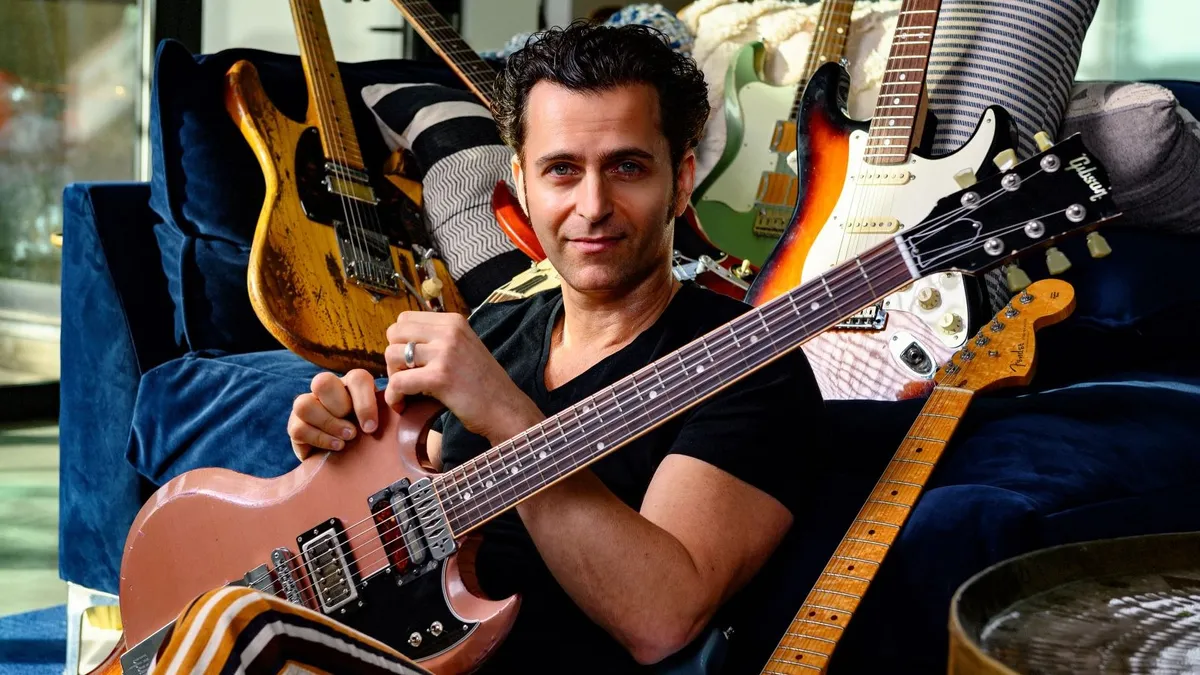
Guitar-wise I’m bringing out a different version of the SG that I typically play. It’s the Roxy-era SG — Gibson released a handful of those — and I just put some different pickups in this one. But other than that it’s pretty much the way the guitar was designed.
They’ve exploited pretty much everything that’s ever existed, and in some cases they’ve put out things I know my dad would never have released.”
— Dweezil Zappa
And I have a different Stratocaster that I’m playing. This particular version that I’m bringing has a humbucker in the bridge and then two single-coils, so I’m able to get a lot of rhythm sounds I need for this tour. But we’re also playing the song “Wild Love” and it has a really crazy guitar solo section. This is from a live version my dad did, I think, in ’78 or something. He just goes into a totally crazy new landscape, and the tone he has is really cool ’cause it’s kind of three layers; you have a clean sound that’s in the middle, and then you have two different fuzz sounds on the left and right. It creates this 3-D image that is super cool, and he’s just doing it with the Stratocaster.
The issues with the estate and your siblings have been heartbreaking to a lot of people. Anything new on that front?
Well, I never talk to them. I’ve always been able to do what I want to do. They just tried to create problems, for no reason. It’s worked out enough at this point in time, but it’s far better to have zero communication with them.
You don’t have input to what’s released from the vaults, but if you ran the world are there things you know are in there that you’d like to see released?
They’ve exploited pretty much everything that’s ever existed, and in some cases they’ve put out things I know my dad would never have released. But, yeah, there are things that could be cultivated into another sort of Shut Up and Play Yer Guitar! series. I know I would be able to amass something like that, far better than anybody else. But nobody’s calling me to do that at this time.
Are you still working on the “What the Hell Was I Thinking?” project?
I am. It’s all fully into a computer, finally. I can actually start piecing it together and doing some finalization of it. It has — I don’t even know — 45 different guitar solos from different famous guitar players. The concept of it is that it’s a continuous piece of music that is constantly morphing from style to the character of the recording and the domain it exists in, so the ambient changes and the stylistic changes are morphing constantly through the piece. It’s an audio movie, essentially.

You had spoken previous about trying to get Jeff Beck on it. Were you able to before he passed away?
We did some stuff, but I didn’t necessarily get something exactly like what I wanted to be able to do. But we’ll see if I can manage to make it work.
What’s on there from Van Halen?
I have two guitar solos from Edward. One is like the best musical joke that we could perpetrate together; it’s kind of a “greatest hits” solo — fairly extended, like a minute long, maybe a slight bit longer, which in guitar solo length is significant.
I have two guitar solos from Edward. One is like the best musical joke that we could perpetrate together; it’s kind of a ‘greatest hits’ solo.”
— Dweezil Zappa
I had these different licks I wanted him to try to incorporate into this solo; there’s probably about 15 different ones, and some of them were a real stretch because there’s this go-to, bebop style like that he did on the Wild Life soundtrack, and people weren’t familiar with this thing but I’d always known about it. He ended up using it later on, kind of tucked in there on the Balance album, but I said, “You’ve got to use that one, and you have to use a little bit of ‘Mean Streets,’ a little bit of ‘Push Comes to Shove,’ a little bit of ‘Dirty Movies,’ a little bit of ‘Ice Cream Man’...” And as we were going through it, he’d say, “I don’t even remember that lick,” and I would have to show him certain licks.
That was funny because it was a complete flip. When I did “My Mother’s a Space Cadet” at 12 years old, he was the one who was sitting with me when I was doing the solo, and I had to punch in and I had never done anything like that before. So he was saying, “When you punch in, you have to play along with what you’ve played before so it doesn’t create something that doesn’t sound like it’s naturally flowing. So here we were in a similar situation with “What the Hell Was I Thinking?” He’s improvising stuff, and we’re like, “Yeah, that’s good, but let’s punch in here” and he was gonna have to play along with what he’d just played, which was not that easy to do because he was just ripping through one lick after another. It was just a really great experience to do all that stuff with him.
And then there’s a second solo which is just a one-take, improvised thing we did at 5150, and he used his original Marshall amps so it had the old-school sound, and it’s great.
Are you privy at all to these archival recordings that Alex Van Halen and Steve Lukather are working on?
I’ve heard about it. I haven’t heard any of it yet, but it’ll be interesting to hear, for sure.
Any ETA for “What the Hell Was I Thinking?”
Well, next year I kinda have some more time — I’m not going to be doing too much extensive touring, so I’m hoping I can do some major focusing on that. I haven’t recorded anybody new for awhile, but there’s definitely a lot of different guitar players out there in the world that are interesting and that are doing cool things.
So when I write the new bits that I need to do I’ll start thinking about a handful of other players I’d have on there. I’d love to get Julian Lage. It’d be nice to get John Scofield. But there’s some other guitar players who do crazy, technical things; there’s a guy named Dussias, a handful of other players I’d love to get on there.
Anything else of your own that you’re working on?
I have all these concerts that we’ve filmed over the 20 years we’ve been doing the Zappa shows. I’ve been editing and mixing those, so hopefully we’ll release a bunch of that stuff next year. And I’m doing a new guitar course that I’m gonna release next year, so with that it’d probably be a good idea to do something, even if it’s just an EP of a few different, new things — maybe the drunken pentatonic stuff I was telling you about.
After the Machine Head reissue, would you like to do more of those kinds of projects?
I would love to. That was a really fun project. I like stuff like that, the challenge of doing something new with something people are so familiar with. It’s very much like what I do with my dad’s music; you want to maintain what people love about their initial experience with it, so you don’t want to change it so much that it’s unrecognizable, but — in the case of the Deep Purple stuff — I just wanted to bring out or enhance some of the details that could just give it a new bit of power and excitement.
I love the puzzle pieces to stuff like that, when you hear it all together and then you realize this is what it sounds like when the guys play music. They were only using 16 tracks, so they were making decisions about what the finished record was going to sound like as they recorded it. You just put the mics up in the room and hope you can capture how amazing they sound. It’s great to hear stuff like that.
Zappa’s DZ20: Like Father, Like Son tour begins October 22 at the Celebrity Theatre in Phoenix and continues through December 5.

