
“Lenny Breau taught me everything on guitar,” Randy Bachman states . “He taught me a vocabulary that, when I listen to stuff I recorded back in ‘66 and ‘67, it’s still the same stuff I continue to play today. It made me what I am.”
The influence of Breau, a Canadian guitarist well versed in jazz, country and classical, looms over Bachman’s six-decade career, in which he performed and recorded with Canadian hitmakers the Guess Who and his own group, Bachman-Turner Overdrive. Take one listen to the Guess Who’s “Undun” or Bachman-Turner Overdrive’s “Looking Out For #1,” among others, and you’ll hear the jazzy chordal interplay Bachman assimilated from his years studying, playing and befriending Breau.
The the first met when both were teenagers in Winnipeg, Manitoba. Breau was 16 and Bachman 15.
“Late at night, I would tune into AM radio stations like WNOE in New Orleans and hear this incredible music that we never really got in Winnipeg,” Bachman tells Guitar Player. “A mixture of country rock and rockabilly.
“One Saturday, the radio DJ announced that a band called CKY Caravan were going to be playing from 11:30 a.m. to 12:30 p.m. live at this car lot which happened to be about six blocks away from my home.
“So I got on my bicycle and rode there. When I arrived, everybody was onstage ready to play. The head guy had on a cowboy shirt and hat, while the woman had a cowboy dress and their son, who was called Junior, was on guitar.
“As soon as Junior started to play, I looked around to see who else was playing, as it sounded like there were three guys playing. But it was just Junior, playing fingerstyle! I had never heard anything like that before.
“After the show, as he was packing up his guitar, I went up to him and said, ‘I thought you were a whole band! How were you doing that?’ And he began to show me on the guitar. I told him, that I needed to learn that too! He told me to, ‘Just go to your record store and ask for a Chet Atkins album.’”
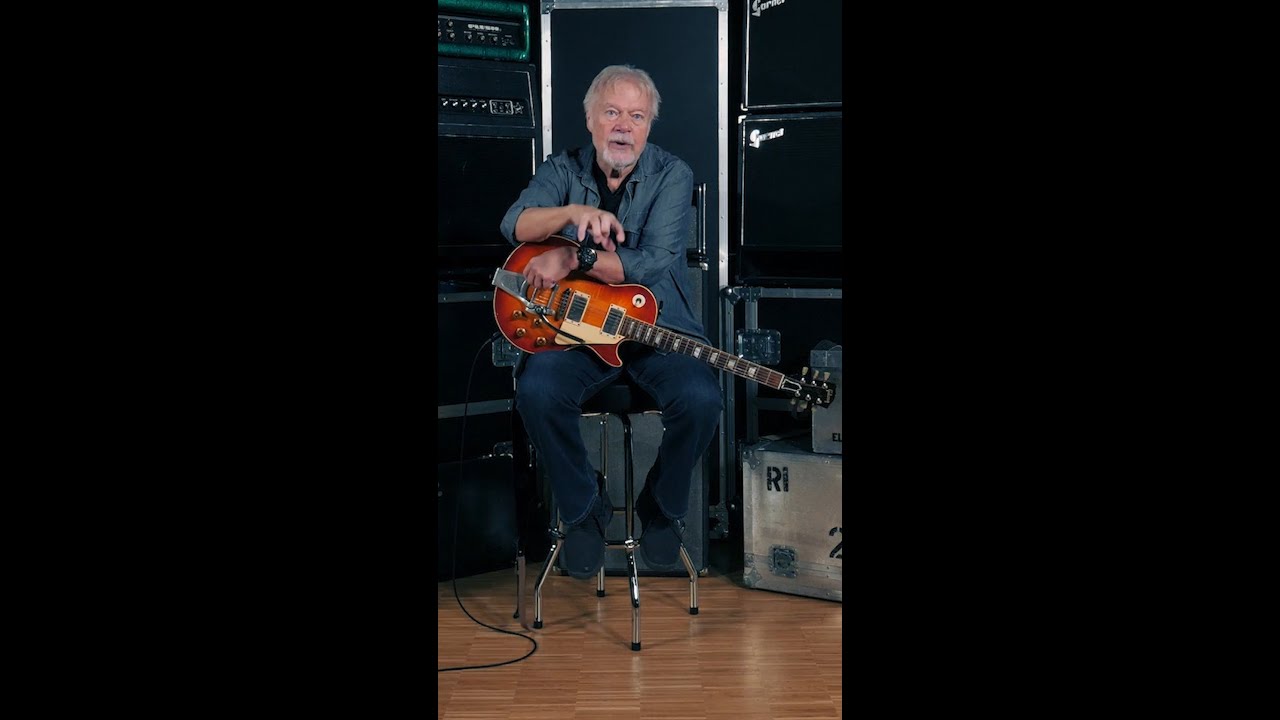
When the family band returned to the parking lot for another performance a few weeks later, Bachman was there again.
“This time I asked him where he lived,” he says. “He gave me his address and asked me to come over and hang out. I later found out he had just moved to town and had no friends, and that he'd been playing guitar since he was six years old in his parents' band.
“And now at 16, he had already mastered note-by-note four Merle Travis albums, and 12 Chet Atkins albums. He was also into Barney Kessel, Tal Farlow, and all these jazz guys.”
Bachman recalls watching in amazement as the youngster played along to Chet Atkins and Tal Farlow records, navigating his fretboard by ear.
“And I learned to play guitar that way too, through osmosis with him.”
As early photos show, Breau — who was a virtuoso on both electric and acoustic guitar — favored an orange Gretsch 6120 , the same model Bachman ended up playing after scouting out musical instrument stores with another Winnipeg pal, Neil Young.
Bachman credits Breau with enriching him with a guitar approach that allowed him to progress his learning on the guitar quite rapidly. He directed him to buy Mickey Baker’s Complete Course in Jazz Guitar, a self-tuition method book series created by Baker, best known as half of the duo Mickey & Sylvia.
“They show you, for example, that when you're playing a blues in G, instead of playing the usual G7, C7, or D7 chords, over and over again, you can play G major 7 or G major 6, or a D9 or a D11. It also taught me that every eighth note can be a different chord, which is what I like about jazz, as you are kind of playing a moving line inside of this chord.”

By the time he was 17, Bachman says, he had absorbed that knowledge and applied it to his own music.
“Over a period of two years, I had become the top rock and roll guitar player in town,” he asserts.” I had learned Merle Travis, Chet Atkins, Les Paul, Dwayne Eddy and the Shadows, and so could play anything on the guitar.”
Bachman had also built an enduring friendship with Breau that continued as the two men followed their respective career paths.
When Breau was found strangled to death in his swimming pool in August 1984, Bachman was devastated. In the midst of his sorrow, he vowed to keep Breau’s musical legacy alive and provide support to his three children by releasing his recordings on a private label called Guitarchives. The first CDs came out in 1995.
“I would put some of Lenny’s recordings onto CDs and sell them,” he says. “And every December I would cut a check, along with a Christmas card, and send it to his kids. I never got any royalties. It all went to his children. It'd be 1200 bucks each or 2,000 bucks each, whatever CDs had sold.”
The Guitarchives label is currently dormant, but Bachman says he’ll reactivate the label, if there’s interest. And he certainly has more material to offer. Over the years Bachman has amassed a vast collection of unreleased recordings of Breau and material related to his old friend and mentor.
“I’ve got 1,800 hours of Lenny Breau material on CD,” he says. “There’s everything from private lessons with students to him playing his favorite song, ‘My Funny Valentine,’ eight different times over a period of about 20 years. I have him playing it when he was 12, 18, 22, and 33 years old.
“So I have got an album that I could put out called My Funny Valentine, showcasing him getting better and better each time. I’ve also got a recording of Lenny playing at George's Spaghetti House in Toronto that was recorded on the first four-track Teac that ever came into Toronto. I also have him playing at the Hot Potato in L.A. over four or five nights.”
Among the prizes in his collection is a tune that recalls the first time Bachman heard Breau in that Winnipeg parking lot, playing and sounding like “a whole band.”
“It’s a recording called ‘Pickin' Cotten’,” he says. “It has Lenny playing with Richard Cotten in Nashville. Lenny’s playing a seven-string with a seventh string on top, and Richard Cotten is playing a seven string too, but with a seventh string on the bottom. And the two of them playing these seven string guitars together sound like four guys playing!”

