
Following on the heels of his Grammy-nominated and mostly acoustic album, Speak to Me, jazz lion Julian Lage flips the script back to playing mostly electric for his next Blue Note release, Scenes From Above. Joe Henry (Bonnie Raitt, Ramblin’ Jack Elliot) remains in the producer’s chair, and it’s an adventurous affair with Lage’s primary guitar foil being the organ wizardry of John Medeski (Medeski, Martin & Wood). Longtime bass guitarist Jorge Roeder (Nels Cline) and dynamic drummer Kenny Wollesen (Bill Frisell) round out the accomplished quartet.
Lage explains, “Scenes From Above is kind of a response to the last record, not only in the bias towards electric versus acoustic but also to have a band that felt really agile where everyone could kind of go anywhere at any time. Speak to Me was basically my working trio surrounded by a perimeter of orchestration that kind of came and went.
“The structure on the new album required me to have a little more authority in the sound or the playing because it was so in the moment. An organ has such a miraculous sound through a Leslie, and it was very important that when the guitar came it didn’t feel like all the energy dropped. The continuous presence of the organ through the whole record made me feel like electric guitar is the better partner, and then to supplement certain moments, we’ll go acoustic.”

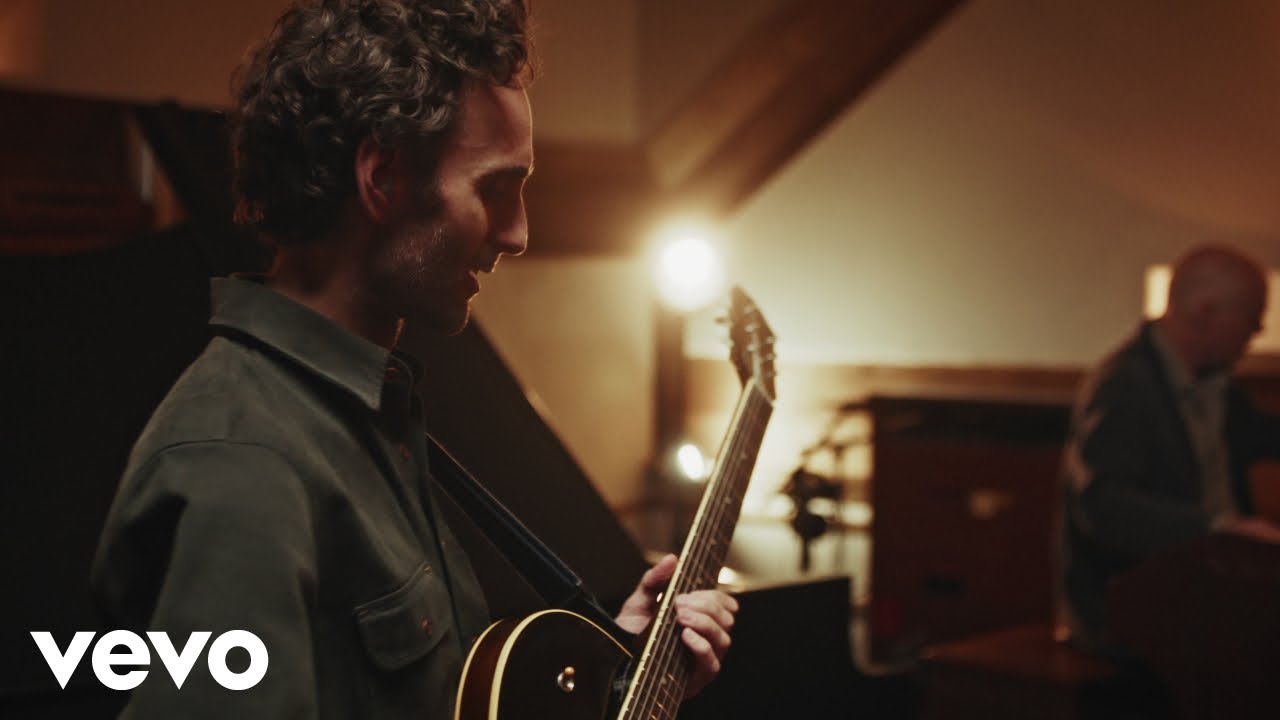
One might assume you’d play your signature Collings 470 JL, but in the official live videos, which are clearly different takes from the album, you’re playing a Gibson.
Right, that’s a Gibson ES-225, and I did the record with a Les Paul.
How’d that happen?
My alibi is as follows: I brought a bunch of guitars to that session. I had been playing a Les Paul the week before at the [Village] Vanguard, but the one I’ve played now for some time is a ’55 Les Paul goldtop with P90s. I have a kind of noise-canceling system in it, so it doesn’t buzz, and I was fired up to use that. But I also brought the Collings 470, several Teles, and then I happened to bring a couple of Les Pauls with humbuckers just to try, because that’s how you learn. Bring some instruments and see what makes sense.
It’s a good thing I did because the radio interference from the Empire State Building — which was just down the block from the studio [Sear Sound] — was so significant that you could not consider using any kind of single-coil pickup. There was nothing we could do to get rid of the 60-cycle hum.
It wasn’t like this even five years ago, but with all the 5G towers it’s become a thing now in New York City, and probably every major city. So the only guitar that was silent in the studio was a humbucker-style Les Paul. I recorded the new album with it, and that was hard, because I hadn’t really played that guitar. But there I was plugging it into my main setup: a Deluxe with certain pedals and whatnot.

There was a period where this album was not strong because of the guitar sound. It was very fuddy. I didn’t quite know what I was doing. There’s so much compression involved with a humbucking guitar, and I am not used to that kind of clamping down. That’s not my voice.
So we tried a bunch of amping ideas and ended up doing a weird hybrid. It’s a Marshall half-stack speaker cabinet from the ’60s with a head that was either a Bassman or some other 100-watt amp modified years ago by Bill Krinard, founder of Two-Rock Amps.
I’m simultaneously going through a Benson — not the modern amps made by Chris Benson, but an old Benson Electronics amp, the kind Howard Roberts used. I think a colleague of his from GIT made his amps. It’s almost like an old Magnatone. Again, not the modern Magnatone, but one with a small 12-inch cabinet — very shallow and kind of papery.
It was a journey. It’s very humbling when there is a vision, and you can see we’re not there yet.”
— Julian Lage
I used those two amps together, plus a treble boost made by Austen Hooks. That’s a big deal. This pedal doesn’t have any knobs; you just plug in and out, but it basically sends a ton of treble information. That whole scenario got us to sounding like what you hear on the record.
And then I went and played that Gibson ES-225. I don’t own that guitar, but I’ve been playing it live. It’s owned by Lynn Wheelwright, who is a guitar historian and collector, and a brilliant cat on the scene in Salt Lake City. I plugged into that for two seconds when I was at his place, and it immediately sounded natively the way the Les Paul sounded going through all that stuff. So when it came to the video sessions [at the Bridge Studio in Brooklyn], I didn’t need a half stack or a rare Benson amp. I could simply plug in that 225.
That was a long walk.
It was wild. I really haven’t recorded much on a Tele, which is funny, because I play a Tele a lot on shows. ArcLight, Modern Lore and Live in Los Angeles are the three albums I recorded with a Tele over the years. Everything else has had to be something else, like the Collings or the Les Paul with P90s. This time it was a journey. It’s very humbling when there is a vision, and you can see we’re not there yet.

And the Les Paul that won the day was….
I used a Nachoguitars Les Paul, which begin as Gibsons. He reshapes the tops and ages them. But I changed the pickups to Ron Ellis humbuckers, which are great pickups that brought some life into it. But that guitar is fundamentally not a jazz guitar. It probably sounds its best cranked through overdrive.
Now I have played Les Pauls that do sound beautiful with just a clean tone through any amp. They’re rare, but they’re out there. And at times I’ve thought, Maybe I’ll convert. But for one reason or another, it usually doesn’t make sense for me.
It’s funny how you seem to wind up playing jazz on guitars that are, well, perhaps not thought of as jazz guitars.
Exactly. [laughs]
When you refer to the Les Paul with P90s that you love playing and have recorded with in the past, are you talking about the ’55 Gibson Les Paul that Christopher Guest gave you?
Yeah, that’s the one that Christopher very graciously has given me. That’s an amazing guitar. I mean, it’s kind of freaky. That neck pickup is one of the great neck pickups, and there’s such a personal connection to it, obviously. That’s a big part of it. But on its own, it’s absolutely stunning.

The fact that you run around playing the Spinal Tap guitar is just the best, you know?
It’s cool. I know. I feel very blessed.
We’ve been blessed with the opportunity to do a couple of Guitar Player Presents events for your annual residency at SFJAZZ. In 2025 we focused on the duo show with Marc Ribot, but as it turns out the evening with John Medeski inspired your new collaboration, correct?
Performing a week of shows like that is a dream because you need to put on something different with new players and new material. Jorge, Kenny and I have played together for years, and I’d been wanting to do something with John for years. When came together, we played previously recorded material to get a show up and running quickly.
I was on track to make a whole different record, but that show was so fun and exhilarating. We pivoted realizing this should be the next thing we do while it’s still fresh in our minds. We needed new material, and I started thinking about takeaways from the show. What kinds of songs worked? What was missing? What would I like more of? And then it was fun to begin writing deliberately for this quartet.

The second song released, “Talking Drum,” is a funky one, with that signature Medeski organ grooving, and it brought the Meters to mind. Is Leo Nocentelli’s guitar playing in that band an influence?
Well, the Meters are woven into the fabric of everything I love. They make the world a much better place. So that’s just inherently ingrained in me, as a guitar player who plays instrumental music. It’s always something to aspire to, whether it’s obvious or not.
When I was writing ‘Talking Drum’ I thought more about Moroccan, North African music, which is a different sort of groove music, and not funk per se.”
— Julian Lage
When I was writing “Talking Drum” I thought more about Moroccan, North African music, which is a different sort of groove music, and not funk per se. These players are funky, so there was this opportunity. That melody and harmonic structure fits so beautifully with the way they feel that beat. It’s very cool, but it certainly wasn’t an agenda of mine, like, “Here’s our groove song.”
If anything, I was trying to get away from that, except when the music simply had to come out that way. “Talking Drum” and “Havens” lean into the model of groovy organ and guitar. Medeski does it better than anyone, and he’s done it with the best guitar players in the world.
I conscientiously didn’t want to have a bias toward that because perhaps it would be a bit obvious, and not precisely where I find myself as a guitar player. I was more interested in the poetic nature of organ and guitar. John is spacious. He’s oozing with so much soul and good taste, which is on full display on the ballads.
The first cut released, “Opal,” is a lovely lyrical ballad. Where did that come from, and how did you develop the composition?
That’s a rather unusual piece of music. I was listening to a lot of calypso music from the ’50s and ’60s while preparing for this record, and we explored some of those gentle propulsive beats. That got me excited. The song structure is very simple, three different framed sections in F#. Something about that minimal, iterative kind of approach meant it didn’t need soloing per se, because the music kind of inches along beautifully with the backdrop of a beat that’s not a swing or a blues, but rather this kind of island beat.
Leo’s got a lot of island music in him. ‘Ocala’ is just kind of an ode to him.”
— Julian Lage
“Ocala” has an island vibe as well, and is probably the most folky, steel-string acoustic tune. What’s the origin story?
That was written for Leo Kottke, actually. When I think of folkloric music, especially from South American countries such as [Peruvian singer-songwriter] Susana Bacca, and you hear it in Cuban music too, there’s this amazing ability for songs to possess kind of a melancholy nature while also being very hopeful and having a sense of forward momentum. It’s emotionally complex, and there’s a soulfulness, like the blues. There’s a lonesome quality to my favorite music.
I wrote “Ocala” on tour with Leo, and that one was very much dedicated to him. Even though he doesn’t play that way, Leo’s got a lot of island music in him. There’s a distinctly Leo Kottke feel, a kind of a bounce to his rhythm sometimes that somehow connects to music from the islands. He usually occupies that space with momentum and upbeat playing, which is so admirable. This is just like a way slowed down version of that. So “Ocala” is just kind of an ode to him.
It’s great that you two keep in touch, and that he’s become one of your mentors.
Absolutely. I love Leo. Anyway, the acoustic guitar came into play on three songs: “Ocala,” which has that melancholy vibe. “Storyville” is avant-garde, and “Havens” is a more driving strum piece. The guitar is so natively plugged into the world of music. It’s got a home in every genre, pretty much. If anything, it’s more unorthodox in jazz.
But seeing the guitar as a folkloric instrument of the world, when you play material that might not be folkloric per se, it can still bring us some of that spirit. The music can feel earthy, grounded and intimate. These are properties of the instrument, not the songs, per se.
And your instrument in this case?
That’s a 1932 Gibson L-00 with 13 frets to the body, all-mahogany. I used it on Speak to Me as well. It’s my wife Margaret’s guitar [Margaret Glaspy], and she plays it pretty exclusively. We’ve had it in the family for a little while. Joe Henry had one originally, and that’s why we got one.
It’s unusual to have 13 frets. It’s a little bit of both worlds. It’s got some of the throaty boxiness of a 12-fret guitar, where things are just a little trapped, but in a very musical way. This sounds more open, but it’s not as open as a 14-fret guitar. It’s one step between those two worlds. I do like the facility. Having that one extra fret makes it feel like more of the neck is easily accessible than a 12-fret.
That’s got to be a club of some sort, people who like 13-fret guitars. They’re very particular.”
— Julian Lage
Interesting that you dig the 13-fret. The Martin SC-13 and Santa Cruz H-13 are also built that way.
It’s great that you point out those other models. That’s got to be a club of some sort, people who like 13-fret guitars. They’re very particular. The tonal balance is just different than having 12 or 14.
“Something More” feels like taking your time to drive home on a country road.
Absolutely. That song was so close to being cut many times because there wasn’t really a place for it on this record. And then when it ended up as the last track, it did exactly what you’re saying. It lands the ship.
And now that you’ve got the record as a blueprint, is the plan to hit the streets with the same group and see where you can take these tunes?
Exactly. We’ve only scratched the surface of knowing what the songs can do because they’re underwritten. There’s a lot of room for interpretation. Things can be faster or slower, longer or shorter. They can be a feature for someone. They can have an intro, or not. I’m so excited to develop the music now that there’s a baseline. The record is the starting point, so God willing we’ll go play it live and learn where the music leads us.
