
“I tend to be a fixer,” Todd Rundgren says of his production gigs. “I get called in during a crisis.”
For Rundgren, it’s a familiar pattern: commercially viable bands stalled by perception, pressure and internal friction. The veteran musician, songwriter, guitarist and producer had his work cut out for him in 1986, when he signed on to produce XTC’s Skylarking.
The English trio — guitarist Andy Partridge, bass guitarist Colin Moulding and multi-instrumentalist Dave Gregory — were in a commercial slump. Their previous two records had failed to sell in the U.S., and Partridge’s dislike of touring meant neither the band nor its label, Virgin Records, was making much money.

The problem, as Virgin saw it, was that the band sounded too English. Rundgren’s job was to translate that identity into something more commercially legible.
He recalls a similar dynamic when he produced Grand Funk Railroad’s breakthrough album We're an American Band in 1973 — another case of a commercially successful group struggling for critical respect and radio traction.
“Their label guy said, ‘If they don’t have some success with this new record, we’re gonna drop them.’ I thought that would’ve been horrible.”
— Todd Rundgren
“They weren’t getting respect,” Rundgren says. “They had conquered commercially, but they weren’t really getting played on AM radio, and critics were always hitting on them. They needed to be really different at that point, and that was part of my reputation — I’d come in, evaluate what needed to be done, and make sure it got done.”
“The Skylarking album was the same sort of situation,” he continues. “But a lot of XTC’s issues had to do with the fact that they never performed. Because they never toured to promote their records, they had to get on the radio somehow.
“But they were getting less and less radio play, partly because of the sound of the records and their approach to the material.
“Their label guy said, ‘If they don’t have some success with this new record — and if they don’t stop spending a fortune making records and never touring — we’re gonna drop them.’
“I was a fan. I thought that would’ve been horrible.”

Rundgren only got the gig because XTC’s label believed the band sounded too English. Executives compiled a list of American producers for consideration, and guitarist Dave Gregory pushed hard for Rundgren.
“I reminded Andy that Todd had produced one of his favorite New York Dolls records,” Gregory said, referring to the group’s 1973 self-titled debut. “In the absence of any better alternatives, he agreed.”
Work began at Rundgren’s Utopia Sound Studios at his home in Woodstock, New York. It didn’t take long for him to identify the group’s main problem: XTC’s identity as a studio-only band wasn’t just a limitation—it shaped how they worked.
“Because they never toured, their entire musical life took place in the studio,” Rundgren says. “Because of that, Andy would be happy to work forever on one record, because as soon as it was done, the fun was over. He got to go home, be alone, and never play that stuff again.
“So he would just drive everybody crazy.”
“Andy would be happy to work forever on one record. Because as soon as it was done, the fun was over.”
— Todd Rundgren
What might have been a creative advantage in another context instead became a pressure cooker. Rundgren and Partridge clashed repeatedly over song choices and arrangements. Where Partridge wanted a distorted electric guitar solo, Rundgren heard mandolins. When Partridge wanted yet another vocal take, Rundgren would push him to move on.
As Partridge recalled, Rundgren’s attitude was, “You can dick around with [the track] for a few hours your way if you like. I’m going up to my house. When you find out it doesn’t work your way, give me a call and we’ll record it my way.”
The strain filtered through the band. Moulding later recalled that Partridge was “so unhappy and taking it out, a little bit, on me.”
The tension eventually reached breaking point.
“Colin quit the band in the middle of making the record,” Rundgren says. “He eventually rejoined to finish it.
“So we made Skylarking under much duress.”

By the time they sat down to mix the tracks, exhaustion had set in, and the band decided they were ready to leave.
“We got through three songs and they said, ‘Okay, you finish it. We’re homesick. We’re going home.’ This was something they’d never done — leaving a project before the mixing was finished.
It was the character that was sewn into the record that became its strength.”
— Colin Moulding
“As soon as Andy got home he shit all over the album to anyone who would listen. Nobody had heard the record yet, of course, but he was saying, ‘It’s the worst record we’ve ever made, blah blah blah blah blah.’ He was ready to hang it up at that point.
“And the rest, of course, is history.”
Indeed it is. Upon its release in 1986, Skylarking became a critically acclaimed hit. That wasn’t solely due to its songwriting, strong though it was. Rundgren’s sometimes baroque, psychedelic, Sgt. Pepper’s–like production delivered the radio-friendly sound XTC’s label wanted without stripping away the band’s distinctly English character.
“Perhaps it lacked the polish of some of the other recordings we had made,” Moulding said in retrospect, “but it was the character that was sewn into the record that became its strength.”
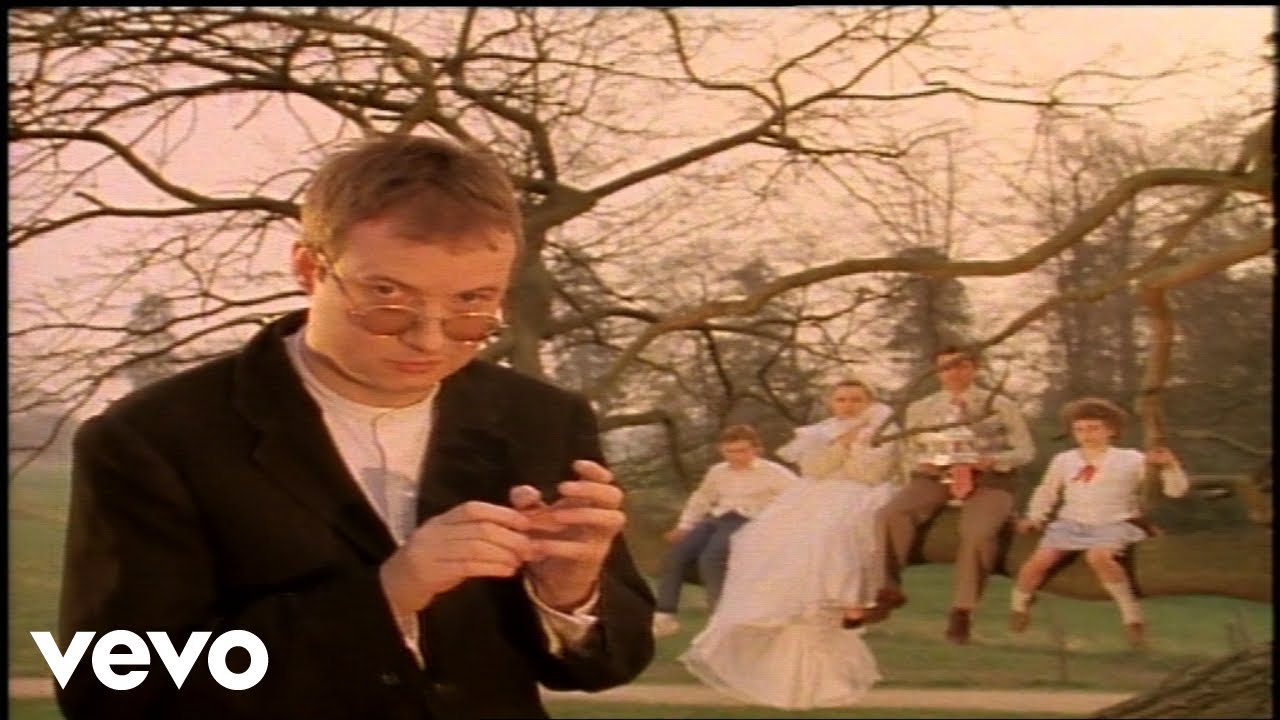
Ironically, the album’s breakthrough moment came from a track that wasn’t originally part of it. XTC initially promoted Skylarking with a video for “Dear God,” a song not included on the original pressings. Once it gained traction on MTV, it was added to later editions of the album, replacing “Mermaid Smiled.”
Skylarking went on to sell roughly a quarter-million copies in the U.S. and spent 29 weeks on the Billboard 200, peaking at No. 70 — XTC’s strongest American chart showing since 1982’s English Settlement.
Much of that outcome, Rundgren suggests, came down to vision — and control.
“But what I took away from it was, first of all, what a talent Dave Gregory was — both in terms of his playing and his overall musical sensibility,” he says. “He did the orchestral chart for ‘1000 Umbrellas,’ and that’s maybe the best chart on the record, even though I did all the other charts.
“And I still see Dave. I did a couple of dates in England last November and saw him while I was there. I see him every time I’m in his neighborhood. We still get along great, and he’s still the sensible one. He tells me stories about what happened with the other guys and all the turmoil.
“And now I think it’s pretty much official: XTC is no more.”

