

Kim Thayil says he “kind of balked” at the idea of writing a memoir when the idea was first presented to him some years ago. It just felt a bit too self-aggrandizing for the Soundgarden guitarist, running counter to his “love for collective pursuits.”
Nevertheless, he ultimately acceded to co-writer Adem Tepedelen, resulting in the new A Screaming Life: Into the Superunknown with Soundgarden and Beyond (William Morrow).
“I’ve always gravitated toward bands, toward superhero teams and baseball teams, more than the individual performances,” Thayil, 65, explains of his initial reticence, via Zoom from his home in Seattle. “What I loved about the Beatles or Kiss wasn’t just Paul or John; it was them working with George and Ringo.
“It was the four different faces of Ace and Gene and Paul and Peter and, ‘Omigod, they’re doing “Rock and Roll All Nite,” this is really cool!’ The overreaching concept is all these talents and stars coming together for one goal. That’s what appeals to me.”

That generosity of spirit is demonstrated through A Screaming Life’s 296 pages, which run from Thayil’s origin story — the son of immigrant Indian parents born and raised in Chicago, where he cut his musical teeth alongside high school classmate and original Soundgarden bass guitarist Hiro Yamamoto.

After graduation, the two moved to Seattle together, where Thayil earned a philosophy degree at the University of Washington and worked as a DJ on KCMU but, most importantly, started Soundgarden during 1984 with Yamamoto and his roommate Chris Cornell, who was originally a drummer before he stepped out to front the band.
The book is, as such, the first truly inside account of Soundgarden’s history, from formation to breakup in 1997 and resumption in 2010 until Cornell committed suicide seven years later. It has a photo but no text about the group’s Rock & Roll Hall of Fame induction last year, but it does bring readers up to speed on the surviving Soundgarden members’ plans for unreleased material they were working on at the time of Cornell’s death, as well as Thayil’s other musical pursuits with a couple of MC5 spinoffs and the all-star 3rd Secret.

Thayil — who says he “may have changed some names” to protect privacy where appropriate — felt a significant weight of responsibility in telling the story, too.
“I had to make sure that people understood the kind of talent that was brought to the group,” he explains. That includes not only himself, Cornell, Hiro, bassist Ben Shepherd and drummer Matt Cameron, but also founding drummer Scott Sundquist and bassist Jason Everman.
I had to make sure that people understood the kind of talent that was brought to the group.”
— Kim Thayil
“They’re both very good and very talented at what they did. Even though we parted ways with them and they’re undocumented on recordings, they brought something to the table,” Thayil says. “There’s a real pride I feel in the collaboration, in the teamwork.
“My friends might think it’s nitpicking, but I want to get the story straight as best I can, and try to be as accurate as possible. I didn’t want it to be emetically driven or be patting myself on the back or entirely self-deprecating or vindictive or any of those things. I wanted to ultimately say, ‘We achieved this, and we lost things. Here are the circumstances around that achievement; here are the losses. Here’s what happened.’”
Louder Than Love
The greatest loss, of course, was Cornell, who hung himself in a Detroit hotel on May 17, 2017, at age 52, shortly after a concert at the city’s Fox Theatre. Although Thayil has equivocated over the years about whether he saw any warning signs that night, he writes in A Screaming Life that he sensed Cornell “didn’t seem right” as the band prepared for the show.
“I just remember that I thought Chris looked pained,” Thayil recalls now. “I’ve known Chris for a long time; he looked pained enough that I asked him twice, and that is not something I would normally do. But he convinced me that he was simply tired.
“And he did sleep; he went back to his dressing room after soundcheck and slept. People wanted to ask him a question about our set, or some songs, and either the tour manager or the security guy said, ‘Oh, no, he’s sleeping. He’s out.’ So I thought, ‘Okay, he was right. He wasn’t pained. He’s very tired.’ That was that.”

In the chapter entitled Slaves & Bulldozers, Thayil goes into great depth about what else he observed during the night and in the show, from its rough start to a Cornell electric guitar malfunction during “Been Away Too Long” that forced Thayil to play the only guitar part. Afterward, he relates in the book, Cornell said, “‘See, you don’t need me at all’ … and the way he said it just didn’t feel right.”
It was almost this futile thing: ‘I want you to know this or that.’ What does it achieve? It doesn’t make time go backwards.”
— Kim Thayil
Thayil acknowledges that these are feelings he’s not shared publicly until now. “I didn’t know how to share it,” he explains. “I didn’t know how to organize the thoughts and the experiences. Even talking to people who were in the same foxhole as me, like our bandmates and some of our crew members — if I even tried to share my experiences or my thoughts with them, it was very difficult for it to come out in any way that was organizational.
“And I saw that in them. We didn’t know how to give it meaning because, ultimately, you’re devastated emotionally, and that’s the conclusion of these events or observations.
“So when you’re trying to organize the observations and the events into something that gives it coherence or meaning, you end up in the same place — it doesn’t solve the problem. It doesn’t change the result. You’re still devastated.
“So it was almost this futile thing: ‘I want you to know this or that.’ What does it achieve? It doesn’t make time go backwards, and you start realizing that you’re ultimately just another human being with dreams and ambitions and ultimately impotent as you experience this loss.”

Overall, however, Thayil’s disposition toward Cornell in A Screaming Life is overwhelmingly charitable and positive and, in spots, revelatory for him.
“One surprise in putting this book together,” Thayil says, “was realizing how generous Chris was in how many times he tried to maintain and address and save the band, how he tried to attend to the interests and needs of his bandmates in a constructive way. And that wasn’t always obvious, because he got so much attention as the attractive and talented frontman and singer. He was managing and kind of navigating that kind of attention, which is very difficult for many singers, which I initially did not understand.
“It really comes out, when the stories are all put together, he championed the band in many ways. There were times I felt I was alone in championing the band, but that’s not true. Now I look back on it and, no, Chris was right there, too.”
Been Away Too Long
Though gone nearly a decade, Cornell is with Soundgarden these days, too. Since coming to terms with his widow, Vicky Cornell, over the recordings the band was working on at the time of his death — along with other legal matters — Thayil, Cameron and Shepherd have been working on those songs with early band producer Terry Date. Thayil says there could “potentially be more than nine” tracks, but with no specific timetable for the finished product.
We’re still working. I still have things to do. So does Ben. There’s no schedule here, because it’s a different process.”
— Kim Thayil
“We’re still working,” he says. “I still have things to do. So does Ben. There’s no schedule here, because it’s a different process. When you work on a record, you have both time and money budgeted out by the record company in concert with the band and management. But because this production doesn’t have a traditional schedule, it’s kind of sideways — in some ways backward and some ways forward.
“In some ways we have a final product in working with Chris’ contributions, and there is a push to have things done. But there’s a pushback, too, saying it’ll be done when it’s done, when we’re satisfied. It has to be the best for me, the best for Matt, the best for Ben — and the best for Chris. It’s going to be the best presentation of Soundgarden we can make it. We can’t do that without him looking as great as he is.”
Placing the music in the context of Soundgarden’s catalog, Thayil describes the songs as “very Soundgarden-like in terms of tone and mood. It’s quite introspective. The perspective, emotionally and creatively, is entirely different and in some ways much more powerful. It doesn’t have the variety of, say, a Down on the Upside. It doesn’t have the viscerality of Ultramega OK or the quirkiness and viscerality of a Badmotorfinger. It’s definitely going to have an overall identity and ambience. It’s going to be a very distinctively different but very Soundgarden-y work.”

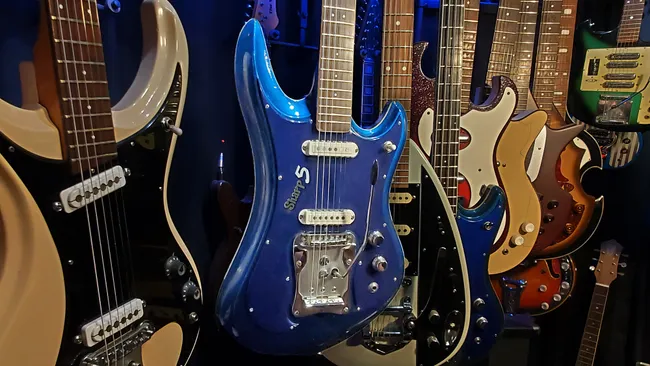
During the recording process, Thayil has been using his familiar Guild S-100 (for which he has a signature model and is looking at another for the S-300), a Fender Stratocaster that he began using with Superunknown, a Gibson ES-335, for which there’s a Cornell signature model, and a Guild acoustic. The Telecasters played for Down on the Upside are gone, but Thayil has “farted around” with a Fender Jazzmaster semi-acoustic that was suggested by his guitar tech and a studio engineer.
“It’s a very interesting, curious guitar I’m trying to learn about,” Thayil says. “It has great action. It plays great. It has a cool sound, and I love it. It’s like, ‘Holy shit, this is so fun and easy to play.’
“I don’t know how long it’s been since I felt this way about a guitar; the only time in recent memory is a Guild acoustic that was custom-made for me. See, I’m not the guy who walks into a guitar store and drools. I don’t have a wish list. I’m not on a first-name basis with my gear. We acquired some gear, some new amps and pedals, my guitar tech picked out for me. But I’m not that guy who geeks out and knows every last detail.”
For now, 3rd Secret — Thayil’s band with Cameron, Nirvana’s Krist Novoselic, Void’s Jon “Bubba” Dupree and others — is taking a back seat to the Soundgarden recording and A Screaming Life. Thayil is planning to do some signings in the Seattle area — and perhaps beyond.
“We’ll see how it goes,” he says. “If it goes well, maybe we’ll consider doing things elsewhere. I’m just learning about this process, the book publishing world.”

