
In Rainbow’s eight-album catalog, “Stargazer” stands as the band’s masterpiece — an eight-and-a-half-minute epic from 1976’s Rising. Ritchie Blackmore certainly thinks so. When Guitar Player asked him earlier this year to name Rainbow’s defining songs, he singled it out alongside “Man on the Silver Mountain” and “Long Live Rock and Roll.”
But Blackmore remembers “Stargazer” as much for what didn’t make it into the final mix. The guitarist says two musicians who helped shape the song ultimately saw their finest contributions disappear from the finished recording — one because it was deemed too elaborate, the other simply because the tape ran out.
Rainbow cut Rising at Munich’s Musicland Studios shortly after Led Zeppelin completed Presence there. As the group settled into the sessions, an engineer played the band “Nobody’s Fault but Mine” from Zeppelin’s then-unreleased album. Blackmore says he recognized the challenge posed by Jimmy Page’s stunning electric guitar work and Robert Plant’s vocal performance. It immediately raised the stakes for Rainbow.

“It was a threat for us, as that song was overwhelmingly good,” he exclaims. “It was hard to follow that. I really thought it was incredible. It was a brilliant riff by Pagey. A very weird riff. Of course Planty sang brilliantly, and I thought, ‘We have to follow this?! We better write something that good.’”
It was a threat for us, as that song was overwhelmingly good. I thought, ‘We have to follow this?! We better write something that good.’”
— Ritchie Blackmore
Blackmore believes Rainbow answered the challenge with “Stargazer,” the fantasy epic he and Ronnie James Dio wrote together during rehearsals. The song tells the story of a wizard who enslaves thousands to build a towering stone monument from which he hopes to fly to the stars.
“Ronnie and I wrote that together; I came up with the riff at home and the progressions. Ronnie sang it brilliantly, within a couple of takes,” Blackmore says.
Dio also contributed one of the song’s defining musical moments. “He came up with going up to the key of B riff — that little part there,” Blackmore says, referring to the refrain “Where is your star?”
“It was so nice to have someone else do some of the writing. I was overjoyed. I was so used to doing it all myself for so long.”
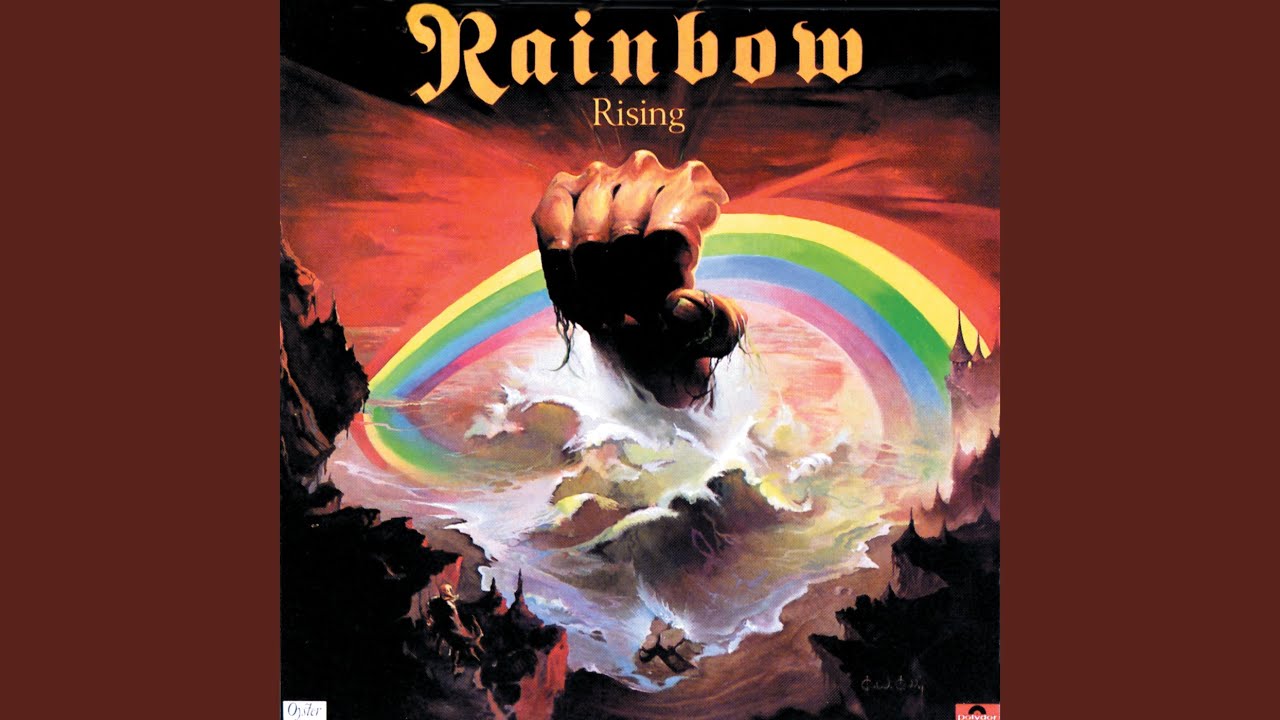
Clocking in at nearly eight and a half minutes, “Stargazer” builds to one of Blackmore’s most blistering solos before riding out over a hypnotic vamp backed by an orchestra. To create the dramatic finale, Rainbow hired 28 members of the Munich Philharmonic Orchestra under the direction of conductor Rainer Pietsch. Blackmore’s instructions were simple.
“I said, ‘Look, there’s a song we have written, basically two chords, A minor and G, and I want you to improvise and play this particular riff.’ I showed him the riff. I said, ‘If you would like to, do some ad libbing yourself, as we will be ending the song with a long, two-minute fade out.’”
Pietsch spent the weekend preparing his arrangement. But when Blackmore and Dio heard the results, they felt the orchestra overwhelmed the song rather than strengthened it.

“Ronnie and I thought it was too busy. We wanted to hit home the main riff of the song. And the conductor was so pleased with what he had written, but it was too much. It didn’t work.
Ronnie said, ‘You tell him it’s too busy.’ I said, ‘No, you tell him.’ We were both apprehensive to break the news.”
— Ritchie Blackmore
“So we brought him into the control room. Ronnie said, ‘You tell him it’s too busy.’ I said, ‘No, you tell him.’ We were both apprehensive to break the news.
“In the end Ronnie told him it was too busy. So we asked him to rewrite it again, with the main riff being prominent, not flowery and busy. He played it again, but it was still too flowery.
“So we had to talk with him again, saying that the main riff — the simple riff — had to be with power, directness and simplicity. Rainer was so demoralized at this point that all we left in was the 28-piece orchestra playing the riff, which is what you hear now.”

Pietsch wasn’t the only musician to leave the session disappointed. Blackmore had also hired what he describes as “a brilliant gypsy violinist” to improvise over the song’s extended fade. The performance was everything he’d hoped for — until the tape machine reached the end of the reel.
“As the song was fading out, the violinist was playing his heart out, and it sounded fantastic,” Blackmore recalls. “Unfortunately the reel came to an end. And we wanted so badly to have him playing this gypsy part at the end.
“The man came into the control room to hear his playing, which was brilliant, and we had to embarrassingly say to him that everything he had just played wasn’t recorded because the stupid tape ran out. He was not amused.”

