
“Did I ever think that one day I’d get good enough to play with John Lennon?” Earl Slick asks. “Of course not. The idea still blows my mind. Lennon was this huge guy; he was a hero. A little kid from Brooklyn doesn’t get to be in a room with him.”
Famous for his nearly career-spanning work with David Bowie, Slick rose through the New York music scene in the 1970s before becoming the heir to Mick Ronson as Bowie's foil for the Diamond Dogs tour in 1974. The straight-talking guitarist would help usher in a new, post-Ziggy Stardust era for Bowie, and would later feature on two ‘70s LPs, Young Americans (1975) and Station to Station (1976).
He would be return to Bowie‘s orbit over the following decades, perhaps most famously when Stevie Ray Vaughan quit the band on the eve of the Serious Moonlight Tour. But Slick was also present when Bowie had his career-changing onstage heart attack, and would ultimately play on five of his studio records, ending with 2013‘s The Next Day.
Asked which records were the most challenging to make, Slick tells Thinking About Guitar, “The ones I don't like!
“I can't name names, but I've been hired by people who hired me because of the name value, but not what I did,” he explains. “So when I got there, they expected something completely different.
“And most of the time I ended up working for a day and leaving, not because the guy was being an asshole, but because [the music] is so out of my range that it ain't gonna sound right. I'm deadly serious; sometimes, they'd call the wrong guy.”
Working with John Lennon, however, proved to be very different for Slick. The former Beatle hired him for his and Yoko Ono‘s 1980 album, Double Fantasy, which also featured Tony Levin on bass a year prior to his joining King Crimson.
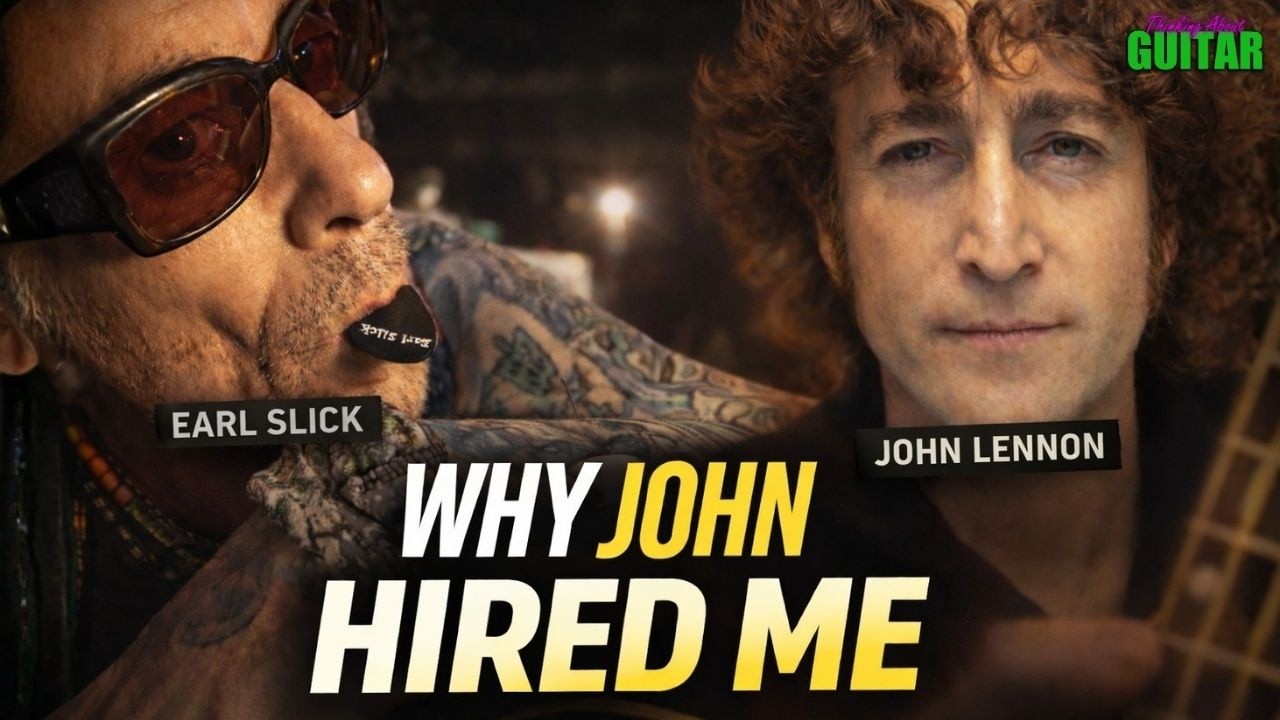
“I know why John hired me,” Slick says. “[Album producer] Jack Douglas told me it was because everybody else in that room could read [music]. Hugh McCracken — I love Huey, he was so good, man — Tony Levin and all these guys could read. I knew as much as John did.”
In other words, not much.
“He wanted a street rock and roll player that didn't know any of that shit,” Slick continues. “That’s why I got the gig. And I had pretty much free rein on that thing. John was just looking for a good take.”
Double Fantasy would prove to be the last record Lennon made before his death in 1980.

A year later, Slick would unite with Ono, Lennon‘s wife and musical partner, to play on Season of Glass, her highest-charting solo record.
Speaking to Guitar Player in 2021, Slick says he wasn't sure how many people he had to compete with to get his gig with Bowie, but once he did, he “was off and running.” It certainly helped bring him to Lennon’s attention.

