

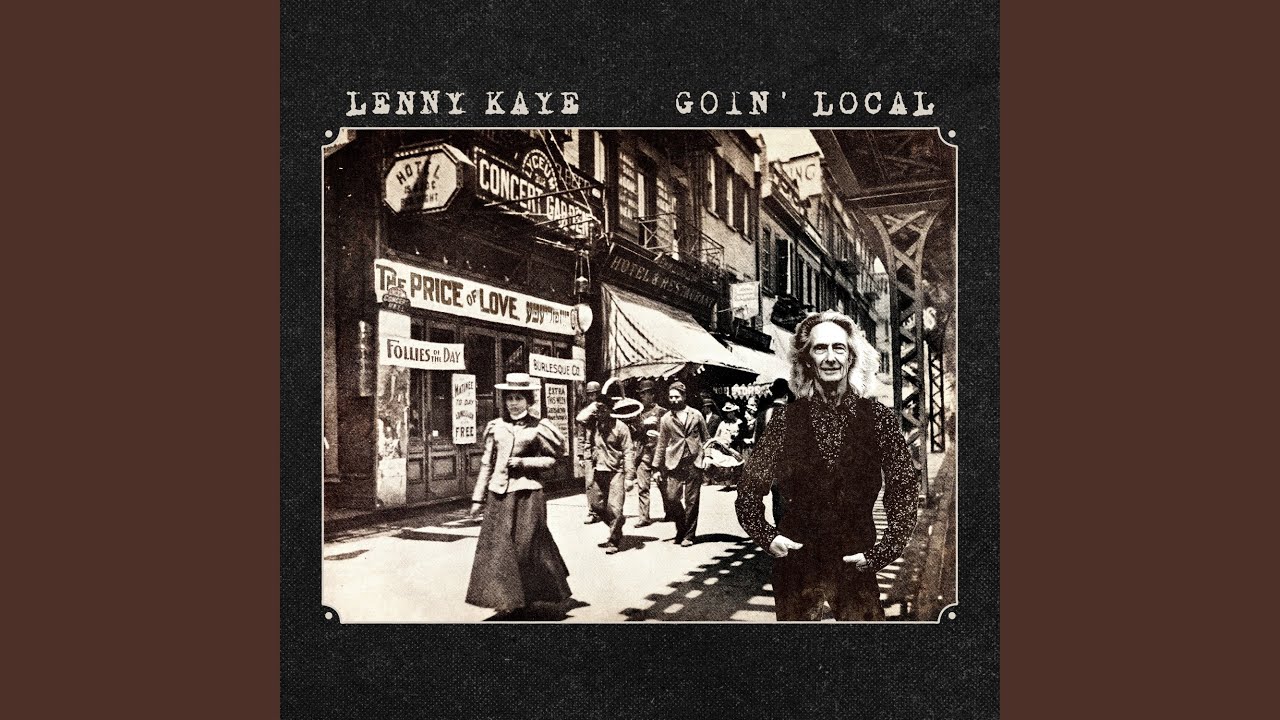
The idea that Lenny Kaye is releasing his first solo album — the new Goin’ Local (Yep Roc) — now, at the age of 79 and after more than 60 years of performing, comes as a surprise.
Make that a shock.
The New York–born Kaye (née Kusikoff), who now makes his home in eastern Pennsylvania, is best known as the guitarist and chief lieutenant in the Patti Smith Group, which he was part of from 1974 to 1979 and, since 1996, co-producing three of her albums during that second tenure.
He curated the acclaimed 1972 compilation album Nuggets: Original Artyfacts from the First Psychedelic Era, 1965–1968 and produced albums for Soul Asylum, Suzanne Vega, James, Cindy Lee Berryhill, the Shams and others, and guested on R.E.M.’s 2011 album Collapse Into Now.
The Rutgers University grad has also written for a number of music publications and has penned a pair of books — You Call It Madness: The Sensuous Song of the Croon in 2004 and 2022’s Lightning Striking: Ten Transformative Moments in Rock and Roll... — as well as co-writing Waylon Jennings’ autobiography in 2012.

He’s still playing select shows with Smith — including a Riot Fest slot on Sept. 20 in Chicago — and maintains what he calls a “goth/psyche/jam band” called Adrift. And he hosts The Lenny Kaye Program on SiriusXM’s Underground Garage channel.
That’s a lot, but somehow an album of his own never made it to the docket — even though he did start his own band, the Lenny Kaye Connection, during the late ’70s and contributed a track to Daddy Rockin’ Strong: A Tribute to Nolan Strong and the Diablos in 2010. Goin’ Local features 12 songs written over the course of decades, and he started recording six of them during the early 2010s with Patti Smith bandmate and bassist Tony Shanahan.
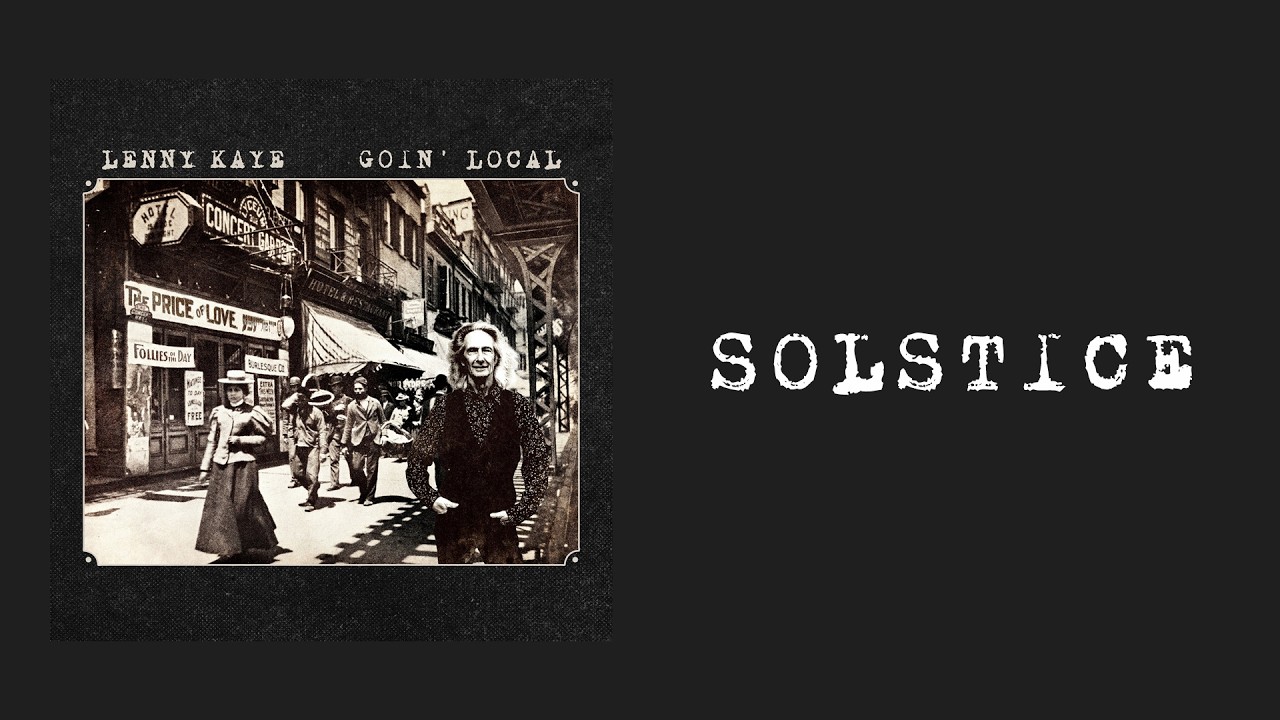
He gets his rock on for the title track and “A Friend Like You,” but the overall tone is more gentle, nuanced and reflective — even sentimental — on songs such as “Let’s Make a Memory,” “Be That As It May,” “The Things You Leave Behind” and “Solstice,” which he co-wrote with Smith.
There’s a hint of bemusement as Kaye talks about the project via Zoom, guitars and a keyboard visible in the background alongside a handsome wood bookcase.

So how have you managed to get this far along without doing an album of your own?
Well... [laughs] To be honest, you always make yourself the lowest priority on the list. It’s not as if I’ve been sitting around over the years; I’m always doing a lot of stuff, and sometimes you just don’t get to something like the album. Basically, the time wasn’t right. I had an assemblage of songs, but I’d keep writing, and when I felt like the songs I had made a whole, that’s when I decided it was time to reveal them to the world.
And it was helped by the fact that out here in northeast Pennsylvania I found a studio close to my home, called Mix-o-Lydian, where I could just call up the guy [Don Sternecker] and say, “Hey, let’s record this afternoon,” and go over there and work on songs without any sense of direction or commercial sensibility, or trying to create a different persona for myself. You do that several times and you start finishing things that began far too long ago.
So when I finally had enough I thought, “This is who I am at this moment in time. It’s ready to be heard.”
How big of a body of work were you drawing from?
I don’t write many songs — one or two a year, perhaps, when I feel the need to examine an emotional intersection in my life or talk about something in time and space. I believe songs need to be written. There are so many songs out there, and I’m just not one to kind of churn ’em out. I feel like they need to have a place in this world of music.
Have you tried to do an album at any point before?
I did some work in the ’90s with my band at the time — Tony Shanahan on bass, Mark Sacco on drums — then the juggernaut of Patti reappeared and that kind of got shelved. Then I did some sessions with Tony and Mark around 2010, 2012; six of the Goin’ Local songs actually began then. I never completed them, but I got to see what they were like. Then over intervening times I’ve written other songs, some of them acoustic-based.
And a lot of those became part of Goin’ Local.
The album is not quite as rockin’ as people might assume, given my history. But it felt like this new persona for me — vulnerable, honest. I’m not trying to surf on any genre here; I have my goth/psych/jam band Adrift, which is darker and louder and noisier. But this album is just me, as open-hearted as I can be.

Were you surprised by that as well?
I’ve always had a romantic streak. I’ve always liked so many different kinds of music, and I don’t like to be confined by genre. I just did what felt natural. Patti said to me — and I appreciated this — “I’ve never heard you sound like this before,” and I agree. It’s a way for me to reveal some of my inner feelings and wear my heart on my sleeve for many of the songs.
I’m very many things. I know I have a great reputation for garage rock, and I love garage rock, but it was the music I made as a teenager, and whatever I’ve done in the past, for me as an artist it’s in the past. Over the years I’ve moved through many musics to understand them. I love free jazz. I love country-western music, even though I’m a fairly substandard steel player. I love folk music. I love reggae. You name the genre, and I’ve spent time unlocking its secrets and bringing it into my music.
I feel at this point I can draw upon 60 years of living music and seeing where it’s placed me and seeing how I can develop further as a musician. I’m very work-oriented and very future-oriented. I have no desire to rest on my supposed laurels. What I’m most interested in, when I get up every morning, is what I’m working on, the songs that are taking shape in my head now.
One of the best solos on the album is on “A Friend Like You,” which is a Stephan Eichar song. What led you to do your own version of that?
There’s not a lot of co-writes on the record, ’cause a lot of it took shape in my living room, when I’m sitting there with a guitar. I found that song in Paris one time when I was there in the ’90s; I just heard it on the radio, and I liked it. I was able to buy a copy of it at the local store, and it set off a sense that I might be able to write lyrics, English lyrics, to it — which I did, with Stephan’s encouragement.
There are two guitar solos in there, and there were in his version, too. The first one is kind of strong but plain, the second one is a little more amped-up. So I was able to kind of embrace this build within the guitar solo, and I think it came out particularly well.
“Solstice” was written with Patti. What’s the story there?
That’s one of the oldest songs on the album, that and the title track. We came about it in the way that things usually come with us; there’s an idea aligned with an interesting guitar lick, and then an expanse of it as it grows.
And as this one grew, Patti felt it reflected my new persona and my sense of the celestial, possibly from my years as a science-fiction fan. She said, “You should sing it,” and so I did. It was kind of left aside for a while, and then I felt it had quality and kind of revisited it, and it grew into its own animal — especially the last half, which was kind of an open plane waiting for something, and I was happy to have the opportunity to fill it.
Maybe the nicest story here is “Yes I Will,” which you wrote to lyrics by your uncle, Larry Kusik — who wrote some notable songs himself, like “A Time for Us” [from the 1968 film adaptation of Romeo and Juliet] and “Speak Softly, Love” [a.k.a. “Love Theme from The Godfather].
My Uncle Ku was great. I made my first record with him, this folk-protest song [“Crazy Like a Fox”] that he wrote with his partner Ritchie Adams. I was in a band called the Zoo, playing Rutgers fraternity houses, but I’d never been in a studio before, so it was kind of exciting. It came out on a record under a pseudonym, Link Cromwell; it wasn’t a hit, which is probably good for me, since it would’ve changed the trajectory of my life. But it gave me a sense that I could be a part of music in some way, shape or form. I just didn’t know how.
With “Yes I Will,” toward the end of his life I would go up to the Upper East Side, where he lived. I would take him out in the car and we’d look at his old neighborhood, go have dinner somewhere. One day I asked him for some lyrics and he gave me that beautiful, beautiful song which, to me, is one of the most simple expressions of fealty.
I put it to music and went up to the hospital to sing it to him. He said, “Thank you,” and the next morning he passed. So I was able to tell him how much his encouragement and inspiration meant to me.
What’s the relationship between Lenny the songwriter/artist and Lenny the guitar player like?
All these pieces are part of the puzzle to me. I’m not a virtuoso. I’m not trained. I don’t read music, unfortunately; if I’d known I would be playing guitar 60 years later I might have learned how to understand those notes so I could pick up a piece of sheet music and understand its theory. [laughs]
But I’ve learned how to be myself. Perhaps that’s encouraged other skills — for one, improvisation, playing by ear, getting a sense of the neck of the guitar and where to go without sometimes knowing what the scale is or what the note is. I’m very instinctual as a player; I think that helped me very much with Patti that I didn’t bring a raft of Chuck Berry licks to her music, that I was able to move with her breathing in a way that was very mobile.
All the songs I’ve learned, all the ones I’ve forgotten, all the musics that I’ve spent time in, trying to figure out how the one-drop in reggae works — all of that kind of funnels into who I am as a musician. I believe there’s a definite connect with dexterity and musical imagination that makes these geniuses apparent. I’m not that. I’m more of a journeyman guitarist, rhythm-based, and when I take a solo I like it to sing like my voice sings during a song, that it’s not just a flurry of notes that have no destination.
I’m an intuitive player. I don’t analyze what I play; I might analyze it later to figure out why this particular chord progression did what it did, but I don’t think about the persona. I think about the music. I think about the space between one note and the next, because that’s music in the present tense. As a musician I just feel like I can draw on 60 years of experience of not knowing where the song is going and trying to figure out my way in it. Sometimes it requires me closing my eyes and imagining what I want to play, and hopefully those notes fall into my hand.

What’s your instrument situation these days?
My main guitar is a 60th Anniversary ’68 Fender Stratocaster that the band gave me on my 60th birthday back in 2006. It’s my main instrument, and what distinguishes it is it only had one pickup, the middle pickup... ’cause I never flicked a switch. I never played the treble. I never played the bridge pickup. I just played the middle pickup, full volume, full tone.
One day I came in and my guitar tech at the time had taken out everything so I just had the one pickup; he cut the pickguard and it was just me and the volume knob. Point and shoot. I call it the Eunichcaster, and really that’s all I need. That’s my main guitar.
Anything else around that might make our mouths water?
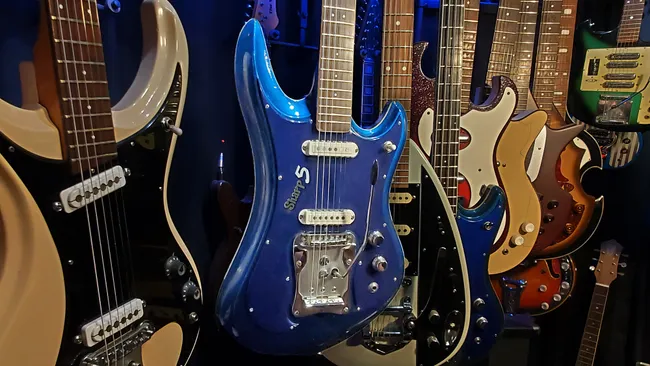
I don’t know if they’ll make mouths water, but they quench my thirst. I have a couple of oldies. I have a 1964 Stratocaster that I bought after my 1962 Stratocaster was stolen in Chicago; I love that guitar, and I have a ’68 Les Paul Custom that Cesar Diaz, the great amplifier technician, sold me. When I moved to Pennsylvania he turned out to be a neighbor, and he was always busting my chops — “You think you know how to play the blues? I’ll cut the top two strings off your guitar and we’ll see how well you play!”
And one day he says, “You don’t have a Gibson?!” I had an SG, but he was still like, “You don’t have a Gibson,” so he sold me this guitar. And it’s a really great Gibson because in ’68 they changed something; I’m not enough of an obsessive to know exactly what that is, but I would always play it for special occasions, or an overdub.
And in Adrift I wanted a heavier sound, so I’ve recently started playing it all the time in that band. I always thought Les Pauls would be harder to play than a Stratocaster. Not true; it’s really simple, and it sounds great. That guitar has so much great work to it.
So I’ve gone over to the dark side in the Fender-Gibson wars. I also have a beautiful Mosrite 12-string, and the acoustic guitar that I play is a Collings, which I have to say is the most beautiful acoustic guitar I’ve ever played, just so resonant and such a great sound. I’ve had it for over 20 years now, so it’s really settled into how I play guitar.
Amps and pedals?
I’ve downsized considerably over the years, and actually I’m amazed at how much better I sound. I have a Magnatone 213 from the early ’60s, which has real vibrato and just sounds so silken. I have a ’65 Fender Princeton that I usually use for recording and in my solo show, and if I need more firepower I have a Fender Deluxe reissue with a Celestion in it to give it a little more chest.
For pedals and effects I try to keep it simple, ’cause you can have so many doo-dads. Once I get my sound I’m not gonna change it that much; I might change a guitar here and there if a performance needs something radically different, but my pedalboard is the basic food groups — Fulltone [Fulldrive] 2 for the push, Boss digital delay, a Julie chorus, which I find to be quite shimmery, and then a wild-card spot where you can put a phaser or a weird reverb or something you might need, even though I hardly ever step on it.
I’m really pretty basic as a guitar player, especially live; I find that you’re not going to hear a lot of the subtleties — maybe in the studio you will. But live you stick on the fuzz tone and you’re good to go.

You mention the guitar theft rather casually.
I’ve lost so many guitars over the years. I remember in the mid-’70s we were playing Chicago, the Aragon Ballroom, and I put my ’57 Strat in its case and left it in the dressing room for the crew to pick up, and when we got to the next stop, Detroit, I opened it up and no ’57. The ’62 went; they took our entire equipment truck — again in Chicago, including the T-shirt that I left on my amp the night before.
I lost a beautiful Fender Precision bass in that as well, and my white Les Paul with the Lion of Judah inlay on the headstock. I’ve never seen any of them since. I have to say that my current Strat, the 60th Anniversary one, I would miss that one.
But, y’know, they’re a piece of wood and strings. Instruments are tools. If I’m in a good place and the instrument is not unfriendly, I’ll be able to play the same on it as I might with my own gear. The only thing you can’t replace in my sound is me. [chuckles]
Can we expect another album from you in less than the, whatever 60 or so years it took to get Goin’ Local?
I certainly hope so! [laughs] I have songs that weren’t right for this record that I have in my back pocket, and I’ve written at least three songs since then. So I’m just gonna keep going, because at this point in my creative life I have no expectations. I don’t particularly understand how the music business works or how people acquire what you do anymore. I just like doing this, and at this point I’m free to do what’s in my heart. I’m a slow worker; I don’t think there’s gonna be another record in the next three months, but I do have eight songs with Adrift, which is kind of a different side of my personality.
You’re the master of your domain, as it were.
I’m just having a really good time, because I’ve earned it. I’ve done pretty much what I’ve needed to do, so all this is a bonus beat. It’s so rare to be able to make a career and a financial living in music, and I’m so grateful I’ve been able to keep my head above water. I’m not a rich rock star; my only indulgence is a couple of beautiful guitars and my 1961 Thunderbird.
I’m enjoying this album. I’m enjoying taking it out on the road; at this point I’m just a solo artist, ’cause it’s portable and affordable, so I’m up there like the folk singer I always hoped I would be — before I saw the Beatles. [laughs]

