
On 7 July, 1967, the Beatles released All You Need Is Love, a song that seemed to capture the spirit of the Summer of Love. The song had been debuted live just twelve days earlier, in extraordinary circumstances: in front of a load of friends – including Keith Richards, Mick Jagger, Eric Clapton, Keith Moon and Graham Nash – for a BBC broadcast that went live to 14 different countries and an audience of over 400 million.
Now that's a pressure gig.
The Our World program was not intended to be the global launch of the new Beatles single All You Need Is Love, but that's how it turned out. Our World was the first ever international satellite television show, with segments from all the participating countries. The UK's segment featured The Beatles, with a song either written by John Lennon especially for the occasion, or chosen because its message could be easily understood by its international audience. (McCartney thinks it was the latter.)
The backing track for the song had already been laid down at Olympic studios a couple of weeks before and overdubs added at Abbey Road. The One World broadcast cued up the performance as though the viewers were catching the band just as they were about to nail the final take. It wasn't a complete ruse: Lennon was singing live, McCartney playing bass live, and George Harrison would play guitar live. (Live drums would have leaked into the other mics, so Ringo was spared.)
Below is the original broadcast and a new colorised version.
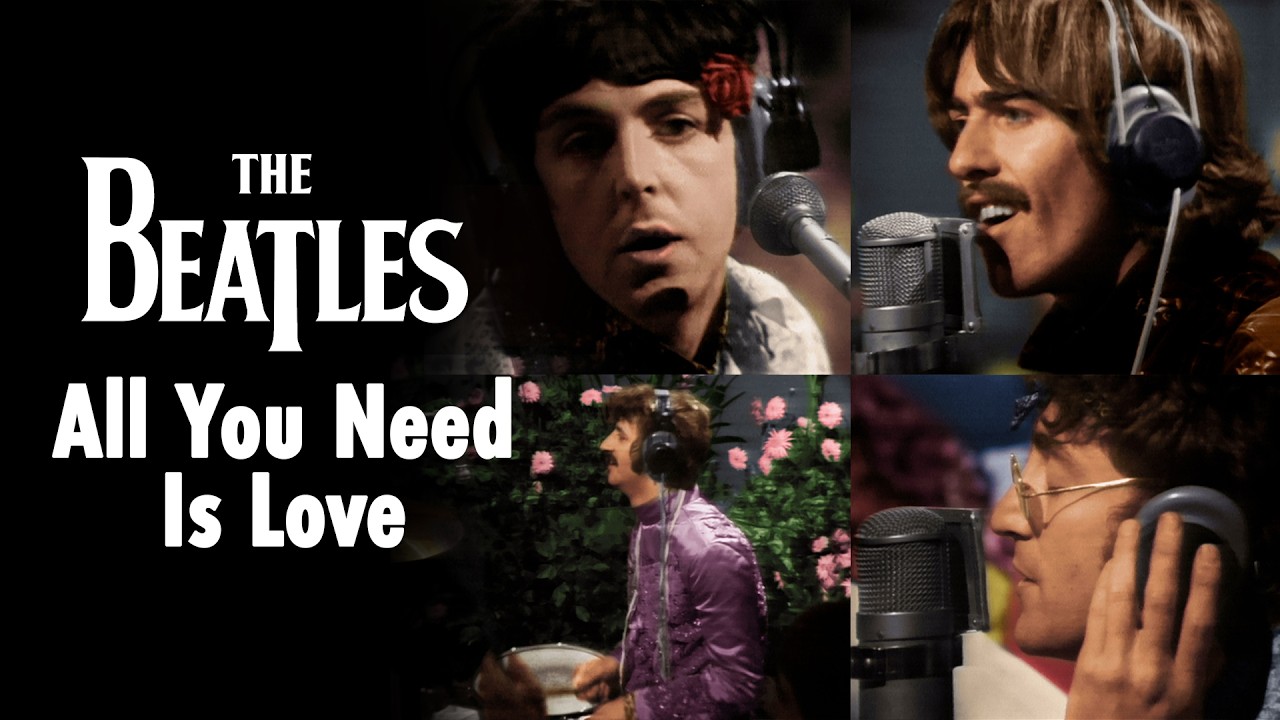
The way sound Engineer Geoff Emerick remembers it, the day before the broadcast, Brian Epstein talked the band into rush-releasing the performance as a single.
"John, of course, was keen," says Emerick, in his book Here, There And Everywhere, "it was his song, after all. It didn't take much effort to talk Paul into it, either... Only George Harrison was reluctant; presumably he was worried that he might muff his solo, even though it was only four bars long. He was finally persuaded when George Martin assured him that we could stay late afterward and do any necessary repair work.”
Of the performance itself, he adds: "John came through like a trouper, delivering an amazing vocal despite his nervousness and the plug of chewing gum in his mouth that he forgot to remove just before we went on air. Paul's playing, as always, was solid, with no gaffs, and even George Harrison's solo was reasonably good, though he did hit a clunker at the end."
He did hit a clunker – seemingly starting to play after the fourth bar, before stopping to let the orchestra in. An easy mistake to make, it's meant that the solo (around 4:08 on the original video, 1:19 on the new version) has appeared on "Worst Solos Ever" lists ever since.
Which is harsh. Everyone makes mistakes, after all. The question is: Why didn't they fix it later? The following day, Lennon laid down a new vocal and Ringo added new drum parts – why didn't the guitarist perfect his solo?
It's a question that's vexed Beatles fans and guitar players for decades.
Emerick thinks that Harrison was just assured it could be fixed in production: “From the very first playback, the four Beatles were knocked out by what they were hearing. Harrison winced a little during his guitar solo, but Richard [assistant engineer Richard Lush] took the initiative and reassured him, saying, 'It'll be fine; we'll put a little wobble on it and it will be great.' In the end, all we had to do was add the effect and duck the last bad note.”
The band were also up against a tight deadline. The single was released on July 7, just 12 days after the performance, a quick turnaround in 1967.
And maybe The Beatles were no longer striving for perfection. In his definitive book, Revolution In The Head, Ian MacDonald suggests that, after the rigours of Sgt Pepper, the band were happy to leave in some imperfections.
To paraphrase Lennon: there's nothing you can play that can't be played. It's easy. Unless, that is, there's 400 million people watching.

