
Van Halen had a rule: No one in the band played on anyone else’s records.
So how did Eddie Van Halen end up delivering one of the most famous guest electric guitar solos of all time on Michael Jackson’s “Beat It”?
According to the guitarist, everyone else in the band was out of town, and he figured no one would mind — or even notice — if he made one exception. Speaking years later, Van Halen explained why he broke the band’s longstanding policy against outside sessions, why he never accepted payment for the performance, how he rearranged part of the song before recording his iconic solo and why those last-minute changes left Steve Lukather and the Thriller team scrambling behind the scenes.

Released in 1982, “Beat It” became one of the biggest singles of the decade and helped propel Michael Jackson’s Thriller to historic success. Producer Quincy Jones enlisted Toto guitarist Steve Lukather — who tracked the song’s now-iconic opening riff and much of the album — before calling on Van Halen, then rock’s biggest guitar hero, to record the solo.
I didn’t ask for anything. It was about 20 minutes out of my life”
— Eddie Van Halen
Speaking on Piers Morgan Live alongside LL Cool J, Van Halen was asked why he hadn’t been paid for the session.
“Well, I didn’t ask for anything,” he replied.
“It was about 20 minutes out of my life,” he said. “Quincy had called me up and asked me if I wanted to do it, and the honest-to-God truth, it was the band’s policy that we didn’t do things outside of the band at the time.”
Even so, he figured he could quietly make an exception.
“Everybody’s out of town, so I had no one to ask,” he said laughing. “I figured, who’s going to know if I play on this black kid’s record?”
He was joking, of course. “Beat It” became a worldwide smash, with estimated sales exceeding 10 million copies, and Van Halen’s unmistakable solo became one of its defining moments. Alex Van Halen has since suggested the appearance only heightened tensions within the band, calling it one of the factors that contributed to David Lee Roth’s departure and eventual solo career with Steve Vai.
Despite describing the session as little more than 20 minutes of work, Eddie said he did far more than simply improvise a solo.
The funniest thing of all was I actually rearranged the song. I said, ‘Oh, I hope you don’t mind, I changed your song.’”
— Eddie Van Halen
“The funniest thing of all was I actually rearranged the song,” he explained. “The section they wanted me to solo over had no chord changes underneath it, so I had to rearrange the song. And then Michael came in, and I said, ‘Oh, I hope you don’t mind, I changed your song,’ and he listened and went, ‘No, I really like that high, fast stuff you do!’”
According to Lukather, those last-minute changes created a major headache behind the scenes.
Speaking on the Roundtable with Drew podcast, he recalled that Van Halen’s decision to move the solo required engineers to physically edit the two-inch master tape, damaging the SMPTE time code that kept the various recordings synchronized.
“We had to make the song backward,” he said. “Quincy had cut another version with Michael’s vocals quintupled; they really worked hard on that vocal. Then they sent the tape up to Ed’s house to Donn [Landee, his engineer], and they cut the two-inch tape, which fucked the SMPTE code, which means they couldn’t sync up the master.
“So they had a two-inch tape with Michael’s pristine vocals, and then Ed decided he wanted the solo [somewhere else], so he put it together and sent it back to him, and it wouldn’t sync back up.”
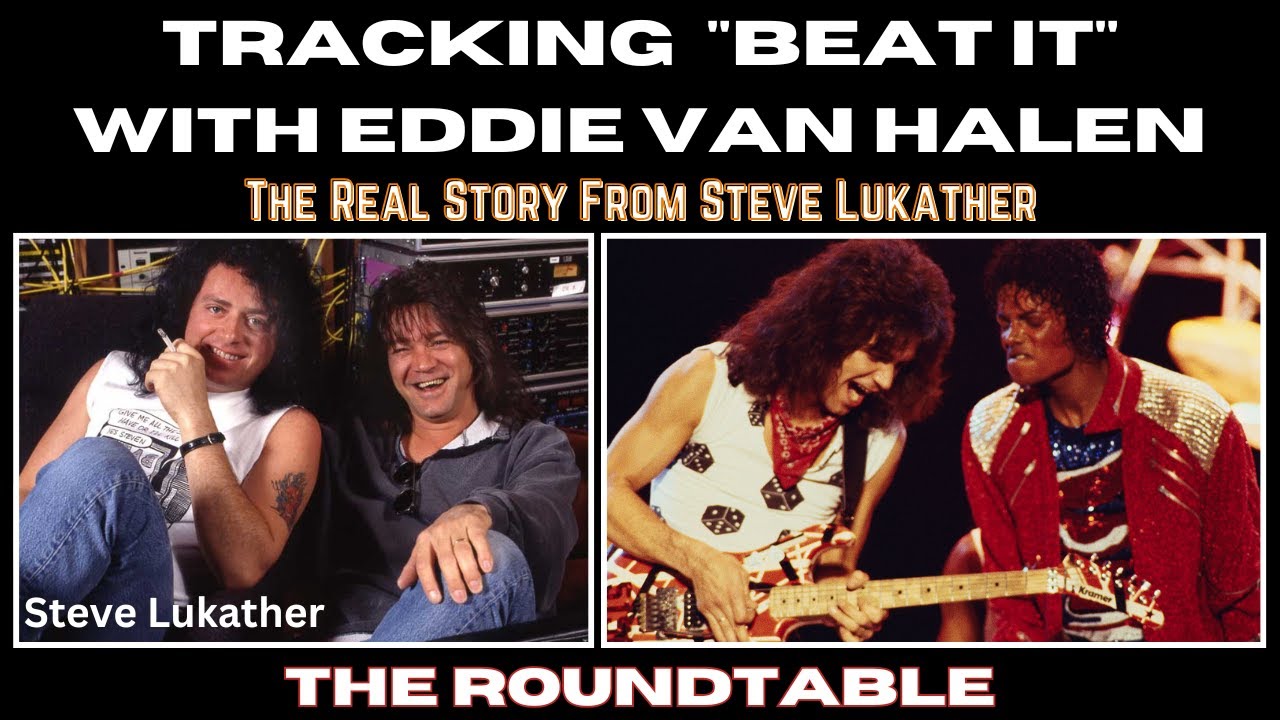
Lukather said reconstructing the master became an exhausting process. Along the way, his own quadruple-tracked rhythm guitars — “I had to make this right for Eddie,” he quipped — were reduced to a double-track, while a Marshall stack was swapped for a Fender Deluxe to give the track a warmer sound better suited to Jackson’s R&B audience.
When Van Halen reflected on Jackson during his Piers Morgan Live appearance — recorded four years after the singer’s death — he also pushed back against the allegations that had surrounded the pop icon.
“He was a sweet guy, is all I know,” he said. “He got accused of a lot of things, [but] I think he wanted to remain a kid himself.”
Lukather, meanwhile, remains part of the conversation surrounding Eddie Van Halen's musical legacy. Although he has insisted he won't play on what is expected to become the final Van Halen album, he has been working with Alex Van Halen as the drummer continues developing the project. Steve Vai has also praised the quality of Eddie's unreleased material, further fueling anticipation for the long-rumored release.

