
Nearly 40 years have passed since Johnny Marr walked away from the Smiths. It was 1987 when a communication breakdown between the guitarist and the group’s frontman, singer Morrissey, caused him to leave the group.
But as he tells Britain’s Channel 4 News in a new interview, he still has fond regard for the group and the years when he and Morrissey crafted the group’s catalog of cherished songs.
Marr explains that the Manchester scene in the 1980s was home to Factory Records, which was known for acts like Joy Division and New Order. The Smiths chose to go with a rival label, Rough Trade.
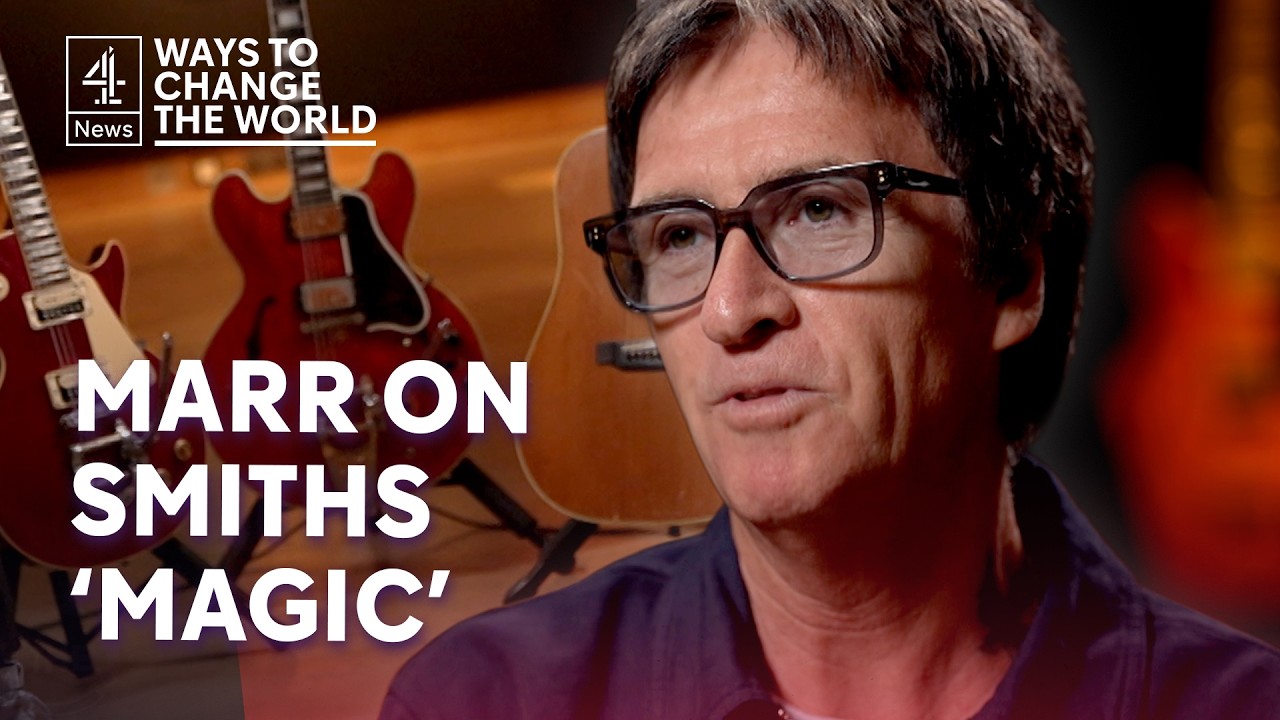
“I was working in a clothes shop when the band was formed, and other Mancunian musicians used to come into the shop, and most of them were on Factory Records,” Marr explains. “So because of the shop, I knew everyone on Factory, and it was the obvious thing to do to sign to Factory. And that became a narrative.”
Factory Records owner Tony Wilson never signed the Smiths, to his great regret. But Marr says that was unlikely to have happened.
“I was never going to sign Factory. Personally I would never let that happen because it was just too obvious, and it wasn’t that kind of music either.”
Factory acts “weren’t guitar bands per se,” Marr says. “They were doing other things with funk and keyboards... different, almost like non-guitar bands. So it was very deliberate that we were going to be a guitar band, and that was my role in it.”

Marr also reveals how he and Morrissey wrote together. Although sometimes their sessions took place separately — Marr writing the music and passing a tape off to Morrissey — he says of the early days of their writing, “We’d get together face to face, and I’d go, ‘I’ve got this.’ And then I’d record it on the tape machine and he’d take the cassette away.”
Later, “when I’d made a few hundred quid,” he purchased a Tascam Portastudio. “I would make these slightly more elaborate demos with a little drum machine and about three or four guitars on top, and then I’d get on my motorbike and ride round because he lived around the corner 10 minutes [away], and I’d drop it through his letterbox.”
But Marr’s fondest memories are of the making of the group’s 1986 third album, The Queen Is Dead. He recalls how he and Morrissey would sit just a few feet apart with a Walkman cassette player between them.
“It was amazing,” he says. “It was magic. I’d literally have the guitar and I’d have the cassette machine between my knees and I’d go, ‘I’ve got this one.’ And I’d press record.
“I think when I pressed ‘record’ the two of us breathed in, and then when I finished we then breathed out. That’s what it felt like.
“Any songwriter will tell you it’s the best feeling in the world.”

Marr also reveals that he wrote songs in threes, anticipating how Morrissey, bassist Andy Rourke and drummer Mike Joyce would embellish his chords with their contributions.
“It was the greatest,” Marr says. “We’ve got three new Smith songs. I can’t wait to hear what the words are. I can’t wait to hear what the vocals are, what the bass is, what Andy does, and what Mike does.
“Man, it was magic!”
Marr is celebrating the results of his guitar auction, held September 16 at Christie’s. Nearly 100 guitars — electrics and acoustics — from Marr’s collection went under the hammer, raising more than £3.6 million for the Guide Dogs for the Blind Association and the Autistic Society.

The guitarist spoke about a few of the instruments in his Channel 4 interview, highlighting the 1959/1960 Gibson ES-355 he got when the Smiths signed to Sire Records in the U.S. (and which sold at the auction for £204,800).
“We were about to do our record deal with Sire Records in America and the head of Sire Records was a really famous guy called Seymour Stein, and he’d been around since the ’60s. I was getting these stories out of him about the Rolling Stones, and he happened to say that he got Brian Jones a couple of guitars in the ’60s. So I saw my opportunity there, and I said to him, ‘Well, look, Seymour, if you get me a guitar, we’ll sign.’
“True to his word. We trudged across in the snow to 48th Street, New York.”
Marr found what he wanted at We Buy Guitars.
“I looked through the window and I saw that hanging up on the wall. And then I darted back to the hotel that we stayed in, and I started playing it. And the very first thing I played was ‘Heaven Knows I’m Miserable Now.’ And I always say that guitar definitely had that song in it. I mean, I know it was. It might seem a little cosmic, but I know that certain instruments have music in them.”
