
Johnny Marr has just made headlines after selling nearly 100 guitars from his collection for just shy of $5 million at auction. That’s a lot of cherished instruments to let go of, but it turns out he only feels he — and every player, in fact — needs three specific guitars.
During last week’s Christie’s auction, the former Smiths guitarist saw several of his historic instruments fetch six-figure sums. A whopping £3,649,280, or around $4.87 million, was spent during the auction, with the money going to selected charities.
During a recent interview with one-time Top Gear host Chris Evans for Virgin Radio, Johnny Marr made it clear why he was happy to slim down his collection. He was asked a hypothetical question: If he could only have three guitars in his life, what would he choose? He answered it with ease.

First up is a bona fide classic electric guitar.
“So, you get a Gibson ES-335, ideally from between 1961 and 1963,” he says. “The reason is that they’re versatile, and they have a really rich, dark sound, made famous by Eric Clapton in Cream.”
As he says, one of Clapton’s main Cream workhorses was a 1964 Gibson ES-335 in its usual and iconic Cherry Red finish. As Guitar World reports, conflicting stories exist about how he got the guitar, but the most likely scenario is that he acquired it in 1968, which is why it became such an important instrument for Cream during the London dates of Cream’s farewell tour just weeks later.
It stayed in his collection until 2004, when it was auctioned off for his Crossroads charity. It sold for $847,500. That lineage, in turn, inspired Marr to get his own mid-’60s Cherry Red 335, with a ’63 model heard across his latest solo album, The Age of Everything.
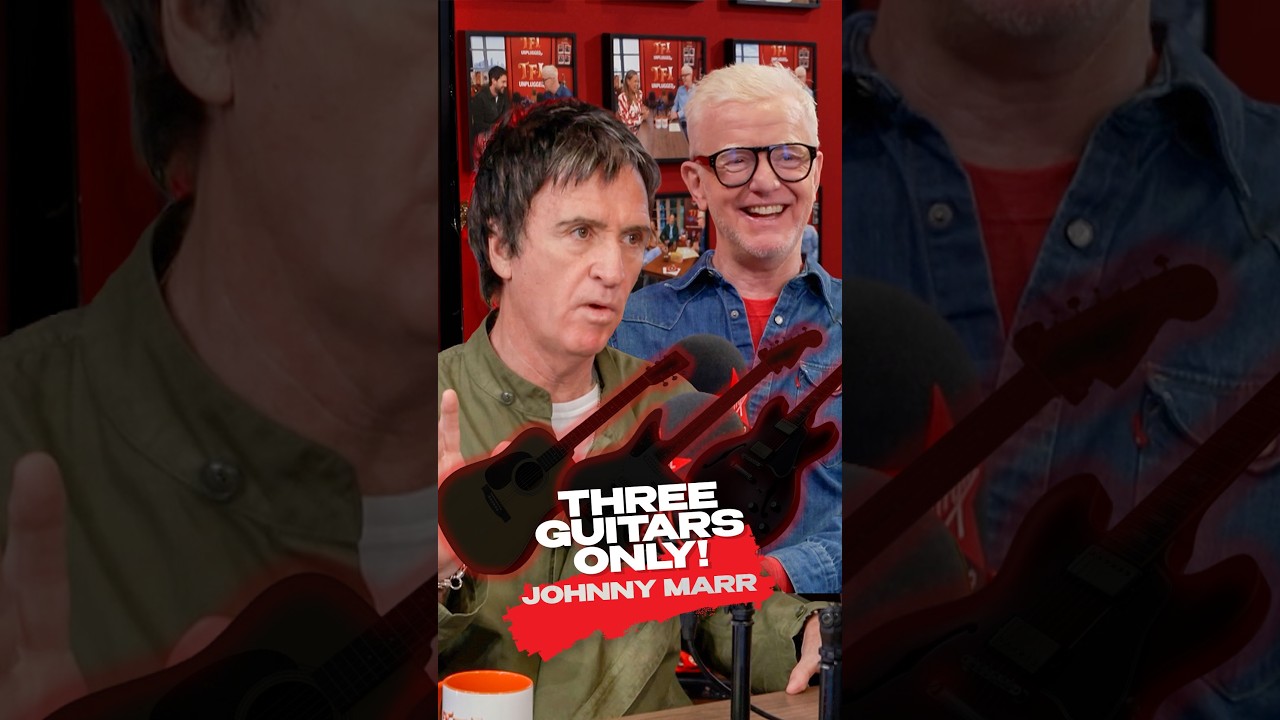
“They just do a thing that other guitars can’t do,” he says.
Next up, Marr picks a guitar even closer to home.
The way my signature Jag sounds, you don’t have to get a Rickenbacker, a Gretsch, a Jazzmaster or a Strat.”
Johnny Marr
“The other guitar, in all honesty, you get my signature Jag,” he explains. “The reason is because of the way my signature Jag sounds; you don’t have to get a Rickenbacker, and you don’t have to get a Gretsch, a Jazzmaster or a Strat, because, inadvertently, I ended up designing a guitar that does all the things [those three guitars do].”
Marr’s signature Fender Jaguar first arrived in 2012, with key features including a four-position Tele-style pickup selector that replaced the Jag’s high-pass filter and individual pickup on/off switches, allowing players to flit between the bridge position, both pickups in parallel or both in series.
Its bridge saddle is also inspired by Fender Mustang guitars, which have better tuning stability when abusing the whammy bar. It became one of Fender’s best-selling signature guitars.

An updated version arrived last year, and Marr reinvented the Jag all over again. New lipstick pickups and a whole new pickup system were noteworthy changes.
“I would have said you need a Rickenbacker for that jangle, and you need a Strat for that slinky sort of thing, and maybe a Gretsch for that ringing thing,” Marr extends. “Well, because all of those are encompassing sort of my sound, I realized after I designed my Jag, it did all three.”
Last but not least, he unplugs to complete the trio.

“Then I’d get a Martin acoustic guitar, a D-28, because if you’ve got to be able to play the acoustic,” he quips. “It’s a little bit of a clumsy comparison, but if you can’t, it’s like learning to drive an automatic car, then getting into a manual.
“Being able to play acoustic makes you infinitely better on the electric, and vice versa,” he reasons.
For Marr — a player with a hatred for satin necks and Yngwie Malmsteen — those guitars are the holy trinity. Other players may disagree, but it’s a versatile trio whichever way you look at it.
Elsewhere, he’s talked about his strange method to avoid impulse buying guitars, explained how Paul McCartney came to his aid when the Smiths broke up, and what made his songwriting tandem with Morrissey magic.

