
It’s been a year since Bob Weir and Dead & Company took over San Francisco’s Golden Gate Park for three concerts, August 1–3, 2025, celebrating the Grateful Dead’s 60th anniversary. The shows — Weir’s last before his death on January 10, 2026 — were a fitting showcase for his singular approach to the guitar: the unconventional chord voicings, rhythmic invention and musical interplay that made him such an essential counterpart to Jerry Garcia.
That distinctive approach was reflected in Weir’s collection of guitars. Over the years he spent as a founding member of the Grateful Dead — and afterward with groups including RatDog, Furthur and Dead & Company — Weir acquired about 100 electric and acoustic models, he said in the 2015 documentary The Other One.
Yet Weir told Guitar Player in 1998 that two guitars in his collection stood above the rest: an early ’70s Gibson ES-335, which he affectionately called “an old sweetheart,” and an Ibanez George Benson model with an especially unusual back story.
“I was working with Ibanez on some designs in the mid ’70s,” Weir told us, “and they showed me a new guitar that had just come in from Japan. I played it a bit, and they told me they had made it for George Benson. I told them, ‘No, you didn’t. You can call the police or do whatever you’re going to do to me, but I’m taking it.’
“It still has Benson’s name on it, and I’ve written so many songs on that guitar. I don’t know if George knows that ever happened, and I’d like to apologize to him.”
The story says something about Weir’s relationship with the guitar — but so does his role in the Grateful Dead. He was never simply the band’s rhythm guitarist, filling in chords beneath Garcia’s solos. His unconventional voicings and constantly shifting rhythmic ideas were a crucial part of the music’s architecture.

No one articulated that better than Garcia, who told Guitar Player’s Jon Sievert in the October 1978 issue that Weir was “like my left hand.”
“We have a long, serious conversation going on musically, and the whole thing is of a complementary nature,” Garcia explained. “We have fun, and we’ve designed our playing to work against and with each other.
“We have a long, serious conversation going on musically, and the whole thing is of a complementary nature.”
— Jerry Garcia
“His playing, in a way, really puts my playing in the only kind of meaningful context it could enjoy. That’s a hard idea to communicate, but any serious analysis of the Dead’s music would make it apparent that things are designed really appropriately.
“There are some passages, some kinds of ideas, that would really throw me if I had to create a harmonic bridge between all the things going on rhythmically with two drums and Phil [Lesh]’s innovative bass style. To solve that kind of problem as he does is extraordinary.”
Weir’s unconventional chord vocabulary had roots in his studies with blues guitarist Reverend Gary Davis, something Jefferson Airplane and Hot Tuna guitarist Jorma Kaukonen highlighted in an interview with Guitar Player late last year.
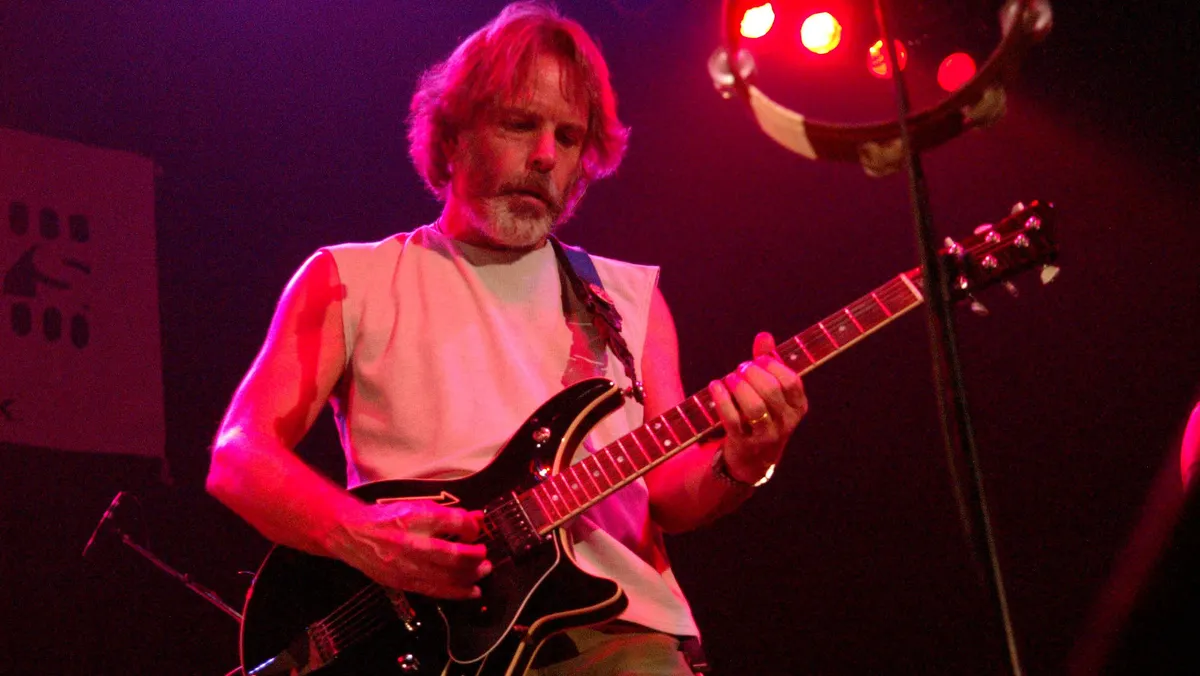
“Bobby’s a freaking genius on a lot of levels,” Kaukonen said. “He went and studied with Reverend Davis, and the chord shapes Bob used were Reverend Davis’s chord shapes, and these were not typical kinds of things most fingerstyle guitar players use. It was interesting, really interesting, ’cause he was playing with a pick, not his fingers. It was really cool, actually.”
That ability to approach the guitar from an unconventional angle remained central to Weir’s playing long after the Grateful Dead ended in 1995. He continued exploring the band’s music and his own songwriting through RatDog, Furthur and eventually Dead & Company, where he shared the stage with fellow Grateful Dead members Mickey Hart and Bill Kreutzmann, as well as John Mayer, Oteil Burbridge and Jeff Chimenti.
And Weir never seemed interested in simply preserving the past. In 1998, he told Guitar Player that the opportunity to keep reinventing himself was part of what made his post-Dead career so appealing.
“Not everybody gets a chance in midlife to reinvent himself,” he said, “and I’d be remiss to overlook that opportunity and challenge.”
A quarter-century later, he was still taking that challenge — and still finding new ways to make a guitar sound like nobody else’s.
