
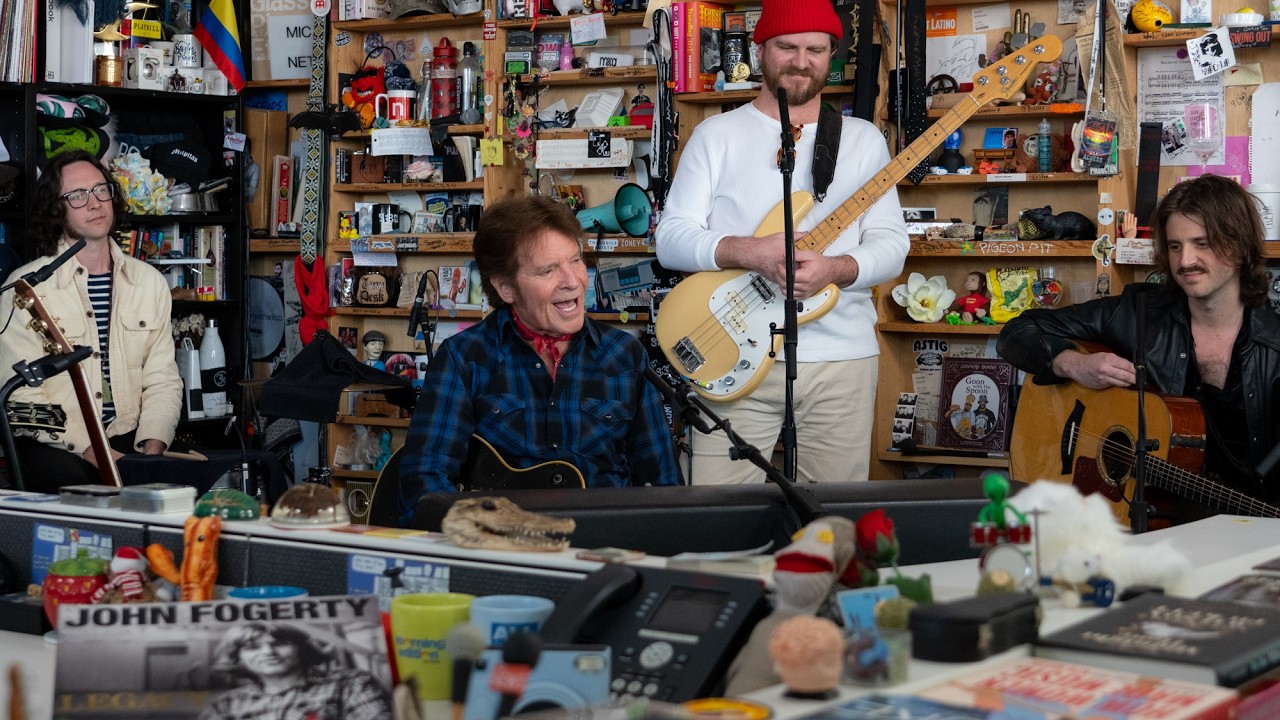
Creedence Clearwater Revival founder John Fogerty used his recent Tiny Desk concert for NPR as an opportunity to reflect on his humble beginnings as a songwriter.
The 80-year-old has renewed vigor after regaining control of his back catalog following a grueling 50-year legal battle that saw his songwriting inspiration “wither and die.”
The return of his beloved ACME Rickenbacker, a guitar he’d sold in the aftermath of CCR’s breakup in 1972, was just a precursor to his second life as a musician, leading to a new solo album, Legacy, on which he featured new recordings of CCR hits.
Thus, his appearance on NPR Music’s famed corner stage feels right, and it’s prompted Fogerty to look back on his roots, after a rousing, timeless performance of “Proud Mary.”
“You know, ‘Proud Mary’ was the first good song I wrote,” he says after the applause dies down. “I've been writing songs since I was about eight years old and in a pretty hap-dash way; finding a piece of paper and maybe a crayon or something to write words with. And all those years, I was learning and listening to the great people who inspired me.
“In 1968, I had already made a lot of records [with previous iterations of the band], but one day I found my honorable discharge on the stairs to my apartment house,” he continues. Fogerty had served six months of active duty in the military the year prior and had done everything he could to escape being sent to Vietnam, where war was raging.
“This is probably June or July of 1968, right at the height of the Vietnam War,” he adds. “I opened my discharge up, and I was really really happy, you know? I went right in the house, picked up my Rickenbacker guitar, started strumming, and the very first line that came out of me was ‘Left a good job in the city, working for the man every night and day,’ and I finished the song in less than an hour. ‘Proud Mary’ was finished, and I realized I had done something I'd never done before.
“It really felt different. And I looked at the page [of lyrics] that I had written, and I said, ‘John, you've written a classic. Wow!’ I’d written hundreds of songs from the time I was little, and I realized I had passed into the land of greatness.”
But this isn’t Fogerty blowing smoke up his own reputation. This was a man who’d spent nearly two decades honing his songwriting craft. Suddenly, it felt he’d arrived at the place he’d always wanted to get to.
“I don't mean that in a bragging way,” he confirms. “This song was so much better than anything I'd ever done. And I was literally kind of dumbfounded and shocked that it had happened. And then the second thing I realized, besides that it was a great song, was that I'm the only person in the whole world who knows about this song and knows that it's a great song. It was just the strangest feeling.”

Speaking to Guitar Player last year, Fogerty said he was “terrified” he might never write a hit as powerful ever again, citing a 19th-century composer as the song's muse. But of course, the hits began pouring out of him, and CCR quickly established themselves in the hearts of American audiences, even if he says the people were “asleep” during their famous Woodstock showcase.
That fear manifested itself in a hot streak for Fogerty, releasing three albums in 1969 alone, with songs like “Fortunate Son” finding their genesis in the Vietnam conflict. But history dictates that he was far from the one-hit wonder he feared that “Proud Mary” would turn him into, and across his five-song set in NPR’s Washington studio, he showed that with aplomb.

