
There were many great guitar moments at this year’s Songwriters Hall of Fame, but none can top the shred fest and sheer joy John Fogerty brought to the stage last night at NYC’s Marriott Marquis.
The youthful 81-year-old and newly honored recipient of the Johnny Mercer Award (the Hall’s most prestigious award) ended his mini set with an epic, blistering jam on “The Old Man Down the Road,” beaming with fatherly pride and tearing it up on the guitar while trading licks with his sons, Shane and Tyler.
The Mercer Award is given to songwriters who are already in the Hall and ‘whose body of work is of such high quality and impact that it upholds the gold standard set by the legendary Johnny Mercer.’

Fogerty began his five-song set with a harmony-filled short version of “Oh! Susanna” in tribute to both his mother and the 19th century American composer Stephen Foster, his first musical idol. He then launched into his singalong classics “Proud Mary,” “Have You Ever Seen the Rain” and “The Old Man Down the Road,” aligning himself as a legitimate link in the American songwriting lineage.
I had never pondered that someone created these songs that my mom would sing around the house.”
— John Fogerty
In his 26-minute speech, the Creedence Clearwater Revival legend told of his mother playing a record when he was a child.
“It was “Oh! Susanna” and the other side was “Camptown Races.” She played both songs a couple of times and said, ‘well Johnny what do you think?’ I’ like it!’ I said.”
“And then she said something remarkable: ‘You know, Johnny, the songwriter who wrote both of those songs is Stephen Foster.’ I had never pondered that someone created these songs that my mom would sing around the house.”
For the rest of his life, Fogerty said, “I’ve wondered about that little ceremony” and the impact it had on him as he discovered other classic songwriters, and ultimately his own skill at songwriting.
The first song he wrote, he continued, was titled “Wash Day Blues,” taken from a line from a radio commercial. The eight-year-old Fogerty set the lyrics against a Muddy Waters rhythm, “one of the most powerful things I could think of at the time. And it was current.”

Fogerty then showed the audience his original songwriting notebook, which he purchased when he realized he needed to be organized if he was serious about his craft.
“I wrote down the very first words in the book: ‘Proud Mary.’ I had no idea what the phrase meant but it’s there in the book.”
An Army serviceman faced with a life choice between continuing in the service or becoming a musician, he received an official government letter in the mail a year later granting him an honorable discharge at the age of 22.
“I ran outside and started strumming my Rickenbacker electric guitar acoustically. Pretty soon I’m singing,” left a good job in the city, working for the man every night and day.”
“I grabbed the notebook and there was the phrase ‘Proud Mary,’ and the word ‘riverboat.’”
Gene Simmons and Paul Stanley

This year’s inductees included Kiss founders Gene Simmons and Paul Stanley, Kenny Loggins, Alanis Morissette, Christopher “Tricky” Stewart, Taylor Swift, Walter Afanasieff, Terry Britten and Graham Lyle. The artist Raye received the Hal David Starlight Award.
Billy Corgan and John Rzeznik (a 2008 Hal David Starlight award honoree) might seem like an unlikely pairing, but both shared their love and admiration for Kiss and the band’s songwriting partners Stanley and Simmons. The two sang “Rock and Roll All Night” and “Shout It Out Loud,” opting to ditch their guitars for the set.
I had the Kiss poster on my wall as a kid before I ever heard Kiss. That imagery was like, ‘What is this? I want to know about this.’”
— Billy Corgan
In a red-carpet interview with Guitar Player prior to the show, Corgan said while he was a massive Rush, Yes and prog music fan growing up, “Black Diamond” was a favorite Kiss track. “Something about the atmosphere of the song and the makeup and being ten years old. I wanted to play that song a hundred times in a row.”
“I had the Kiss poster on my wall as a kid before I ever heard Kiss. That imagery was like, ‘What is this? I want to know about this.’ The music seemed to marry to the image for me, not the other way around.”
As a teen growing up in the suburbs, Corgan said “Gene challenged me in one way — the business angle — and Paul challenged me in another — to think about freedom and self-expression.
“Over time I really began to understand their brilliance as musicians and songwriters.” Gene’s bass playing, he said, “is more ‘50s doo-wop where Paul is more of a Free, Humble Pie, straightahead style. It’s a very interesting mélange of influences.”

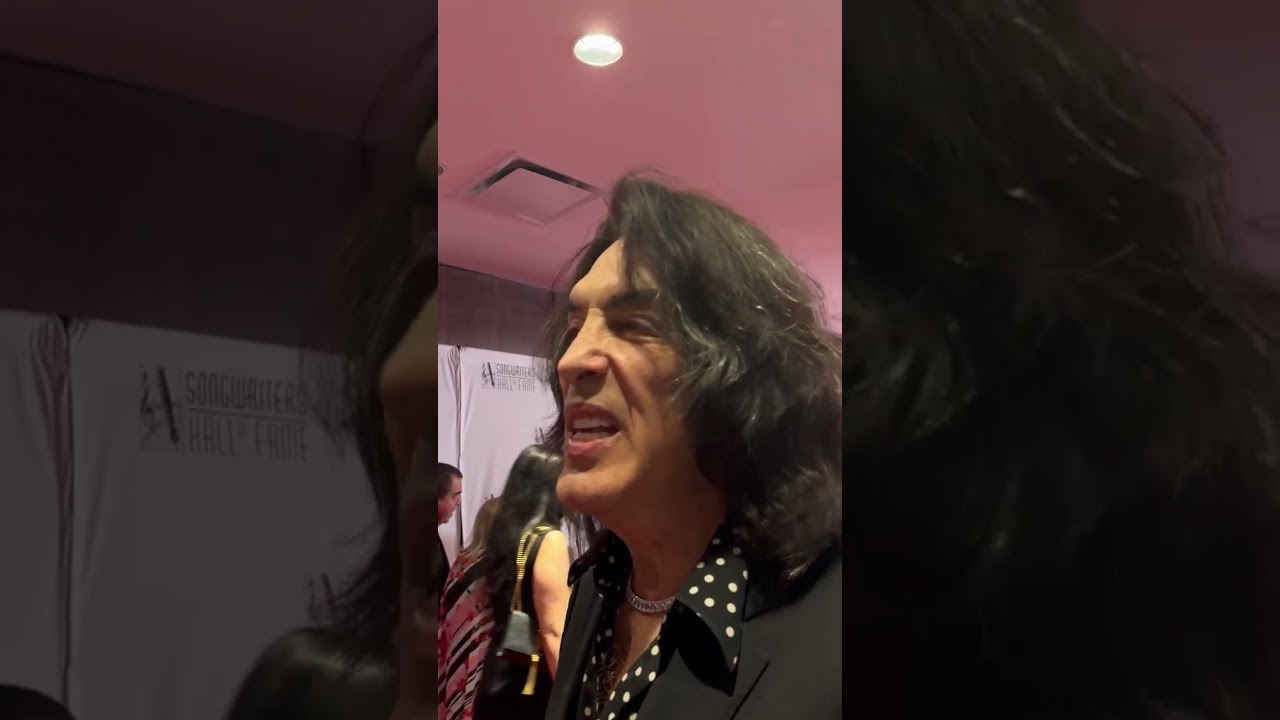
Simmons could not attend due to a family emergency and Stanley did not perform any of his classics at the event. But he did give a pre-show interview to this magazine.
“I wanted to be a great songwriter from the beginning,” the guitarist said. “I never wrote songs to jam on. I wrote songs to sing.”
I wanted to be a great songwriter from the beginning. I never wrote songs to jam on. I wrote songs to sing.”
— Paul Stanley
“That can seem simple when you are looking at a song like ‘Rock and Roll All Nite’ or ;Heaven’s on Fire’ or ‘Lick it Up.’ But it’s elusive and deceptive. Those songs follow the same formula as a lot of the great songs that inspired me. I was inspired by everyone who was working in the Brill Building.”
He also offered a juicy anecdote specific to this magazine.
“The first time we were on Guitar Player magazine, the guitar snobs at the time were horrified, that it had sold out. Then when the sales came in and it did better than other issues, everybody liked it! It opened the floodgates, not unlike some of the stuff Kiss has done.”
Taylor Swift

Film director Steven Spielberg paid tribute to Taylor Swift, the youngest female artist to be inducted into the Hall, noting “no algorithm can replace the soul of a true original who defies the status quo.”
Most people start with a six-string. Isn’t that right? But you were an overachiever at the age of 12.”
— Steven Spielberg, inducting Taylor Swift
Spielberg noted her dedication to her craft going all the way back to when “she first picked up a 12-string guitar. Most people start with a six-string. Isn’t that right? But you were an overachiever at the age of 12.”
Swift gave an emotional 21-minute speech, acknowledging her family, collaborators and the importance of the arts.
“Everything came together when I learned to play guitar at 12. I wrote my first song after learning my first three chords. It felt easy to work incredibly hard with this.
“It felt easy to nurture something I loved so much, to watch callouses form on the tips of my tiny fingers and to become a constant observer of the human condition, because people’s feelings, passions and motivations have always fascinated me, and it was easy to choose songwriting over everything else in my life.”
Madison Cunningham, Brandi Carlile, Alanis Morissette & Kenny Loggins

Other notable guitar highlights of the evening were more subtle, with artists using their instruments to complement and support the song’s lyrical meaning.
Grammy Award winner Madison Cunningham performed a stunning solo acoustic take on the Tina Turner classic “What’s Love Got to Do with It,” paying tribute to the songwriters and inductees Graham Lyle and Terry Britten. Using a Martin nylon string classical guitar in a dropped tuning, Cunningham’s gentle picking set the musical bed for the song’s emotional core.
Before the show, Cunningham spoke with GP about the song’s depth and importance.
The song is a “treasure,” she said. “It’s a very 80’s sexy song that bears a lot of heartbreak within it. I’m putting a different spin on it to showcase the lyrics.”
Alanis Morissette stripped down her classic “You Oughta Know” to two acoustic guitars and her vocal. Guitarists Julian Coryell and Jason Orme effortlessly weaved beautifully played single note runs and counterpoint lines in between Morissette’s breathy and focused lyrics of love gone wrong.
Brandi Carlile paid tribute to Morissette with an equally mesmerizing acoustic version of “Uninvited,” joined by the violin duo Sistastrings.
Kenny Loggins, whose vast catalog includes many guitar-centric classics like “Footloose,” “Your Mama Don’t Dance,” “Danny’s Song,” “Danger Zone” and more told GP of his relationship with the instrument.
“The guitar always has a mind of its own. I’ll be starting a song, and I’ll hit a chord and go oh that’s different. It will change the direction of the song.” While writing the classic “Danny’s Song,” he said, “the guitar showed up and added about six different chords than it originally had.”
