
Stevie Ray Vaughan’s first encounter with Jimi Hendrix didn’t come from some carefully curated record collection or a mentor’s recommendation. It came out of a trash bin.
As Vaughan recalled to Guitar Player in 1989, his brother Jimmie returned from a gig in Dallas one night with a discarded Hendrix album he’d found behind a club.
“The first time | ever heard Jimi’s name was when my brother brought home a record of his. | guess it was around '67, and Jimmie had found it in a trash bin. He recognized it because he'd seen a short paragraph about Jimi Hendrix in a magazine, and he knew he was supposed to be something really happening.”

“He put it on the record player, and what could you do but say ‘Yeah!’” Stevie laughed. “It really knocked my socks off.”
I would go in there and floorboard it—dress up as cool as I could and try to learn his stuff.”
— Stevie Ray Vaughan
At the time, Vaughan was still a teenager — barely 15 — and like so many of his generation, he learned guitar the hard way: by listening repeatedly until the music gave up its secrets. Hendrix’s records became a private master class in his room.
“I remember getting my little stereo — an Airline with the cardboard satellite speakers — and I would mic that up with a Shure PA that I had in my bedroom.
“For some of my first gigs, I’d rent four separate reverbs, and I’d have all this set up in my room. Of course, the parents were at work. I would go in there and floorboard it—dress up as cool as I could and try to learn his stuff.”
No instruction — just repetition, obsession, and a willingness to chase every nuance of the music on his electric guitar.
But Hendrix wasn’t just another technical hurdle. For Vaughan, he was proof that the blues could be something larger.
There seems to be a thing about it being sacrilegious to play Jimi Hendrix’s music. I think he would call bullshit on that”
— Stevie Ray Vaughan
By the time SRV was famous and speaking publicly about Hendrix, he was pushing back against the idea that his music was untouchable. In his view, Hendrix wasn’t an outsider to the blues tradition — he was one of its most radical extensions.
“Some people don’t see that Jimi Hendrix was a blues player,” he said. “I hear it in the way he approaches things. Even though he wasn’t ashamed at all of doing some things differently, I still hear the roots of the old style.”
That perspective carried directly into SRV’s playing. Hendrix material wasn’t something he kept at arm’s length; it was part of his live arsenal. And he never treated that decision as controversial.
“For some reason, there seems to be a thing about it being sacrilegious to play Jimi Hendrix’s music. I think he would call bullshit on that,” he said from a London limo in 1988. “I may be wrong, but it seems he would want his music to be out there, just as accessible as anyone else’s.
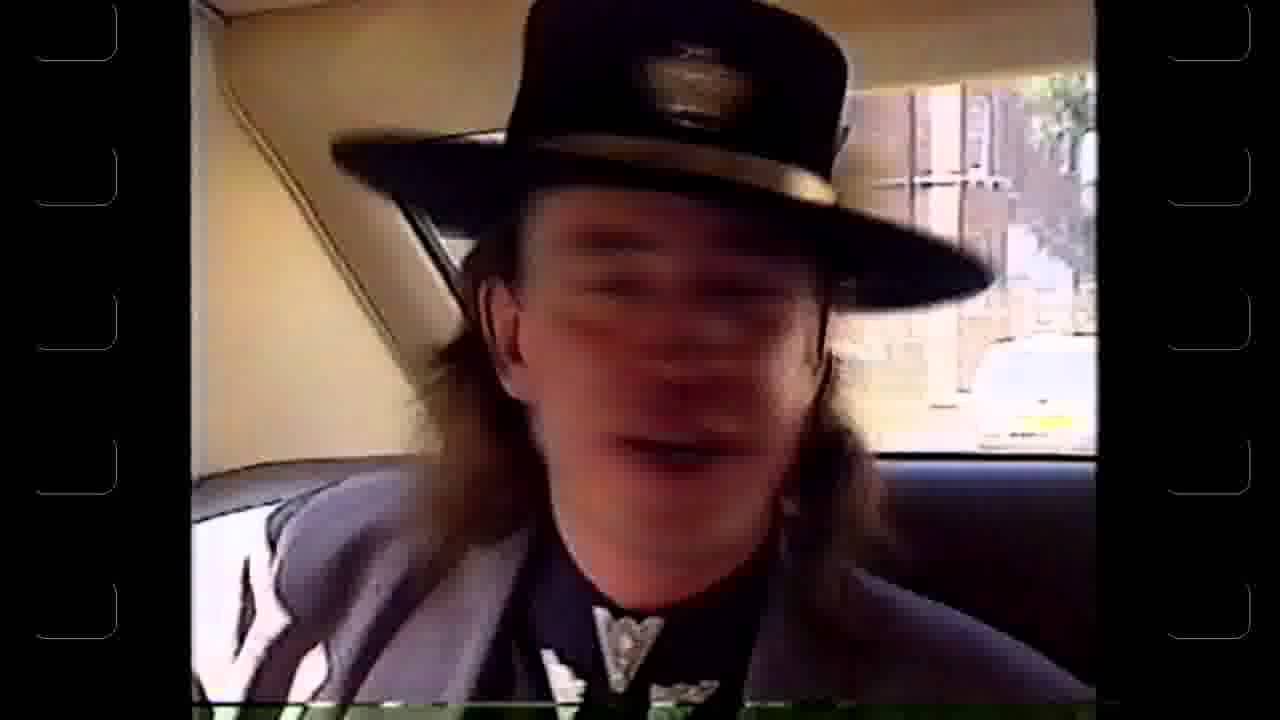
“Hendrix was not scared to take [his] influences and incorporate them into his music,” he added. “Now, some people look at that as ripping people off. If it’s added to, and it comes out as yourself… it’s still got a new bite to it.”
Which is exactly what SRV did throughout his career. He honored Hendrix while cutting his own path as he stunned both David Bowie and Eric Johnson, and left Jeff Beck to compare him to his old friend Jimi.
Fittingly, Hendrix never left Stevie’s setlist. Vaughan’s final live performance closed with “Voodoo Child (Slight Return),” a full-circle moment that underscored how deeply the connection ran.

