
Singer Boz Scaggs has spent much of his career working with some of the best session players in the business. Les Dudek, Louie Shelton and Fred Tackett played on his 1976 breakthrough album, Silk Degrees, while Steve Lukather was featured in its touring band.
But one of the most remarkable guitarists to appear on a Scaggs record came much earlier — on his 1969 self-titled album, which featured Duane Allman, years before the Allman Brothers Band became a going concern.
The album marked the beginning of a new chapter for Scaggs, who had been the vocalist in the Steve Miller Band before leaving after the group’s second album, 1968’s Sailor. He had already launched a solo career in 1965 with his debut album, Boz, but his self-titled record would set him on a path that would eventually lead to Silk Degrees and international stardom.
Back home in San Francisco, Scaggs’ neighbor and friend was Jann Wenner, founder of Rolling Stone magazine. Wenner liked Scaggs’ songs and encouraged Atlantic Records executive Jerry Wexler to listen to his demo. Wexler agreed and signed Scaggs to make an album, with Wenner serving as producer.
Scaggs and Wenner chose Muscle Shoals Sound Studio in Sheffield, Alabama, for the sessions. Wenner was an early champion of Duane Allman, the young electric guitar player from Macon, Georgia, and wanted him on the record.
The choice made sense. Allman was already a regular at Muscle Shoals and nearby FAME Studios, where he had cut a number of sides, including Wilson Pickett’s “Hey Jude.” His playing on the song so impressed Eric Clapton that Clapton once pulled his car off the road to listen to it. He didn’t know who Allman was at the time, but he would soon become a fan, as Bobby Whitlock has recalled.

There was just one problem: Allman had moved back to Macon to concentrate on his new group, the Allman Brothers Band. Fortunately, Wenner convinced him to return to Muscle Shoals for the week required to make the record.
“In those days, everybody who worked at Muscle Shoals, you get one week,” Scaggs tells Mark Hummel’s Harmonica Party. “You go in on Monday morning, and you come out on Friday night or Saturday morning, and you're done.”
As Scaggs recalls, the sessions had wrapped up on Friday evening and the musicians were packing up to go home.
“Everybody’s putting their stuff in their cars, just loading out.”
That was when someone — Scaggs thinks it was Wenner — noticed they still had time left on the clock.
“He says, ‘You got time here. I mean, we're all here. Is there one more song you want to do? Is there one last thing?’”

Scaggs’ mind went to a blues tune he’d heard performed in Cambridge, Massachusetts, by guitarist Elvin Bishop and his singer, Jo Baker.
“They did a song by Fenton Robinson — I didn't know his name at the time — called ‘Loan Me a Dime,’” Scaggs explains. “It was right out of where I come from, the blues.”
Scaggs had never heard the song before. “I just heard her [Jo].”
He could recall the melody and changes, but he didn’t know the words. A quick call to Baker in San Francisco supplied them.
“She gave them to me, and I said [to the band], ‘It goes like this, and it’s a minor blues.’”
Scaggs had no doubt the musicians were up to the task.
“You know, with that rhythm section and Duane Allman?”
The challenge was that Muscle Shoals Sound Studio was tiny — “about the size of a double garage,” as Scaggs recalls. Most tracks for the album were cut over several sessions, with overdubs, because it was difficult, if not impossible, to fit all the musicians required for an arrangement into the studio at once.
With no time for overdubs, the musicians had to make use of every available space in the building so they could record together.
“There was a cloak room and there was a bathroom and there was a control room,” Scaggs recalls. “The horn players had to go back where the Coke machine was [in the cloak room]. There's a little closet, and they had three or four horns, or maybe five horns.
“And they put me back in some little office or tape room, or something, with a microphone in it.
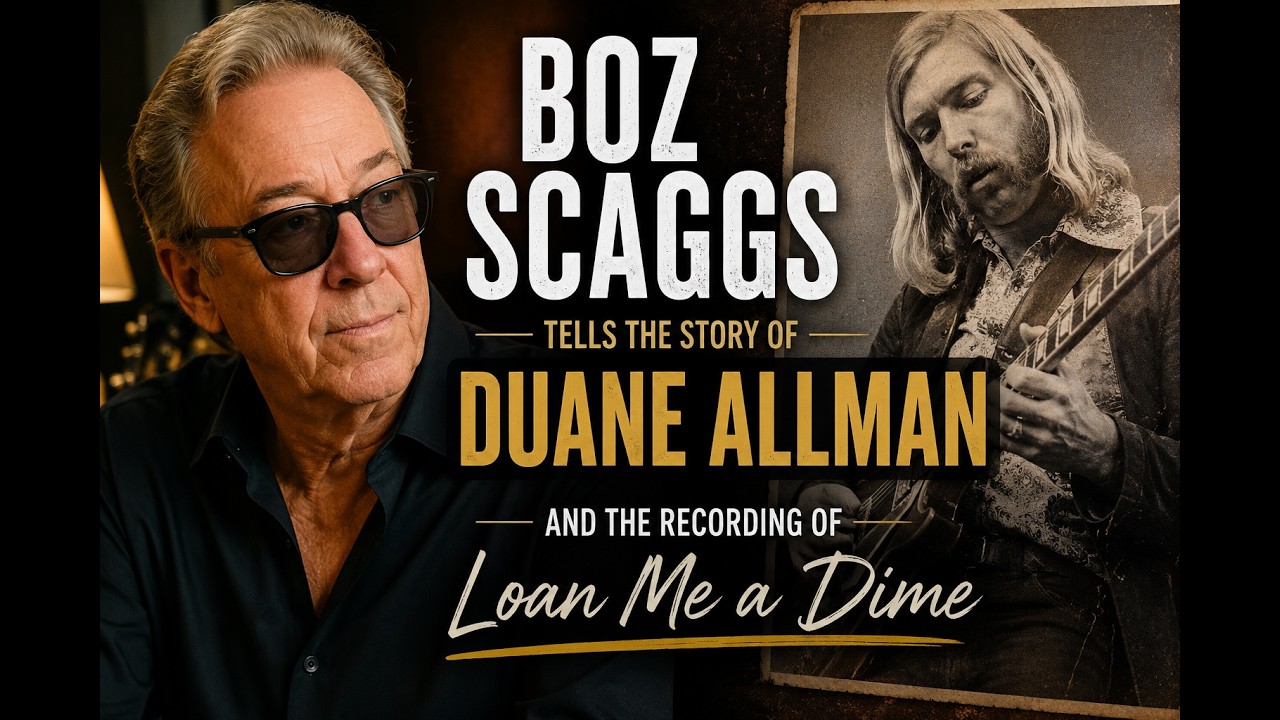
“Duane Allman was sitting with his amp in the toilet. He was sitting up on the top of the toilet, feet on the toilet seat, and his little amp is right there, and he crowded in there with the headphones on. And he's got a great tone in there, with the little amp and the ambience in that room.”
The band rehearsed the song with the tape machine running, just in case magic struck. It did.
“We ran the song down, and came to the end,” Scaggs continues. “And, as happens, somebody just kind of kept playing: It was the rhythm section. They just kind of started going into a little lope with it, going through the changes with it — double time, boogaloo, and then it went into this kind of a shuffle, a full-on four-on-the-floor shuffle.
“And, of course, Duane is blowing. And it was probably 15, 16, 17 minutes long. And everybody went. Whoa!”
The take was fantastic, but it wasn’t complete. The second take was, and, as Scaggs notes, “the energy was a little different.”
Why?
“Duane was the main difference.”
The guitarist had found his groove, and the result became one of the most memorable performances of Allman’s short career. His playing on “Loan Me a Dime” remains one of the highlights of his pre-Allman Brothers work — a performance that came together almost by accident, when the musicians realized they had one more song and some time left on the clock.
For all the lightning-in-a-bottle excitement of that session, though, Scaggs says his favorite memories of Allman came after the album was completed. Duane asked Scaggs to drive him to Chattanooga, Tennessee, to visit a traveling guitar salesman who was staying at a hotel.
“He had one of the greatest collections of original Dobros and National steel guitars, and Duane got word of it,” Scaggs explains. As no one else had a car, the singer was asked to help Duane make the journey.
“We spent the day driving up there and looking at guitars and driving back,” Scaggs told The Herald-Dispatch of Huntington, West Virginia. “Duane was a wonderful and lovely guy — a really focused, solid, hard-working and direct guy. He was a really nice man. And, of course, he was an enormous talent and a real easy and wonderful guy to be around.”
