

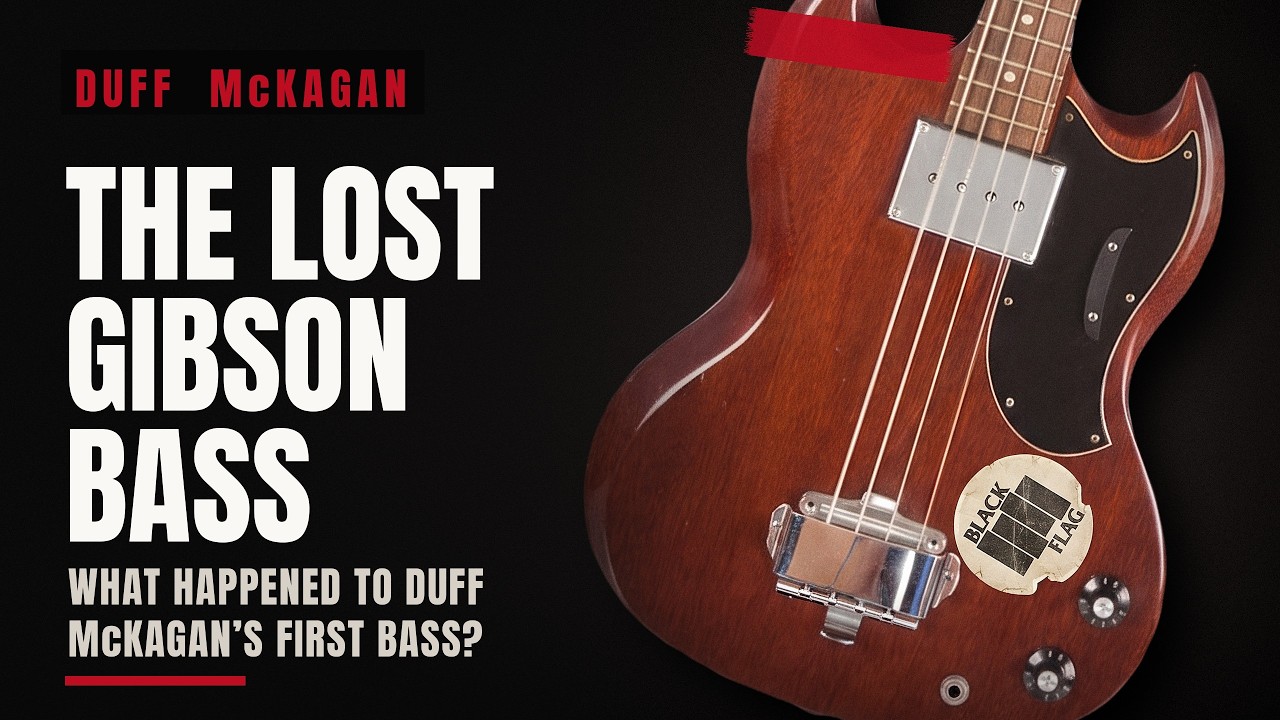
Guns N’ Roses’ Duff McKagan is hoping to recover a piece of his musical history: the Cherry Red Gibson EB-0 bass he bought with money from his paper route as a teenager, and which disappeared during the early years of the band’s rise to fame.
The instrument was McKagan’s first bass and accompanied him through his formative years in Seattle, where he discovered punk rock, started playing in bands and became immersed in the city’s underground music scene. Now Gibson is helping launch a worldwide search for the instrument, which McKagan says has not been seen since the mid-1980s.
“I had a paper route,” McKagan recalls in a new video interview. “My first bass was a Gibson Cherry EB-0. I paid for it in installments with my paper route money.”
Growing up in Seattle, McKagan was surrounded by his older siblings’ record collections and developed an early interest in music, drawing inspiration from local garage-rock pioneers the Sonics and the emerging punk movement.
The EB-0 became his constant companion as he explored that world, including his discovery of Black Flag. The band's My War album made a particularly strong impression.
“That My War record got me through shit,” he says. “I felt good about putting that Black Flag sticker on my bass.”
More than just a first instrument, the EB-0 helped establish the playing approach McKagan would carry into his career with Guns N’ Roses.
“The approach that I still have; it was born from playing that thing,” he explains. “I learned to attack playing that bass.”
McKagan moved to Los Angeles in 1984 to pursue music full-time, bringing the bass with him. But amid the chaos of forming Guns N’ Roses, recording Appetite for Destruction and the band's rapid ascent from Hollywood clubs to international success, the instrument disappeared.
“My Gibson EB-0 was my bass at home,” he recalls. “In that whole chaos of us getting signed and making Appetite, the bass just disappeared. It must have gotten misplaced. Hollywood was nuts at that point. I have no idea what happened to it.”

Introduced in 1959, the Gibson EB-0 was redesigned in 1961 with the SG-style body shape that became its signature. Other notable players of the model include Cream's Jack Bruce, Alice Cooper's Dennis Dunaway and Minutemen's Mike Watt.
For McKagan, however, its significance goes well beyond its place in Gibson history. It was the instrument that helped turn his musical ambitions into something tangible.
“The approach that I still have to music to this day, it was born from playing that thing,” he says. “It turned imagination into possibility. It made me think, ‘This is possible.’”
Gibson and McKagan are now asking fans and collectors to help locate the Cherry Red EB-0. Whether it's in a private collection, in storage or somewhere its owner doesn't realize its history, the search is on.
Anyone with information about the bass can visit Duff McKagan's website or email tips directly to tips@duffmckagan.com.
