




GuitarPlayer Verdict
Positive Grid’s Spark Cab 2 delivers impressive sound, substantial volume and versatile connectivity in a compact, amp-styled FRFR speaker. Designed to complement the company’s Spark amps and pedal, it also works equally well with third-party modelers. Its pronounced low end may require some preset tweaking, but the Cab 2 offers enough muscle to keep up with a drummer and holds its own against more expensive competitors. At $399, it’s an appealing option for players seeking affordable, portable stage monitoring.
Reasons to buy
- +
PRO A very handy and good-sounding FRFR for modeling amps, Spark or otherwise, at a reasonable price point.
Reasons to avoid
- -
CON Its core sound tends to emphasize low frequencies
You can trust Guitar Player. Our expert reviewers spend hours testing and comparing guitar products so you can choose the best for you. Find out more about how we test.
Modeling amps have advanced to the point where there’s no longer much argument about their sonic authenticity and overall utility, but many players still struggle to attain an amp-like “in the room” experience when using them live. Guitarists who don’t have the benefit of mammoth FOH and monitor rigs onstage have turned to dedicated full-range flat-response (FRFR) speakers, such as powered monitor wedges. The more capable models, however, can be quite spendy. Meanwhile, amp makers such as Friedman, Fender, Laney and others have entered the game with amp-styled FRFRs of their own.
Now Positive Grid has updated its own entry-level contestant, Spark Cab, with the redesigned Spark Cab 2 ($399 street), a compact 140-watt FRFR with a single 10-inch woofer and two one-inch tweeters in a fully enclosed cabinet. It’s primarily designed as a rig expander for the company’s Spark amps, but it can take your digital emulations from any standard source onto the stage or into the rehearsal room, so it’s a viable budget option whatever modeler or preamp-into-IR-based setup you’re working with.
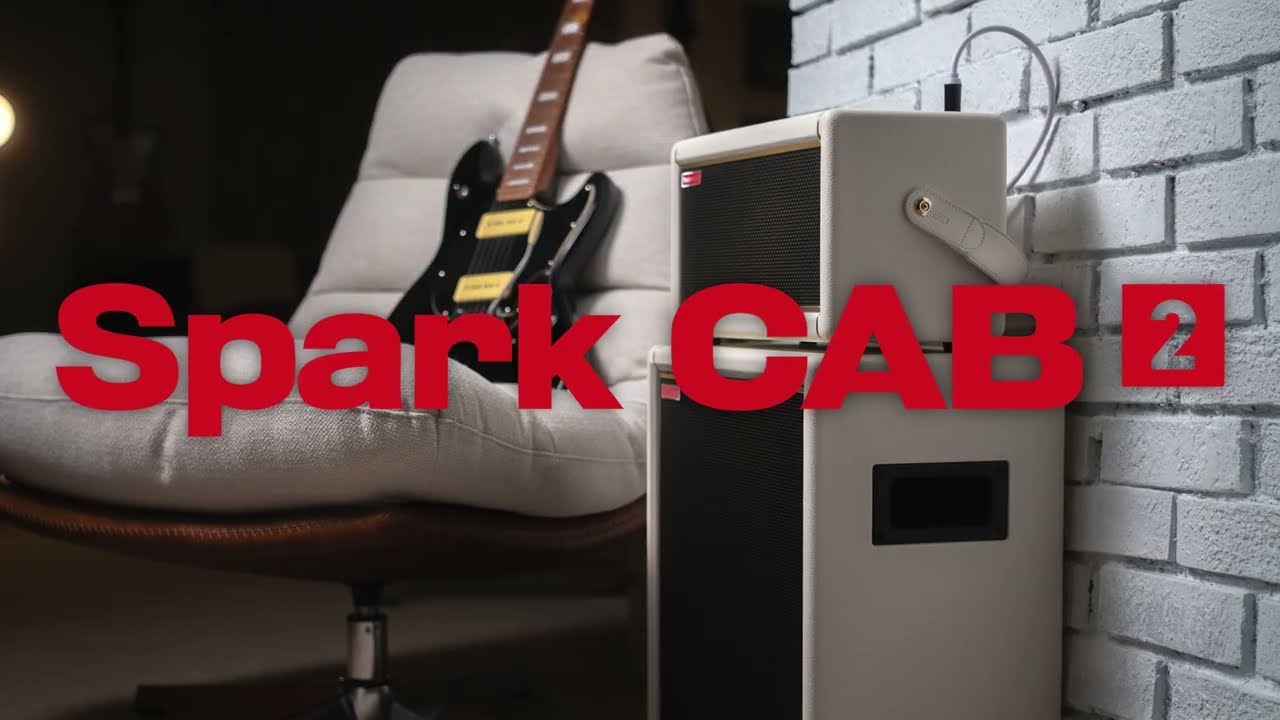
Measuring 19.5 by 15.75 by 10 inches and weighing a hair under 30 pounds, Cab 2 offers a compact and relatively affordable solution to onstage modeler reproduction when you need to supply your own. It also looks appealingly amp-like — an important consideration with many FRFRs — with a rock-certified livery of black or pearl (off-white), a woven black/gold grille cloth, gold piping and recessed side handles. The result is an appealing resemblance to a Marshall stack when viewed from a distance.

Although it looks much like the original Spark Cab, aside from a few subtle cosmetic tweaks, Positive Grid says it has been totally redesigned inside and out, with an improved signal path through the amplifier and retuned acoustics within the cab.
Controls are minimal and include just one speaker volume and one line out volume control, with a pushbutton mid contour switch alongside the former and a ground lift next to the XLR for the latter.
But Spark Cab 2 boasts relatively flexible connectivity that makes it a sort of home base for your rig, rather than just the cab that you hear it through. There are two standard inputs via dual XLR/TRS jacks labeled 1/L and 2/R, a dedicated 3.5mm stereo Spark input, a USB-C port for power to smaller Spark devices and firmware updates, and a center-negative 20V/2.5A DC output to power Spark 2 and Spark 40. A built-in cable tie at the top right of the control panel is a nifty bonus feature and should prevent more than a few accidental pull-outs during use.
Otherwise, there’s not much to discuss in the functionality department. Just plug in your Spark Amp, Spark Pedal or third-party modeler of choice. If you're using one of the former, power it up via the Cab 2’s DC outs, set your volume level, and go. Since it’s a mono cab, the dual XLR/TRS inputs and 3.5mm Spark TRS input make it easy to connect stereo modeling signals without losing half of your delay or what have you. The left-right pair is summed to mono within Cab 2.

I tested Cab 2 with the Spark Pedal I reviewed, as well as a Fractal FM9 floor modeler and an older Atomic Ampli-Firebox, using a Fender Telecaster and a Gibson ES-335. I found a lot to like in this powerful yet portable little FRFR speaker.
Before delving further, it’s worth noting that I’ve never found a thoroughly convincing “amp in the room” experience from a powered FRFR. Rather than sound like a traditional guitar amp sitting next to me, FRFRs sound more like an amp miked in the next room, with its sound coming through control room monitors. But once I adjust my expectations, the experience can be quite satisfying.
That was true with the Spark Cab 2 as well. It sounds very good, especially for the money, and isn’t dramatically less rewarding than guitar-intended FRFRs costing considerably more money.
Although its connectivity and power-supply options are optimized for use with Spark amps and the Spark Pedal, Spark Cab 2 reproduces the signal equally well from whatever device you connect to it. While it doesn’t exhibit quite the fidelity or fine detail of some of the more refined FRFR options for stage (including powered wedges from makers like EV and QSC, which are also considerably more expensive), its tone has a certain body and weight that helps this unit sit well amid a band in the room and maintain some muscle alongside a drummer.

Positive Grid has delivered a useful and good-sounding FRFR option at one of the more reasonable prices in this ever-more-competitive market.”
— Dave Hunter
Spark Cab 2 produces pretty hefty volume when pushed, while retaining its own headroom well (relative to the headroom or lack thereof in your modeled amp preset, of course), and certainly enough power to keep up with a reasonable drummer. Like most such units, how amp-like it sounds is also affected by the psychoacoustic effects of volume. Your modeler will sound somewhat more realistic at higher Cab 2 volume levels and less so when you keep the volume down. Such is the nature of the human ear. The contour switch boosts low and high frequencies at lower volumes, helping to even things out a little, but you’ll want it off when cranking the thing or things get too boomy.
Speaking of which, Spark Cab 2’s overall sonic character has a somewhat pronounced low-end emphasis, so without any onboard EQ I found that dialing in my modeler’s preset to compensate (removing some low end either at the amp or cab block) helped considerably. That's par for the course when matching a preset to its playback system. I should add that the Spark Cab 2 acquitted itself admirably in side-by-side comparisons with a Fender Tone Master FR-10 I have on hand. The FR-10 required less at-source tweaking to achieve a realistic sound and offers more onboard EQ, but the Spark Cab 2 lists for around $150 less.
Positive Grid touts the stereo inputs and summed-mono output as an easy way to connect stereo modelers while maintaining separate level controls for your stage monitoring (Cab 2) and FOH signal. While I’d rather hear a summed-mono version of my stereo presets than lose half of a delay, reverb, modulation effect or dual-cab rig optimized for stereo, I’m also likely to have mono versions of those presets available for occasions when I can’t run stereo outs, as do many guitarists.
Which is to say, rather than summing a stereo preset into Spark Cab 2 and sending mono to the FOH, it will probably make more sense to send a full stereo signal to the mix and tap off a mono or summed L-R for your own monitoring, but the built-in two-into-one feature is handy if and when you need it.
Put it all together, and Positive Grid has delivered a useful and good-sounding FRFR option for modeling-amp players in the new Spark Cab 2, and done so at one of the more reasonable prices in this ever-more-competitive market.
CONTACT Positivegrid.com
PRICE $399 street
CONTROLS Speaker Volume, Line Out Volume, with a pushbutton Mid Contour switch and a Ground Lift
CONNECTIVITY Dual XLR/TRS jacks for Input 1 and 2, XLR Line Out, 3.5mm Spark Input, center-negative DC out, USB-C power out
WATTAGE 140 watts
WEIGHT 29.67 lbs
MADE IN Vietnam
PRO A very handy and good-sounding FRFR for modeling amps, Spark or otherwise, at a reasonable price point.
CON Its core sound tends to emphasize low frequencies

