
Olivia Rodrigo’s “The Cure” started with a guitar mistake — and ended with Dan Nigro having to Melodyne a piano to match an acoustic guitar that was 15 to 20 cents sharp.
Speaking to the Song Exploder podcast, Rodrigo and her co-writer and producer Nigro broke down the making of the song, which Rodrigo has called her favorite track on her latest album, You Seem Pretty Sad For a Girl So in Love.
The song began with a conversation Rodrigo had with a friend while sitting next to him in his Jeep. She told him that she was in love, but also miserable much of the time, and that she wanted to write love songs.

“He’s like, ‘You have to write about how you’re actually feeling. You can’t pretend to write a certain way. You can’t write in the way that you think you’re supposed to feel.’”
A few days later, Rodrigo started writing “The Cure” on her couch with an acoustic guitar. And although she admits, “I’m not great at guitar,” that turned out to be an advantage.
“I was trying to play a chord and I played it wrong. I messed up where my fingers were, but it actually just sounded cool. And I was like, ‘Oh, that’s great!’ A wonderful thing about being a novice is sometimes you make a happy accident.”
When she brought the song to Nigro, they worked out the guitar part and added a bridge. But when it came time to record it, Nigro didn’t exactly follow standard acoustic-guitar recording procedure.
Rather than set up microphones specifically for the guitar, he used two microphones that were already positioned above his piano.
“These two microphones that are up on my piano were there,” he says. “And instead of micing the guitar properly, I literally just stood on the piano bench and played the guitar into the two piano mics. It was a really rough take, and then [Olivia] recorded her vocals to my guitar.”
That rough guitar recording became the foundation for the vocals — and created a second, rather unusual recording problem. Nigro says he deliberately avoided pitch correction on Rodrigo’s vocals, leaving the two vocal tracks to rub against each other slightly and preserve the song’s uneasy character.
“There’s no Auto-Tune, and there’s no Melodyning or anything,” he says. “They’re just her vocal tracks; they kind of rub a little bit in spaces [and] that makes it feel unsettling. And I feel like as much as we have all the modern tools that we can, like, make a vocal feel perfect, it felt imperfectly perfect.”
But the guitar itself wasn’t quite in tune. Nigro had recorded the part so quickly that he hadn’t checked the tuning, leaving the instrument 15 to 20 cents sharp.
“My guitar is actually about 15 to 20 cents sharp, and so I ended up having to tune every other instrument to the guitar and the vocal because I didn’t want to mess with it,” he says. “When I played the piano, because the piano was actually in tune, I had to Melodyne the piano to be in tune with the guitar.”
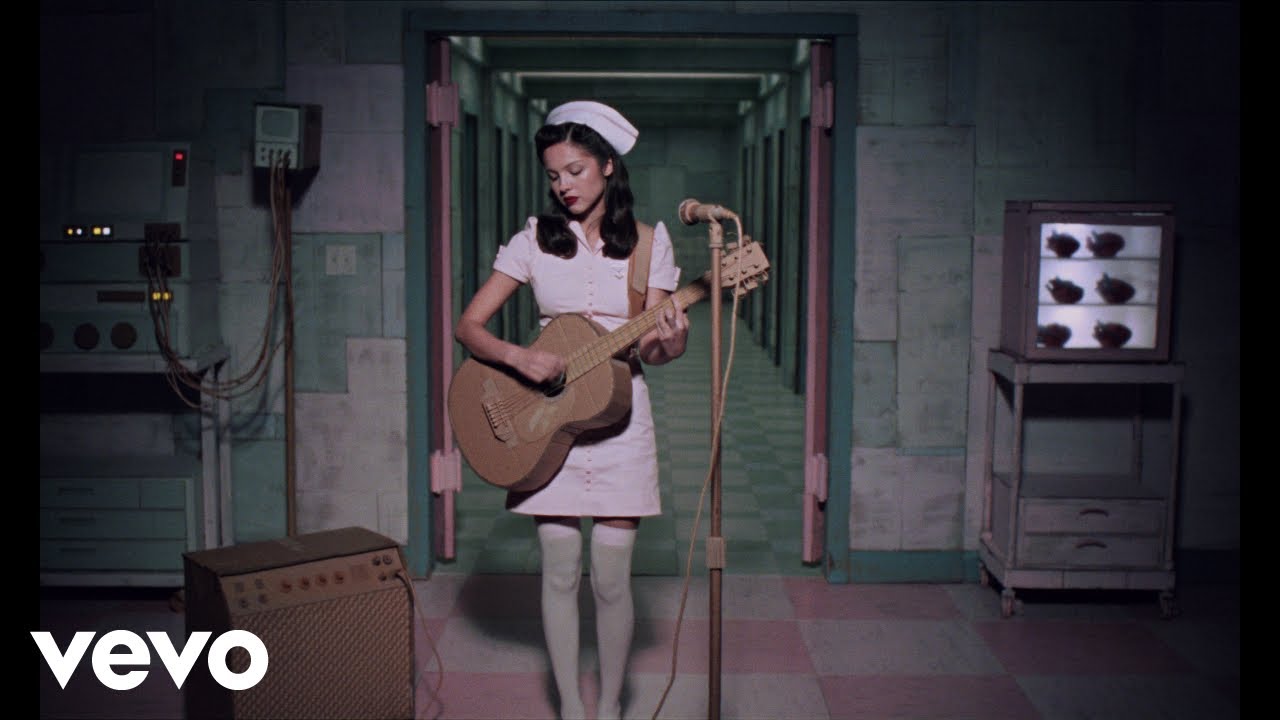
So while Melodyne wasn’t used to clean up Rodrigo’s vocals, it was used to make the properly tuned piano conform to the accidentally sharp guitar.
That imperfection became part of the character of “The Cure,” a song Rodrigo describes as “very tense.” Nigro deliberately kept building that tension into the second verse, withholding the drums when listeners might expect them to arrive.
“I think everyone thinks when they hear it for the first time that the drums are about to come in, but they don’t,” he says.
When the drums and strings finally arrive, Rodrigo says the payoff feels earned — the same philosophy that shaped the song’s guitar recording in the first place: rather than polish away every imperfection, they kept the elements that made the track feel human and unsettled.
