
Alex Van Halen has never been shy about preferring one era of Van Halen over another, and he believes David Lee Roth brought something to the band that no one else could replace.
While Sammy Hagar fronted Van Halen through its most commercially successful years, Alex says the group’s defining chemistry belonged to the original lineup.
Speaking with KazaGastão, the drummer reflected on what made Roth such an essential part of Van Halen’s rise.
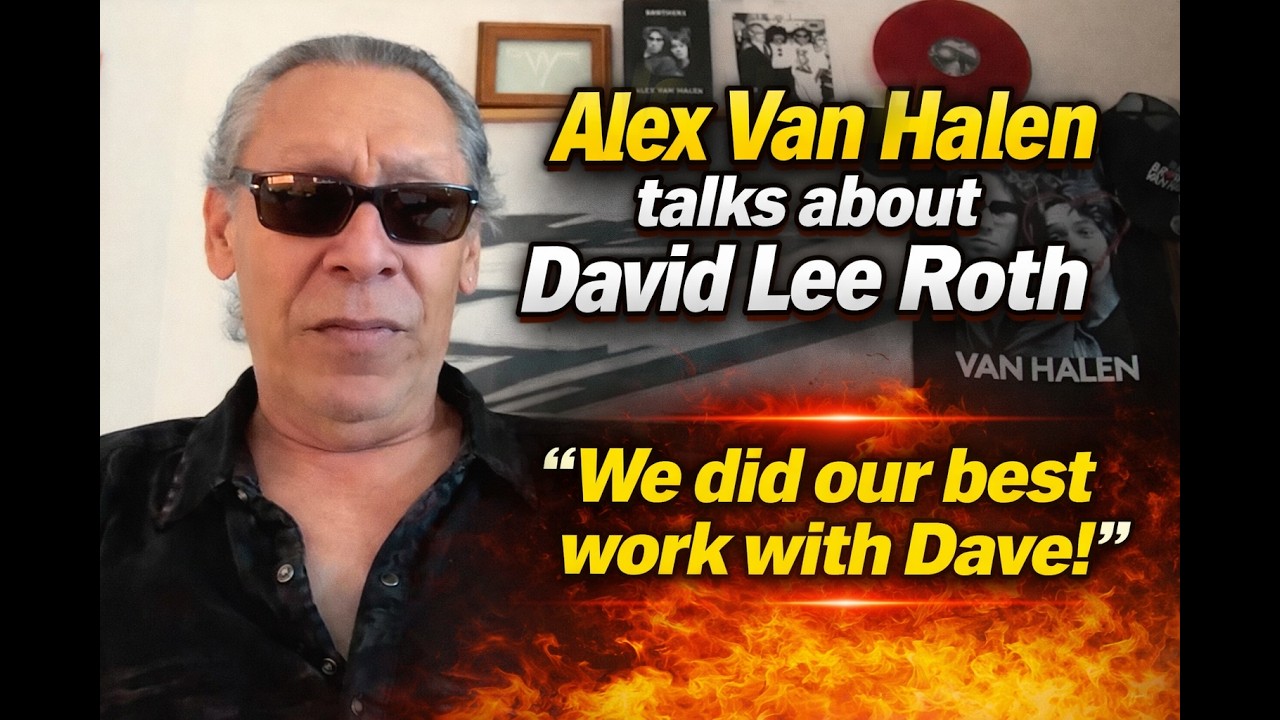
“To me, Dave was a poet. It was the confluence of the complete opposite ends of the spectrum that made it happen. And it was brilliant soup — until it wasn’t.”
Roth fronted Van Halen on the band’s first six albums before leaving in 1985 to pursue a solo career. The relationship had already begun to fracture by then, and Eddie Van Halen’s secret recording session playing the electric guitar solo on Michael Jackson’s “Beat It” proved to be the final breaking point.
Looking back, though, Alex says those disagreements disappeared after Eddie’s death in 2020.
“That’s the important part: Remember the good times,” he said. “All the fights and disagreements that we had went by the wayside when Ed passed.
“Dave was the first person I called. He’s the only person I called, because it goes beyond words. It goes beyond the fact that we made music together and traveled together. We were kindred spirits.”

When the interviewer asked about Sammy Hagar — who replaced Roth in 1985 and sang on four studio albums with the band — Alex acknowledged what they accomplished together but insisted Van Halen’s defining chemistry belonged to the original lineup.
“There was good music made and all that, but the essence and the spirit and the balls-to-the-wall was the first model,” he said. “Everybody has a peak in their life, and he wasn’t there during that time period. We did our best work with Dave.”
There was good music made and all that, but the essence and the spirit and the balls-to-the-wall was the first model.”
— Alex Van Halen
For Alex, part of that success came from Roth’s unpredictable personality, which he says fueled the band’s creativity rather than undermining it.
“Dave was a restless guy,” he explained. “He couldn’t settle on one thing for one day. The next day, he is on something else. Some people might think it is a negative, and it is if it’s left alone to fester and become something it shouldn’t be. But you need conflict. You need contradiction. You need friction. Without friction, you’ve got no heat. Without heat, you’ve got nothing.
“A creative environment is an extremely difficult thing to foster and to keep in check and keep it balanced. Now, you don’t want to be completely balanced because then it becomes inert. Then it becomes predictable. We were very concerned about ending up doing the same thing over and over again.”

Alex also argued that Roth’s greatest contribution wasn’t his vocals or stage antics but his ability to connect with audiences.
Although Roth’s larger-than-life personality often put him at odds with those around him, Alex insisted he was “never in competition with anybody.”
“We stole the show because Dave had a way of connecting with the people, which was extremely important,” he said. “He has that skill, and nobody’s going to stop that. I don’t care what anybody says. I love the guy.
“Music is about people. People don’t really remember what you played. They remember how you made them feel.”
Meanwhile, songwriter Desmond Child recently reflected on his difficult songwriting sessions with Van Halen and Roth, while Joe Satriani revealed that Roth approached him about a Van Halen tribute tour in the 1990s — an experience that left the guitarist stunned by what he saw as disrespect toward Eddie Van Halen.

