
Filming for Sam Mendes’ forthcoming Beatles biopics is well underway, and the on-screen Fab Four have been spotted in London re-creating the band’s iconic Abbey Road album cover.
Harris Dickinson, Paul Mescal, Joseph Quinn and Barry Keoghan are set to play John Lennon, Paul McCartney, George Harrison and Ringo Starr, respectively, in a four-film project directed by Mendes. Each film will focus on the backstory of a specific Beatle, making it one of the most ambitious music biopic projects ever to hit the big screen.
But the shoot to re-create the Abbey Road album cover this past weekend was getting all the attention.
Since the record’s release in 1969, the image of the four Beatles walking in line on the zebra crossing in front of Abbey Road — the historic studio where they made nearly all of their recordings — has become one of the most recognizable album sleeves ever produced.
Famous as the image is, the idea behind it was actually quite simple. The Beatles were struggling to come up with a suitable design for the record cover, and Paul McCartney suggested photographing the group crossing the street outside the studio.
On the morning of August 8, the late photographer Iain Macmillan was brought in to make the idea a reality. Beginning at 11:35, Macmillan was allowed 10 minutes to shoot the photo while a policeman held up traffic.
In the days leading up to the shoot, the photographer had used stand-ins to meticulously plan the shot. Still, he couldn’t predict the issues on the day. He managed to get just six shots. One was ruined by a car pulling out from behind the studio; another was marred by too much spacing between Starr and Lennon.
The fifth shot proved to be the perfect choice. Selected by McCartney, it was chosen partly because it was the only one that featured all four members mid-stride.
Paul McCartney’s concept sketch of the famous Abbey Road album cover.from r/beatles
As former Apple Records creative director John Kosh told Forbes in 2019, he had just days to work on the design for the completed album jacket.
“I suddenly found myself [thinking], ‘By God, I’ve got to do this and get it out on Wednesday?’” he remembers.
Kosh had assumed the photo had been taken for publicity. He was already busy working on the cover for what he assumed would be the group’s next album, Get Back, recorded the previous January (and ultimately released as Let It Be in May 1970).
“But in the middle of all of this,” Kosh says, “they put that on hold, and Abbey Road came in.”
I suddenly found myself [thinking], ‘By God, I’ve got to do this and get it out on Wednesday?’”
— John Kosh
It was trial by fire, but Kosh stuck to his vision for the cover. He was against having any type on the front of it, insisting no one would have any doubt as to who the four musicians were.
“I thought, ‘Here are the four Beatles walking across the street. If you do not know who they are, you have definitely been in a cave somewhere.’”
His decision outraged Sir Joseph Lockwood, the chairman of EMI, Apple Records’ parent company. He called Kosh in the middle of the night to complain that he was ruining the Beatles’ career.
When Kosh showed up at Apple headquarters the next morning, he ran into George Harrison and told him what had happened.
“George looked at me and said, ‘Oh fuck it. We’re the Beatles.’
“So that was the end of that. George was such a sweet man. All the Beatles were fun to work with.”
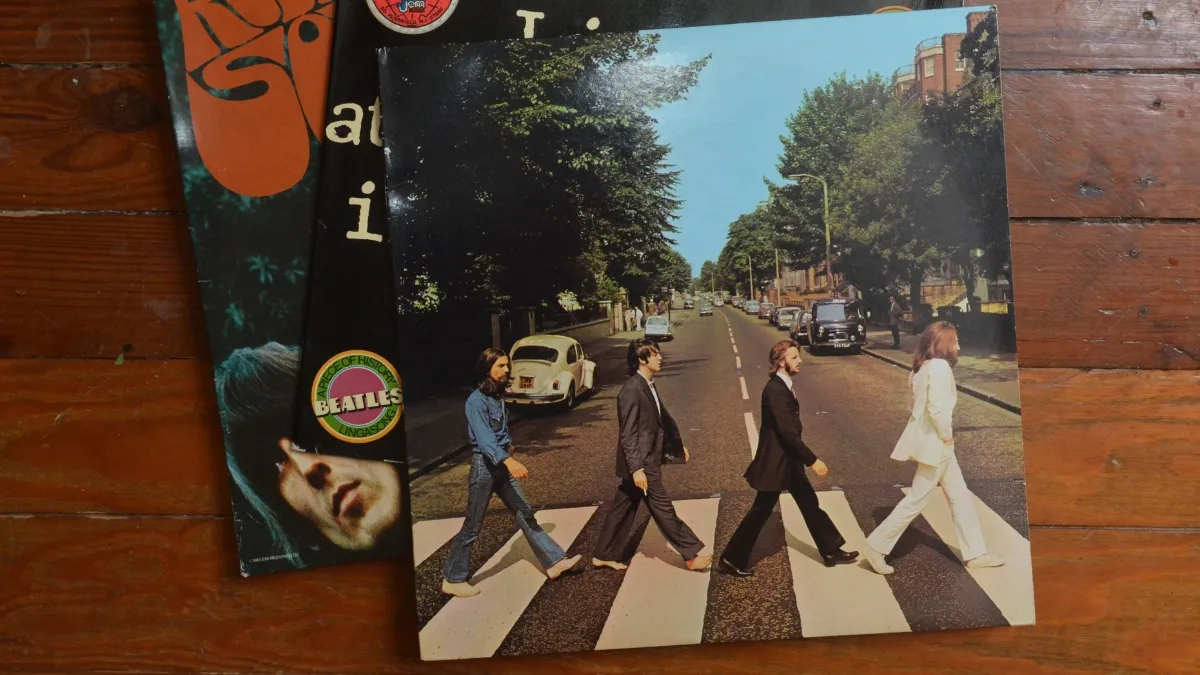
In the end, Kosh got the cover he wanted — and one that went down in history.
“This was my first album cover, not really knowing what I was doing,” he confessed. “The fact that it’s turned into an icon, and possibly the most parodied album cover of all time, is really thrilling to me.”
Because I was barefoot, it being a scorching summer’s day, it was taken as a bizarre Mafia sign of death.”
— Paul McCartney
But the cover not only birthed an icon — it drew untold numbers of visitors to re-create the crossing themselves. Artists copied it as well, including Booker T. & the MGs (1970’s McLemore Avenue), the Red Hot Chili Peppers (1988’s The Abbey Road E.P.) and even McCartney, who repeated the crossing with his sheepdog for the cover of his 1993 album, Paul Is Live.
Unfortunately, the original photo fueled the late-1960s rumor that McCartney had died and been replaced by a look-alike. Sleuths pointed to the fact that he was the only Beatle walking barefoot as a hint that the bass guitarist was dead.
“Back in the Sixties, the wild rumor was that I was dead because of certain alleged ‘clues’ on the Abbey Road sleeve,” he wrote in the press notes accompanying the Paul Is Live album sampler. “Because I was barefoot, it being a scorching summer’s day, it was taken as a bizarre Mafia sign of death.”
The Volkswagen parked on the side of the road in the photo provided another clue. Its license plate read 28IF. “It meant I, being 27 at the time, would have been 28 if I’d lived,” McCartney wrote.
More than half a century later, the image is still being copied. This time, it’s the actors playing the Beatles in Mendes’ films who have taken the famous walk, giving a new generation of Fab Four a chance to step into one of the most recognizable photographs in music history.

